

436
L. M. Martínez-Prieto and P. W. N. M. van Leeuwen
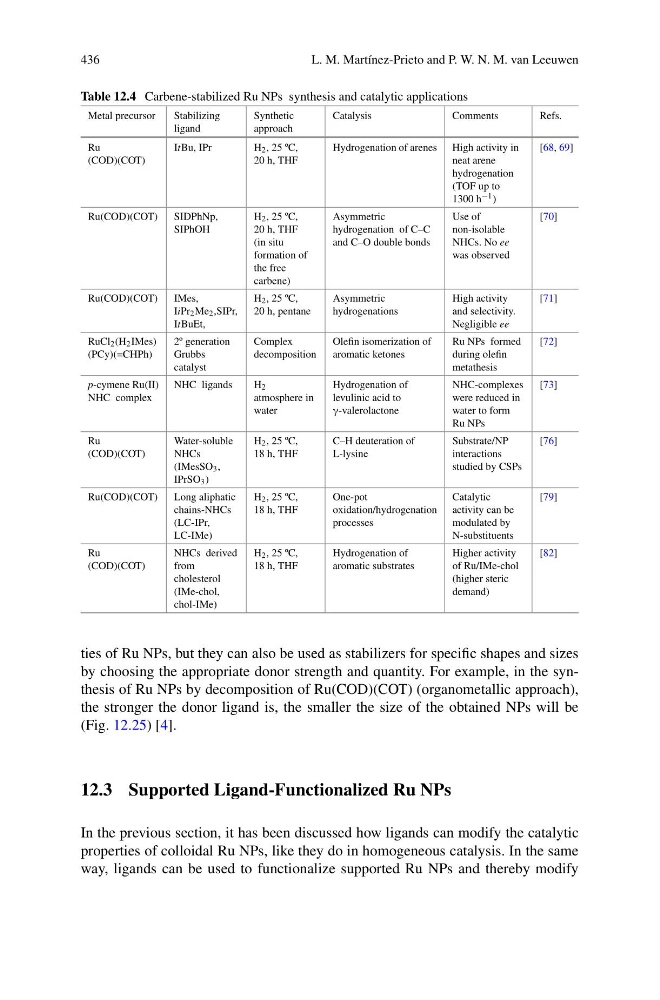
Table 12.4 Carbene-stabilized Ru NPs synthesis and catalytic applications
Metal precursor
Stabilizing
ligand
Synthetic
approach
Catalysis
Comments
Refs.
Ru
(COD)(COT)
ItBu, IPr
H 2 , 25 ºC,
20 h, THF
Hydrogenation of arenes High activity in
neat arene
hydrogenation
(TOF up to
1300 h −1 )
[68, 69]
Ru(COD)(COT)
SIDPhNp,
SIPhOH
H 2 , 25 ºC,
20 h, THF
(in situ
formation of
the free
carbene)
Asymmetric
hydrogenation of C–C
and C–O double bonds
Use of
non-isolable
NHCs. No ee
was observed
[70]
Ru(COD)(COT)
IMes,
IiPr 2 Me 2 ,SIPr,
ItBuEt,
H 2 , 25 ºC,
20 h, pentane
Asymmetric
hydrogenations
High activity
and selectivity.
Negligible ee
[71]
RuCl 2 (H 2 IMes)
(PCy)(=CHPh)
2º generation
Grubbs
catalyst
Complex
decomposition
Olefin isomerization of
aromatic ketones
Ru NPs formed
during olefin
metathesis
[72]
p-cymene Ru(II)
NHC complex
NHC ligands
H 2
atmosphere in
water
Hydrogenation of
levulinic acid to
γ-valerolactone
NHC-complexes
were reduced in
water to form
Ru NPs
[73]
Ru
(COD)(COT)
Water-soluble
NHCs
(IMesSO 3 ,
IPrSO 3 )
H 2 , 25 ºC,
18 h, THF
C–H deuteration of
L-lysine
Substrate/NP
interactions
studied by CSPs
[76]
Ru(COD)(COT)
Long aliphatic
chains-NHCs
(LC-IPr,
LC-IMe)
H 2 , 25 ºC,
18 h, THF
One-pot
oxidation/hydrogenation
processes
Catalytic
activity can be
modulated by
N-substituents
[79]
Ru
(COD)(COT)
NHCs derived
from
cholesterol
(IMe-chol,
chol-IMe)
H 2 , 25 ºC,
18 h, THF
Hydrogenation of
aromatic substrates
Higher activity
of Ru/IMe-chol
(higher steric
demand)
[82]
ties of Ru NPs, but they can also be used as stabilizers for specific shapes and sizes
by choosing the appropriate donor strength and quantity. For example, in the synthesis of Ru NPs by decomposition of Ru(COD)(COT) (organometallic approach),
the stronger the donor ligand is, the smaller the size of the obtained NPs will be
(Fig. 12.25) [4].
12.3 Supported Ligand-Functionalized Ru NPs
In the previous section, it has been discussed how ligands can modify the catalytic
properties of colloidal Ru NPs, like they do in homogeneous catalysis. In the same
way, ligands can be used to functionalize supported Ru NPs and thereby modify
L. M. Martínez-Prieto and P. W. N. M. van Leeuwen
Table 12.4 Carbene-stabilized Ru NPs synthesis and catalytic applications
Metal precursor
Stabilizing
ligand
Synthetic
approach
Catalysis
Comments
Refs.
Ru
(COD)(COT)
ItBu, IPr
H 2 , 25 ºC,
20 h, THF
Hydrogenation of arenes High activity in
neat arene
hydrogenation
(TOF up to
1300 h −1 )
[68, 69]
Ru(COD)(COT)
SIDPhNp,
SIPhOH
H 2 , 25 ºC,
20 h, THF
(in situ
formation of
the free
carbene)
Asymmetric
hydrogenation of C–C
and C–O double bonds
Use of
non-isolable
NHCs. No ee
was observed
[70]
Ru(COD)(COT)
IMes,
IiPr 2 Me 2 ,SIPr,
ItBuEt,
H 2 , 25 ºC,
20 h, pentane
Asymmetric
hydrogenations
High activity
and selectivity.
Negligible ee
[71]
RuCl 2 (H 2 IMes)
(PCy)(=CHPh)
2º generation
Grubbs
catalyst
Complex
decomposition
Olefin isomerization of
aromatic ketones
Ru NPs formed
during olefin
metathesis
[72]
p-cymene Ru(II)
NHC complex
NHC ligands
H 2
atmosphere in
water
Hydrogenation of
levulinic acid to
γ-valerolactone
NHC-complexes
were reduced in
water to form
Ru NPs
[73]
Ru
(COD)(COT)
Water-soluble
NHCs
(IMesSO 3 ,
IPrSO 3 )
H 2 , 25 ºC,
18 h, THF
C–H deuteration of
L-lysine
Substrate/NP
interactions
studied by CSPs
[76]
Ru(COD)(COT)
Long aliphatic
chains-NHCs
(LC-IPr,
LC-IMe)
H 2 , 25 ºC,
18 h, THF
One-pot
oxidation/hydrogenation
processes
Catalytic
activity can be
modulated by
N-substituents
[79]
Ru
(COD)(COT)
NHCs derived
from
cholesterol
(IMe-chol,
chol-IMe)
H 2 , 25 ºC,
18 h, THF
Hydrogenation of
aromatic substrates
Higher activity
of Ru/IMe-chol
(higher steric
demand)
[82]
ties of Ru NPs, but they can also be used as stabilizers for specific shapes and sizes
by choosing the appropriate donor strength and quantity. For example, in the synthesis of Ru NPs by decomposition of Ru(COD)(COT) (organometallic approach),
the stronger the donor ligand is, the smaller the size of the obtained NPs will be
(Fig. 12.25) [4].
12.3 Supported Ligand-Functionalized Ru NPs
In the previous section, it has been discussed how ligands can modify the catalytic
properties of colloidal Ru NPs, like they do in homogeneous catalysis. In the same
way, ligands can be used to functionalize supported Ru NPs and thereby modify