

12 Ligand Effects in Ruthenium Nanoparticle Catalysis
431
O 2 atmosphere was replaced by H 2 and the oxidation product was selective hydrogenated (Fig. 12.23b). Interesting differences in the activity were observed depending on the N-substituent of the LC-NHC ligand. The bulkier the N-substituents are,
the larger the amount of open active sites is and the higher the activity. Therefore,
LC-NHCs protect Ru NPs toward deep oxidation, which makes them suitable for
oxidation-hydrogenation two-step processes. In addition, their catalytic reactivity
can be modulated by modifying their N-substituents. The same LC-NHC ligands
(Fig. 12.23) were used to stabilize Pt NPs, resulting in soluble Pt NPs active in the
hydroboration of phenylacetylene [81]. Here, as well as in the previous example, a
clear influence of the bulkiness of the N-substituents on the size, surface state, and
catalytic activity was observed.
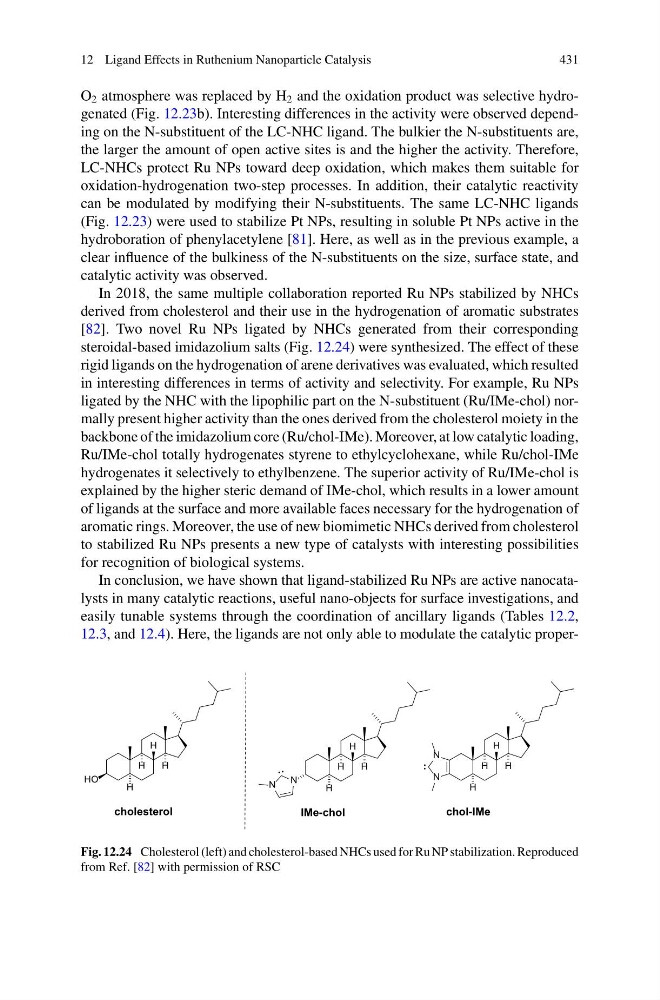
In 2018, the same multiple collaboration reported Ru NPs stabilized by NHCs
derived from cholesterol and their use in the hydrogenation of aromatic substrates
[82]. Two novel Ru NPs ligated by NHCs generated from their corresponding
steroidal-based imidazolium salts (Fig. 12.24) were synthesized. The effect of these
rigid ligands on the hydrogenation of arene derivatives was evaluated, which resulted
in interesting differences in terms of activity and selectivity. For example, Ru NPs
ligated by the NHC with the lipophilic part on the N-substituent (Ru/IMe-chol) normally present higher activity than the ones derived from the cholesterol moiety in the
backbone of the imidazolium core (Ru/chol-IMe). Moreover, at low catalytic loading,
Ru/IMe-chol totally hydrogenates styrene to ethylcyclohexane, while Ru/chol-IMe
hydrogenates it selectively to ethylbenzene. The superior activity of Ru/IMe-chol is
explained by the higher steric demand of IMe-chol, which results in a lower amount
of ligands at the surface and more available faces necessary for the hydrogenation of
aromatic rings. Moreover, the use of new biomimetic NHCs derived from cholesterol
to stabilized Ru NPs presents a new type of catalysts with interesting possibilities
for recognition of biological systems.
In conclusion, we have shown that ligand-stabilized Ru NPs are active nanocatalysts in many catalytic reactions, useful nano-objects for surface investigations, and
easily tunable systems through the coordination of ancillary ligands (Tables 12.2,
12.3, and 12.4). Here, the ligands are not only able to modulate the catalytic properH
H
H
H
H
H
H
N
H
N
N
N
IMe-chol
chol-IMe
H
H
H
H
cholesterol
HO
Fig. 12.24 Cholesterol (left) and cholesterol-based NHCs used for Ru NP stabilization. Reproduced
from Ref. [82] with permission of RSC
431
O 2 atmosphere was replaced by H 2 and the oxidation product was selective hydrogenated (Fig. 12.23b). Interesting differences in the activity were observed depending on the N-substituent of the LC-NHC ligand. The bulkier the N-substituents are,
the larger the amount of open active sites is and the higher the activity. Therefore,
LC-NHCs protect Ru NPs toward deep oxidation, which makes them suitable for
oxidation-hydrogenation two-step processes. In addition, their catalytic reactivity
can be modulated by modifying their N-substituents. The same LC-NHC ligands
(Fig. 12.23) were used to stabilize Pt NPs, resulting in soluble Pt NPs active in the
hydroboration of phenylacetylene [81]. Here, as well as in the previous example, a
clear influence of the bulkiness of the N-substituents on the size, surface state, and
catalytic activity was observed.
In 2018, the same multiple collaboration reported Ru NPs stabilized by NHCs
derived from cholesterol and their use in the hydrogenation of aromatic substrates
[82]. Two novel Ru NPs ligated by NHCs generated from their corresponding
steroidal-based imidazolium salts (Fig. 12.24) were synthesized. The effect of these
rigid ligands on the hydrogenation of arene derivatives was evaluated, which resulted
in interesting differences in terms of activity and selectivity. For example, Ru NPs
ligated by the NHC with the lipophilic part on the N-substituent (Ru/IMe-chol) normally present higher activity than the ones derived from the cholesterol moiety in the
backbone of the imidazolium core (Ru/chol-IMe). Moreover, at low catalytic loading,
Ru/IMe-chol totally hydrogenates styrene to ethylcyclohexane, while Ru/chol-IMe
hydrogenates it selectively to ethylbenzene. The superior activity of Ru/IMe-chol is
explained by the higher steric demand of IMe-chol, which results in a lower amount
of ligands at the surface and more available faces necessary for the hydrogenation of
aromatic rings. Moreover, the use of new biomimetic NHCs derived from cholesterol
to stabilized Ru NPs presents a new type of catalysts with interesting possibilities
for recognition of biological systems.
In conclusion, we have shown that ligand-stabilized Ru NPs are active nanocatalysts in many catalytic reactions, useful nano-objects for surface investigations, and
easily tunable systems through the coordination of ancillary ligands (Tables 12.2,
12.3, and 12.4). Here, the ligands are not only able to modulate the catalytic properH
H
H
H
H
H
H
N
H
N
N
N
IMe-chol
chol-IMe
H
H
H
H
cholesterol
HO
Fig. 12.24 Cholesterol (left) and cholesterol-based NHCs used for Ru NP stabilization. Reproduced
from Ref. [82] with permission of RSC