

430
L. M. Martínez-Prieto and P. W. N. M. van Leeuwen
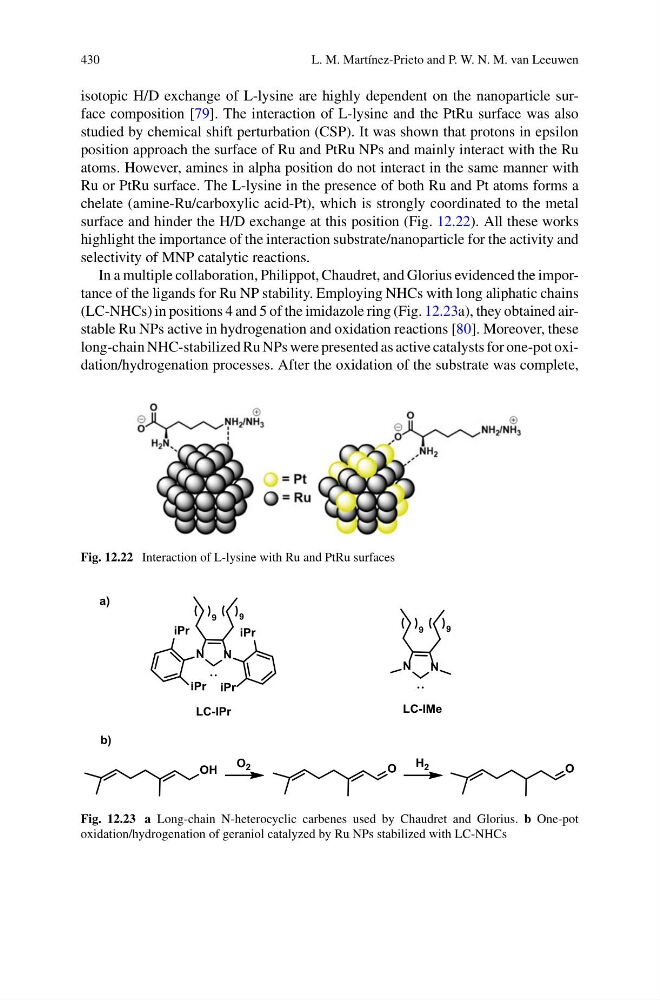
isotopic H/D exchange of L-lysine are highly dependent on the nanoparticle surface composition [79]. The interaction of L-lysine and the PtRu surface was also
studied by chemical shift perturbation (CSP). It was shown that protons in epsilon
position approach the surface of Ru and PtRu NPs and mainly interact with the Ru
atoms. However, amines in alpha position do not interact in the same manner with
Ru or PtRu surface. The L-lysine in the presence of both Ru and Pt atoms forms a
chelate (amine-Ru/carboxylic acid-Pt), which is strongly coordinated to the metal
surface and hinder the H/D exchange at this position (Fig. 12.22). All these works
highlight the importance of the interaction substrate/nanoparticle for the activity and
selectivity of MNP catalytic reactions.
In a multiple collaboration, Philippot, Chaudret, and Glorius evidenced the importance of the ligands for Ru NP stability. Employing NHCs with long aliphatic chains
(LC-NHCs) in positions 4 and 5 of the imidazole ring (Fig. 12.23a), they obtained airstable Ru NPs active in hydrogenation and oxidation reactions [80]. Moreover, these
long-chain NHC-stabilized Ru NPs were presented as active catalysts for one-pot oxidation/hydrogenation processes. After the oxidation of the substrate was complete,
Fig. 12.22 Interaction of L-lysine with Ru and PtRu surfaces
N
N
iPr
iPr
iPr
iPr
9
9
N
N
9
9
LC-IPr
LC-IMe
OH
O 2
O
H 2
O
a)
b)
Fig. 12.23 a Long-chain N-heterocyclic carbenes used by Chaudret and Glorius. b One-pot
oxidation/hydrogenation of geraniol catalyzed by Ru NPs stabilized with LC-NHCs
L. M. Martínez-Prieto and P. W. N. M. van Leeuwen
isotopic H/D exchange of L-lysine are highly dependent on the nanoparticle surface composition [79]. The interaction of L-lysine and the PtRu surface was also
studied by chemical shift perturbation (CSP). It was shown that protons in epsilon
position approach the surface of Ru and PtRu NPs and mainly interact with the Ru
atoms. However, amines in alpha position do not interact in the same manner with
Ru or PtRu surface. The L-lysine in the presence of both Ru and Pt atoms forms a
chelate (amine-Ru/carboxylic acid-Pt), which is strongly coordinated to the metal
surface and hinder the H/D exchange at this position (Fig. 12.22). All these works
highlight the importance of the interaction substrate/nanoparticle for the activity and
selectivity of MNP catalytic reactions.
In a multiple collaboration, Philippot, Chaudret, and Glorius evidenced the importance of the ligands for Ru NP stability. Employing NHCs with long aliphatic chains
(LC-NHCs) in positions 4 and 5 of the imidazole ring (Fig. 12.23a), they obtained airstable Ru NPs active in hydrogenation and oxidation reactions [80]. Moreover, these
long-chain NHC-stabilized Ru NPs were presented as active catalysts for one-pot oxidation/hydrogenation processes. After the oxidation of the substrate was complete,
Fig. 12.22 Interaction of L-lysine with Ru and PtRu surfaces
N
N
iPr
iPr
iPr
iPr
9
9
N
N
9
9
LC-IPr
LC-IMe
OH
O 2
O
H 2
O
a)
b)
Fig. 12.23 a Long-chain N-heterocyclic carbenes used by Chaudret and Glorius. b One-pot
oxidation/hydrogenation of geraniol catalyzed by Ru NPs stabilized with LC-NHCs