

12 Ligand Effects in Ruthenium Nanoparticle Catalysis
429
tested the chiral one in a few asymmetric catalytic reactions. Despite the high activity and chemoselectivity observed, negligible enantiomeric excess was obtained. The
lack of enantioinduction in asymmetric hydrogenation reactions with chiral ligandstabilized Ru NPs reveals that it is not always possible to extrapolate the catalytic
behavior of metal complexes to metal NPs.
In 2016, Scaiano and Fogg reported NHC-stabilized Ru NPs
formed from the decomposition of second-generation Grubbs catalyst,
RuCl 2 (H 2 IMes)(PCy 3 )(=CHPh) [H 2 IMes = 1,3-bis(2,4,6-trimethylphenyl)-4,5dihydroimidazol-2-ylidene] during olefin metathesis [72]. The resulting NPs
demonstrated to be very active in isomerization of estragole, being the first example
of olefin isomerization by Ru NPs. Also, by decomposition of NHC complexes,
Stubbs and Huynh generated NHC-stabilized Ru NPs, which were selective catalysts
in the hydrogenation of levulinic acid (LA) toward γ-valerolactone (GVL) [73].
Specifically, mono- and bidentate p-cymene Ru (II) NHC complexes were reduced
by H 2 in water to form the catalytically active Ru NPs.
Recently, Chaudret et al. obtained water-soluble NHC-stabilized Pt [74] and Pd
[75] NPs by decomposition of NHC complexes in water. After that, Martínez-Prieto
and Chaudret employed for the first time the same water-soluble NHCs (WS-NHCs;
Fig. 12.20d) to prepare Ru NPs characterized by their high activity, stability, and
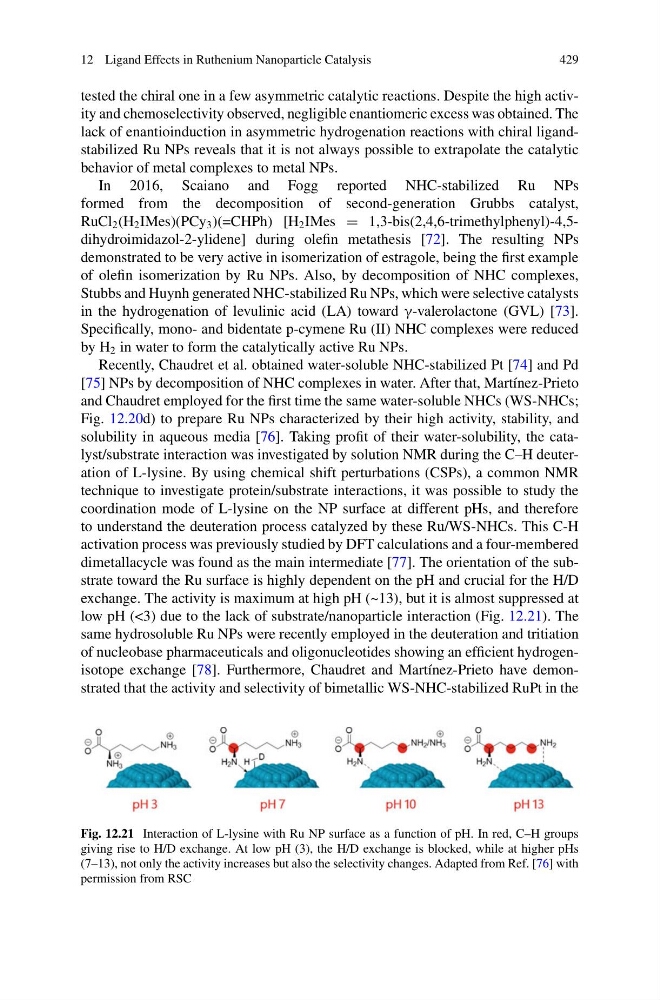
solubility in aqueous media [76]. Taking profit of their water-solubility, the catalyst/substrate interaction was investigated by solution NMR during the C–H deuteration of L-lysine. By using chemical shift perturbations (CSPs), a common NMR
technique to investigate protein/substrate interactions, it was possible to study the
coordination mode of L-lysine on the NP surface at different pHs, and therefore
to understand the deuteration process catalyzed by these Ru/WS-NHCs. This C-H
activation process was previously studied by DFT calculations and a four-membered
dimetallacycle was found as the main intermediate [77]. The orientation of the substrate toward the Ru surface is highly dependent on the pH and crucial for the H/D
exchange. The activity is maximum at high pH (~13), but it is almost suppressed at
low pH (<3) due to the lack of substrate/nanoparticle interaction (Fig. 12.21). The
same hydrosoluble Ru NPs were recently employed in the deuteration and tritiation
of nucleobase pharmaceuticals and oligonucleotides showing an efficient hydrogenisotope exchange [78]. Furthermore, Chaudret and Martínez-Prieto have demonstrated that the activity and selectivity of bimetallic WS-NHC-stabilized RuPt in the
Fig. 12.21 Interaction of L-lysine with Ru NP surface as a function of pH. In red, C–H groups
giving rise to H/D exchange. At low pH (3), the H/D exchange is blocked, while at higher pHs
(7–13), not only the activity increases but also the selectivity changes. Adapted from Ref. [76] with
permission from RSC
429
tested the chiral one in a few asymmetric catalytic reactions. Despite the high activity and chemoselectivity observed, negligible enantiomeric excess was obtained. The
lack of enantioinduction in asymmetric hydrogenation reactions with chiral ligandstabilized Ru NPs reveals that it is not always possible to extrapolate the catalytic
behavior of metal complexes to metal NPs.
In 2016, Scaiano and Fogg reported NHC-stabilized Ru NPs
formed from the decomposition of second-generation Grubbs catalyst,
RuCl 2 (H 2 IMes)(PCy 3 )(=CHPh) [H 2 IMes = 1,3-bis(2,4,6-trimethylphenyl)-4,5dihydroimidazol-2-ylidene] during olefin metathesis [72]. The resulting NPs
demonstrated to be very active in isomerization of estragole, being the first example
of olefin isomerization by Ru NPs. Also, by decomposition of NHC complexes,
Stubbs and Huynh generated NHC-stabilized Ru NPs, which were selective catalysts
in the hydrogenation of levulinic acid (LA) toward γ-valerolactone (GVL) [73].
Specifically, mono- and bidentate p-cymene Ru (II) NHC complexes were reduced
by H 2 in water to form the catalytically active Ru NPs.
Recently, Chaudret et al. obtained water-soluble NHC-stabilized Pt [74] and Pd
[75] NPs by decomposition of NHC complexes in water. After that, Martínez-Prieto
and Chaudret employed for the first time the same water-soluble NHCs (WS-NHCs;
Fig. 12.20d) to prepare Ru NPs characterized by their high activity, stability, and
solubility in aqueous media [76]. Taking profit of their water-solubility, the catalyst/substrate interaction was investigated by solution NMR during the C–H deuteration of L-lysine. By using chemical shift perturbations (CSPs), a common NMR
technique to investigate protein/substrate interactions, it was possible to study the
coordination mode of L-lysine on the NP surface at different pHs, and therefore
to understand the deuteration process catalyzed by these Ru/WS-NHCs. This C-H
activation process was previously studied by DFT calculations and a four-membered
dimetallacycle was found as the main intermediate [77]. The orientation of the substrate toward the Ru surface is highly dependent on the pH and crucial for the H/D
exchange. The activity is maximum at high pH (~13), but it is almost suppressed at
low pH (<3) due to the lack of substrate/nanoparticle interaction (Fig. 12.21). The
same hydrosoluble Ru NPs were recently employed in the deuteration and tritiation
of nucleobase pharmaceuticals and oligonucleotides showing an efficient hydrogenisotope exchange [78]. Furthermore, Chaudret and Martínez-Prieto have demonstrated that the activity and selectivity of bimetallic WS-NHC-stabilized RuPt in the
Fig. 12.21 Interaction of L-lysine with Ru NP surface as a function of pH. In red, C–H groups
giving rise to H/D exchange. At low pH (3), the H/D exchange is blocked, while at higher pHs
(7–13), not only the activity increases but also the selectivity changes. Adapted from Ref. [76] with
permission from RSC