

12 Ligand Effects in Ruthenium Nanoparticle Catalysis
423
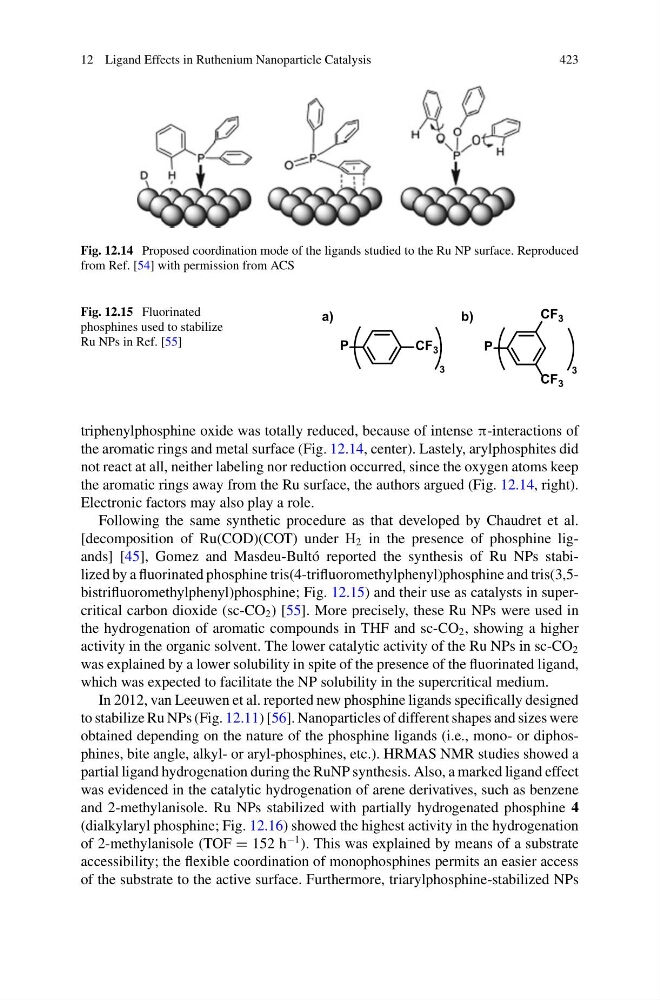
Fig. 12.14 Proposed coordination mode of the ligands studied to the Ru NP surface. Reproduced
from Ref. [54] with permission from ACS
Fig. 12.15 Fluorinated
phosphines used to stabilize
Ru NPs in Ref. [55]
P
CF 3
3
P
3
CF 3
CF 3
a)
b)
triphenylphosphine oxide was totally reduced, because of intense π-interactions of
the aromatic rings and metal surface (Fig. 12.14, center). Lastely, arylphosphites did
not react at all, neither labeling nor reduction occurred, since the oxygen atoms keep
the aromatic rings away from the Ru surface, the authors argued (Fig. 12.14, right).
Electronic factors may also play a role.
Following the same synthetic procedure as that developed by Chaudret et al.
[decomposition of Ru(COD)(COT) under H 2 in the presence of phosphine ligands] [45], Gomez and Masdeu-Bultó reported the synthesis of Ru NPs stabilized by a fluorinated phosphine tris(4-trifluoromethylphenyl)phosphine and tris(3,5bistrifluoromethylphenyl)phosphine; Fig. 12.15) and their use as catalysts in supercritical carbon dioxide (sc-CO 2 ) [55]. More precisely, these Ru NPs were used in
the hydrogenation of aromatic compounds in THF and sc-CO 2 , showing a higher
activity in the organic solvent. The lower catalytic activity of the Ru NPs in sc-CO 2
was explained by a lower solubility in spite of the presence of the fluorinated ligand,
which was expected to facilitate the NP solubility in the supercritical medium.
In 2012, van Leeuwen et al. reported new phosphine ligands specifically designed
to stabilize Ru NPs (Fig. 12.11) [56]. Nanoparticles of different shapes and sizes were
obtained depending on the nature of the phosphine ligands (i.e., mono- or diphosphines, bite angle, alkyl- or aryl-phosphines, etc.). HRMAS NMR studies showed a
partial ligand hydrogenation during the RuNP synthesis. Also, a marked ligand effect
was evidenced in the catalytic hydrogenation of arene derivatives, such as benzene
and 2-methylanisole. Ru NPs stabilized with partially hydrogenated phosphine 4
(dialkylaryl phosphine; Fig. 12.16) showed the highest activity in the hydrogenation
of 2-methylanisole (TOF = 152 h
−1 ). This was explained by means of a substrate
accessibility; the flexible coordination of monophosphines permits an easier access
of the substrate to the active surface. Furthermore, triarylphosphine-stabilized NPs
423
Fig. 12.14 Proposed coordination mode of the ligands studied to the Ru NP surface. Reproduced
from Ref. [54] with permission from ACS
Fig. 12.15 Fluorinated
phosphines used to stabilize
Ru NPs in Ref. [55]
P
CF 3
3
P
3
CF 3
CF 3
a)
b)
triphenylphosphine oxide was totally reduced, because of intense π-interactions of
the aromatic rings and metal surface (Fig. 12.14, center). Lastely, arylphosphites did
not react at all, neither labeling nor reduction occurred, since the oxygen atoms keep
the aromatic rings away from the Ru surface, the authors argued (Fig. 12.14, right).
Electronic factors may also play a role.
Following the same synthetic procedure as that developed by Chaudret et al.
[decomposition of Ru(COD)(COT) under H 2 in the presence of phosphine ligands] [45], Gomez and Masdeu-Bultó reported the synthesis of Ru NPs stabilized by a fluorinated phosphine tris(4-trifluoromethylphenyl)phosphine and tris(3,5bistrifluoromethylphenyl)phosphine; Fig. 12.15) and their use as catalysts in supercritical carbon dioxide (sc-CO 2 ) [55]. More precisely, these Ru NPs were used in
the hydrogenation of aromatic compounds in THF and sc-CO 2 , showing a higher
activity in the organic solvent. The lower catalytic activity of the Ru NPs in sc-CO 2
was explained by a lower solubility in spite of the presence of the fluorinated ligand,
which was expected to facilitate the NP solubility in the supercritical medium.
In 2012, van Leeuwen et al. reported new phosphine ligands specifically designed
to stabilize Ru NPs (Fig. 12.11) [56]. Nanoparticles of different shapes and sizes were
obtained depending on the nature of the phosphine ligands (i.e., mono- or diphosphines, bite angle, alkyl- or aryl-phosphines, etc.). HRMAS NMR studies showed a
partial ligand hydrogenation during the RuNP synthesis. Also, a marked ligand effect
was evidenced in the catalytic hydrogenation of arene derivatives, such as benzene
and 2-methylanisole. Ru NPs stabilized with partially hydrogenated phosphine 4
(dialkylaryl phosphine; Fig. 12.16) showed the highest activity in the hydrogenation
of 2-methylanisole (TOF = 152 h
−1 ). This was explained by means of a substrate
accessibility; the flexible coordination of monophosphines permits an easier access
of the substrate to the active surface. Furthermore, triarylphosphine-stabilized NPs