

422
L. M. Martínez-Prieto and P. W. N. M. van Leeuwen
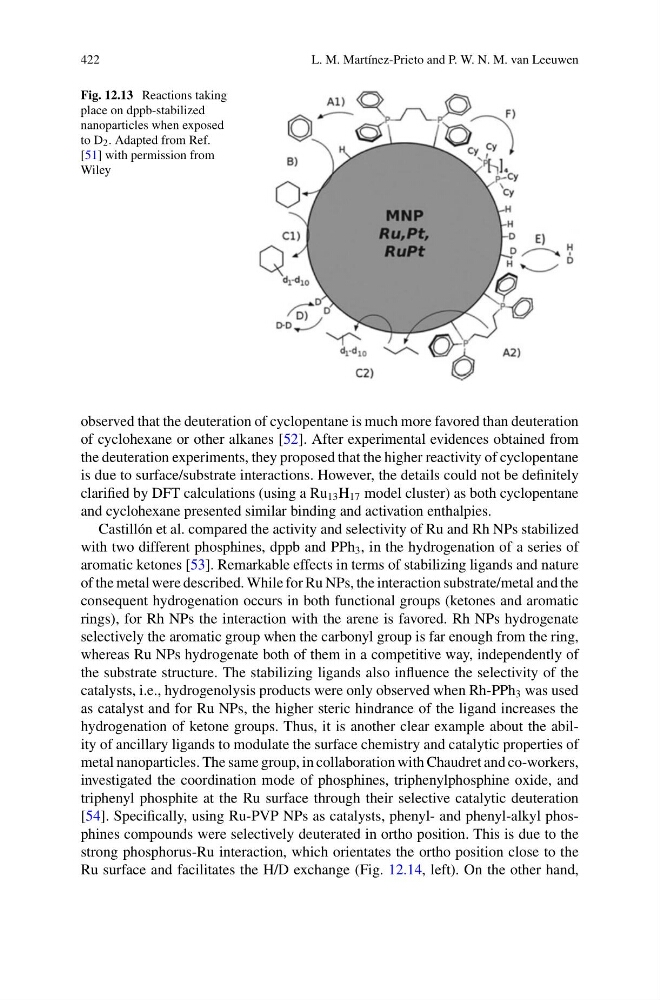
Fig. 12.13 Reactions taking
place on dppb-stabilized
nanoparticles when exposed
to D 2 . Adapted from Ref.
[51] with permission from
Wiley
observed that the deuteration of cyclopentane is much more favored than deuteration
of cyclohexane or other alkanes [52]. After experimental evidences obtained from
the deuteration experiments, they proposed that the higher reactivity of cyclopentane
is due to surface/substrate interactions. However, the details could not be definitely
clarified by DFT calculations (using a Ru 13 H 17 model cluster) as both cyclopentane
and cyclohexane presented similar binding and activation enthalpies.
Castillón et al. compared the activity and selectivity of Ru and Rh NPs stabilized
with two different phosphines, dppb and PPh 3 , in the hydrogenation of a series of
aromatic ketones [53]. Remarkable effects in terms of stabilizing ligands and nature
of the metal were described. While for Ru NPs, the interaction substrate/metal and the
consequent hydrogenation occurs in both functional groups (ketones and aromatic
rings), for Rh NPs the interaction with the arene is favored. Rh NPs hydrogenate
selectively the aromatic group when the carbonyl group is far enough from the ring,
whereas Ru NPs hydrogenate both of them in a competitive way, independently of
the substrate structure. The stabilizing ligands also influence the selectivity of the
catalysts, i.e., hydrogenolysis products were only observed when Rh-PPh 3 was used
as catalyst and for Ru NPs, the higher steric hindrance of the ligand increases the
hydrogenation of ketone groups. Thus, it is another clear example about the ability of ancillary ligands to modulate the surface chemistry and catalytic properties of
metal nanoparticles. The same group, in collaboration with Chaudret and co-workers,
investigated the coordination mode of phosphines, triphenylphosphine oxide, and
triphenyl phosphite at the Ru surface through their selective catalytic deuteration
[54]. Specifically, using Ru-PVP NPs as catalysts, phenyl- and phenyl-alkyl phosphines compounds were selectively deuterated in ortho position. This is due to the
strong phosphorus-Ru interaction, which orientates the ortho position close to the
Ru surface and facilitates the H/D exchange (Fig. 12.14, left). On the other hand,
L. M. Martínez-Prieto and P. W. N. M. van Leeuwen
Fig. 12.13 Reactions taking
place on dppb-stabilized
nanoparticles when exposed
to D 2 . Adapted from Ref.
[51] with permission from
Wiley
observed that the deuteration of cyclopentane is much more favored than deuteration
of cyclohexane or other alkanes [52]. After experimental evidences obtained from
the deuteration experiments, they proposed that the higher reactivity of cyclopentane
is due to surface/substrate interactions. However, the details could not be definitely
clarified by DFT calculations (using a Ru 13 H 17 model cluster) as both cyclopentane
and cyclohexane presented similar binding and activation enthalpies.
Castillón et al. compared the activity and selectivity of Ru and Rh NPs stabilized
with two different phosphines, dppb and PPh 3 , in the hydrogenation of a series of
aromatic ketones [53]. Remarkable effects in terms of stabilizing ligands and nature
of the metal were described. While for Ru NPs, the interaction substrate/metal and the
consequent hydrogenation occurs in both functional groups (ketones and aromatic
rings), for Rh NPs the interaction with the arene is favored. Rh NPs hydrogenate
selectively the aromatic group when the carbonyl group is far enough from the ring,
whereas Ru NPs hydrogenate both of them in a competitive way, independently of
the substrate structure. The stabilizing ligands also influence the selectivity of the
catalysts, i.e., hydrogenolysis products were only observed when Rh-PPh 3 was used
as catalyst and for Ru NPs, the higher steric hindrance of the ligand increases the
hydrogenation of ketone groups. Thus, it is another clear example about the ability of ancillary ligands to modulate the surface chemistry and catalytic properties of
metal nanoparticles. The same group, in collaboration with Chaudret and co-workers,
investigated the coordination mode of phosphines, triphenylphosphine oxide, and
triphenyl phosphite at the Ru surface through their selective catalytic deuteration
[54]. Specifically, using Ru-PVP NPs as catalysts, phenyl- and phenyl-alkyl phosphines compounds were selectively deuterated in ortho position. This is due to the
strong phosphorus-Ru interaction, which orientates the ortho position close to the
Ru surface and facilitates the H/D exchange (Fig. 12.14, left). On the other hand,