

420
L. M. Martínez-Prieto and P. W. N. M. van Leeuwen
12.2.3 Phosphorous Donor-Stabilized Ru NPs
12.2.3.1 Phosphine Ligands
Phosphines have been broadly used in organometallic chemistry to stabilize
metal complexes, and during the last decade, they have also been employed to
stabilize metal nanoparticles. One of the first example of phosphine-stabilized
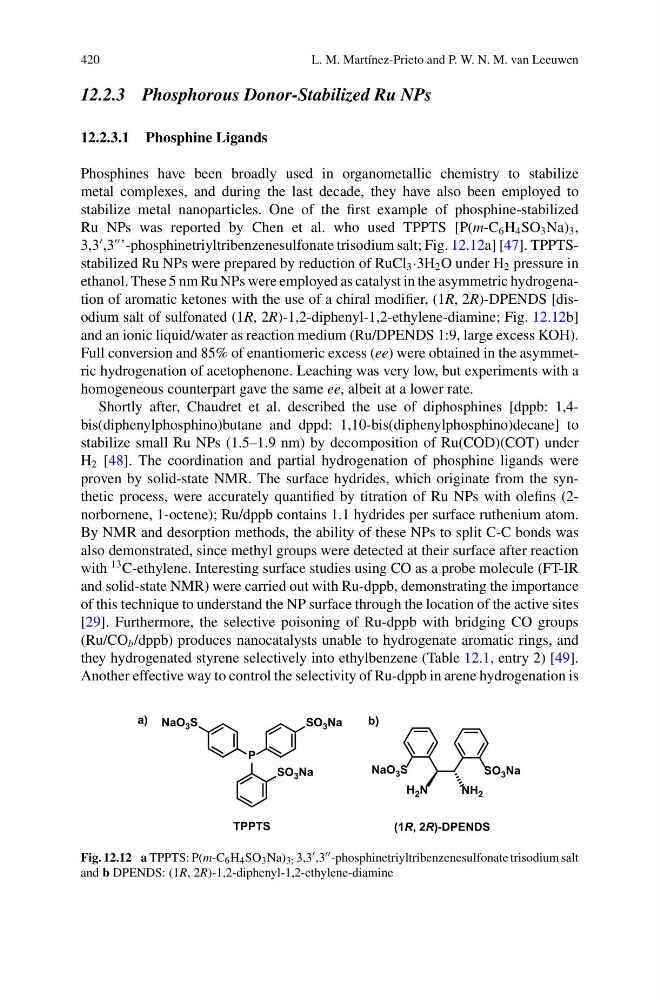
Ru NPs was reported by Chen et al. who used TPPTS [P(m-C 6 H 4 SO 3 Na) 3 ,
3,3
,3
’-phosphinetriyltribenzenesulfonate trisodium salt; Fig. 12.12a] [47]. TPPTSstabilized Ru NPs were prepared by reduction of RuCl 3 ·3H 2 O under H 2 pressure in
ethanol. These 5 nm Ru NPs were employed as catalyst in the asymmetric hydrogenation of aromatic ketones with the use of a chiral modifier, (1R, 2R)-DPENDS [disodium salt of sulfonated (1R, 2R)-1,2-diphenyl-1,2-ethylene-diamine; Fig. 12.12b]
and an ionic liquid/water as reaction medium (Ru/DPENDS 1:9, large excess KOH).
Full conversion and 85% of enantiomeric excess (ee) were obtained in the asymmetric hydrogenation of acetophenone. Leaching was very low, but experiments with a
homogeneous counterpart gave the same ee, albeit at a lower rate.
Shortly after, Chaudret et al. described the use of diphosphines [dppb: 1,4bis(diphenylphosphino)butane and dppd: 1,10-bis(diphenylphosphino)decane] to
stabilize small Ru NPs (1.5–1.9 nm) by decomposition of Ru(COD)(COT) under
H 2 [48]. The coordination and partial hydrogenation of phosphine ligands were
proven by solid-state NMR. The surface hydrides, which originate from the synthetic process, were accurately quantified by titration of Ru NPs with olefins (2norbornene, 1-octene); Ru/dppb contains 1.1 hydrides per surface ruthenium atom.
By NMR and desorption methods, the ability of these NPs to split C-C bonds was
also demonstrated, since methyl groups were detected at their surface after reaction
with
13 C-ethylene. Interesting surface studies using CO as a probe molecule (FT-IR
and solid-state NMR) were carried out with Ru-dppb, demonstrating the importance
of this technique to understand the NP surface through the location of the active sites
[29]. Furthermore, the selective poisoning of Ru-dppb with bridging CO groups
(Ru/CO b /dppb) produces nanocatalysts unable to hydrogenate aromatic rings, and
they hydrogenated styrene selectively into ethylbenzene (Table 12.1, entry 2) [49].
Another effective way to control the selectivity of Ru-dppb in arene hydrogenation is
P
SO 3 Na
SO 3 Na
NaO 3 S
TPPTS
H 2 N
NH 2
NaO 3 S
SO 3 Na
(1R, 2R)-DPENDS
a)
b)
Fig. 12.12 a TPPTS: P(m-C 6 H 4 SO 3 Na) 3; 3,3 ,3 -phosphinetriyltribenzenesulfonate trisodium salt
and b DPENDS: (1R, 2R)-1,2-diphenyl-1,2-ethylene-diamine
L. M. Martínez-Prieto and P. W. N. M. van Leeuwen
12.2.3 Phosphorous Donor-Stabilized Ru NPs
12.2.3.1 Phosphine Ligands
Phosphines have been broadly used in organometallic chemistry to stabilize
metal complexes, and during the last decade, they have also been employed to
stabilize metal nanoparticles. One of the first example of phosphine-stabilized
Ru NPs was reported by Chen et al. who used TPPTS [P(m-C 6 H 4 SO 3 Na) 3 ,
3,3
,3
’-phosphinetriyltribenzenesulfonate trisodium salt; Fig. 12.12a] [47]. TPPTSstabilized Ru NPs were prepared by reduction of RuCl 3 ·3H 2 O under H 2 pressure in
ethanol. These 5 nm Ru NPs were employed as catalyst in the asymmetric hydrogenation of aromatic ketones with the use of a chiral modifier, (1R, 2R)-DPENDS [disodium salt of sulfonated (1R, 2R)-1,2-diphenyl-1,2-ethylene-diamine; Fig. 12.12b]
and an ionic liquid/water as reaction medium (Ru/DPENDS 1:9, large excess KOH).
Full conversion and 85% of enantiomeric excess (ee) were obtained in the asymmetric hydrogenation of acetophenone. Leaching was very low, but experiments with a
homogeneous counterpart gave the same ee, albeit at a lower rate.
Shortly after, Chaudret et al. described the use of diphosphines [dppb: 1,4bis(diphenylphosphino)butane and dppd: 1,10-bis(diphenylphosphino)decane] to
stabilize small Ru NPs (1.5–1.9 nm) by decomposition of Ru(COD)(COT) under
H 2 [48]. The coordination and partial hydrogenation of phosphine ligands were
proven by solid-state NMR. The surface hydrides, which originate from the synthetic process, were accurately quantified by titration of Ru NPs with olefins (2norbornene, 1-octene); Ru/dppb contains 1.1 hydrides per surface ruthenium atom.
By NMR and desorption methods, the ability of these NPs to split C-C bonds was
also demonstrated, since methyl groups were detected at their surface after reaction
with
13 C-ethylene. Interesting surface studies using CO as a probe molecule (FT-IR
and solid-state NMR) were carried out with Ru-dppb, demonstrating the importance
of this technique to understand the NP surface through the location of the active sites
[29]. Furthermore, the selective poisoning of Ru-dppb with bridging CO groups
(Ru/CO b /dppb) produces nanocatalysts unable to hydrogenate aromatic rings, and
they hydrogenated styrene selectively into ethylbenzene (Table 12.1, entry 2) [49].
Another effective way to control the selectivity of Ru-dppb in arene hydrogenation is
P
SO 3 Na
SO 3 Na
NaO 3 S
TPPTS
H 2 N
NH 2
NaO 3 S
SO 3 Na
(1R, 2R)-DPENDS
a)
b)
Fig. 12.12 a TPPTS: P(m-C 6 H 4 SO 3 Na) 3; 3,3 ,3 -phosphinetriyltribenzenesulfonate trisodium salt
and b DPENDS: (1R, 2R)-1,2-diphenyl-1,2-ethylene-diamine