

12 Ligand Effects in Ruthenium Nanoparticle Catalysis
419
catalytic properties of the nanoparticles, and in particular their selectivity. For example, using Ru/Me-α-CD, the aromatic rings were not hydrogenated at all, obtaining
selectively ethylbenzene in styrene hydrogenation. However, Ru/Me-γ-CD showed a
total hydrogenation of the aromatic rings, ethylcyclohexene being the unique reaction
product. In the case of Ru/Me-β-CD, the substitution degree governs the selectivity;
while a low degree of substitution leads to total hydrogenation of aromatic rings, a
higher degree of substitution blocks arene hydrogenation in benzene derivatives with
an alkyl chain of more than two carbon atoms. This was explained by differences in
the hydrophobic host cavities of Me-β-CDs. The hydrogenation of other substrates
(olefins, ketones, and disubstituted arenes) was also accomplished by using the same
catalytic system [45]. Recyclability studies revealed a high stability of the catalyst
in the hydrogenation of ethyl pyruvate.
Philippot and Poteau combined experimental and computational studies to investigate the surface of Ru NPs capped with a new stabilizing ligand, ethanoic acid [46].
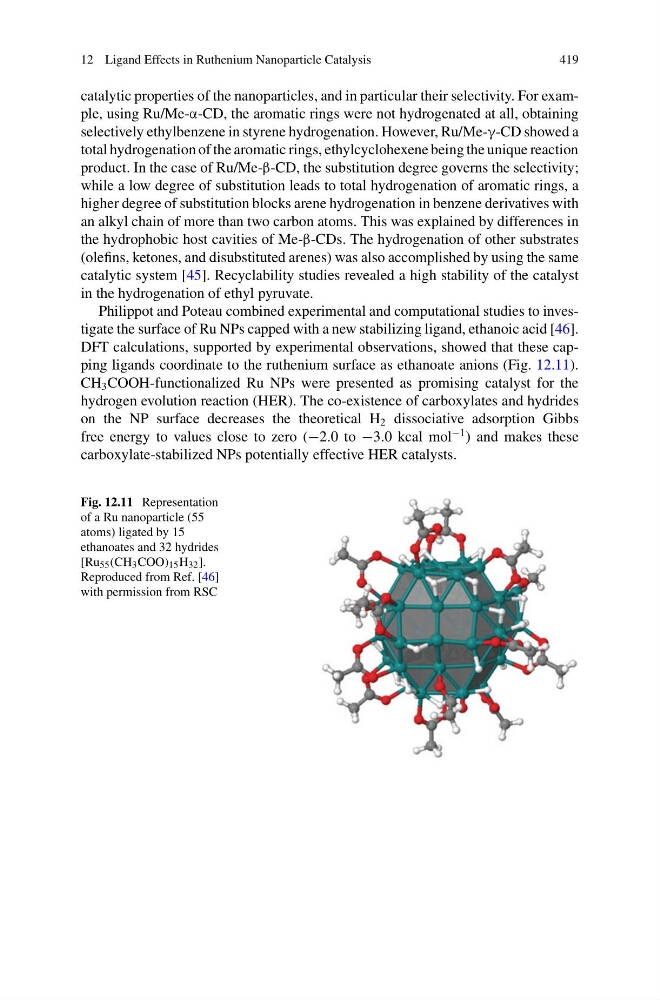
DFT calculations, supported by experimental observations, showed that these capping ligands coordinate to the ruthenium surface as ethanoate anions (Fig. 12.11).
CH 3 COOH-functionalized Ru NPs were presented as promising catalyst for the
hydrogen evolution reaction (HER). The co-existence of carboxylates and hydrides
on the NP surface decreases the theoretical H 2 dissociative adsorption Gibbs
free energy to values close to zero (−2.0 to −3.0 kcal mol
−1 ) and makes these
carboxylate-stabilized NPs potentially effective HER catalysts.
Fig. 12.11 Representation
of a Ru nanoparticle (55
atoms) ligated by 15
ethanoates and 32 hydrides
[Ru 55 (CH 3 COO) 15 H 32 ].
Reproduced from Ref. [46]
with permission from RSC
419
catalytic properties of the nanoparticles, and in particular their selectivity. For example, using Ru/Me-α-CD, the aromatic rings were not hydrogenated at all, obtaining
selectively ethylbenzene in styrene hydrogenation. However, Ru/Me-γ-CD showed a
total hydrogenation of the aromatic rings, ethylcyclohexene being the unique reaction
product. In the case of Ru/Me-β-CD, the substitution degree governs the selectivity;
while a low degree of substitution leads to total hydrogenation of aromatic rings, a
higher degree of substitution blocks arene hydrogenation in benzene derivatives with
an alkyl chain of more than two carbon atoms. This was explained by differences in
the hydrophobic host cavities of Me-β-CDs. The hydrogenation of other substrates
(olefins, ketones, and disubstituted arenes) was also accomplished by using the same
catalytic system [45]. Recyclability studies revealed a high stability of the catalyst
in the hydrogenation of ethyl pyruvate.
Philippot and Poteau combined experimental and computational studies to investigate the surface of Ru NPs capped with a new stabilizing ligand, ethanoic acid [46].
DFT calculations, supported by experimental observations, showed that these capping ligands coordinate to the ruthenium surface as ethanoate anions (Fig. 12.11).
CH 3 COOH-functionalized Ru NPs were presented as promising catalyst for the
hydrogen evolution reaction (HER). The co-existence of carboxylates and hydrides
on the NP surface decreases the theoretical H 2 dissociative adsorption Gibbs
free energy to values close to zero (−2.0 to −3.0 kcal mol
−1 ) and makes these
carboxylate-stabilized NPs potentially effective HER catalysts.
Fig. 12.11 Representation
of a Ru nanoparticle (55
atoms) ligated by 15
ethanoates and 32 hydrides
[Ru 55 (CH 3 COO) 15 H 32 ].
Reproduced from Ref. [46]
with permission from RSC