

416
L. M. Martínez-Prieto and P. W. N. M. van Leeuwen
two mechanisms operate in parallel in the hydrogenation of quinoline (Ru/MgO),
palmitic acid (Ru/NH 2 -rGO), or acetophenone (Ru/NH 2 -rGO).
A short while ago, Axet et al. investigated the influence of the ligands on the
hydrogenation of nitrobenzene using Ru NPs as catalyst [37]. In particular, the
ruthenium nanoparticles used in this study were stabilized by two donor ligands,
which are directly coordinated to the metal surface (HDA = hexadecylamine and
IPr = 1,3-bis(2,6- diisopropylphenyl)imidazol-2-ylidene), a polymer that presents
almost no interaction with the ruthenium surface (PVP = poly(vinylpyrrolidone)),
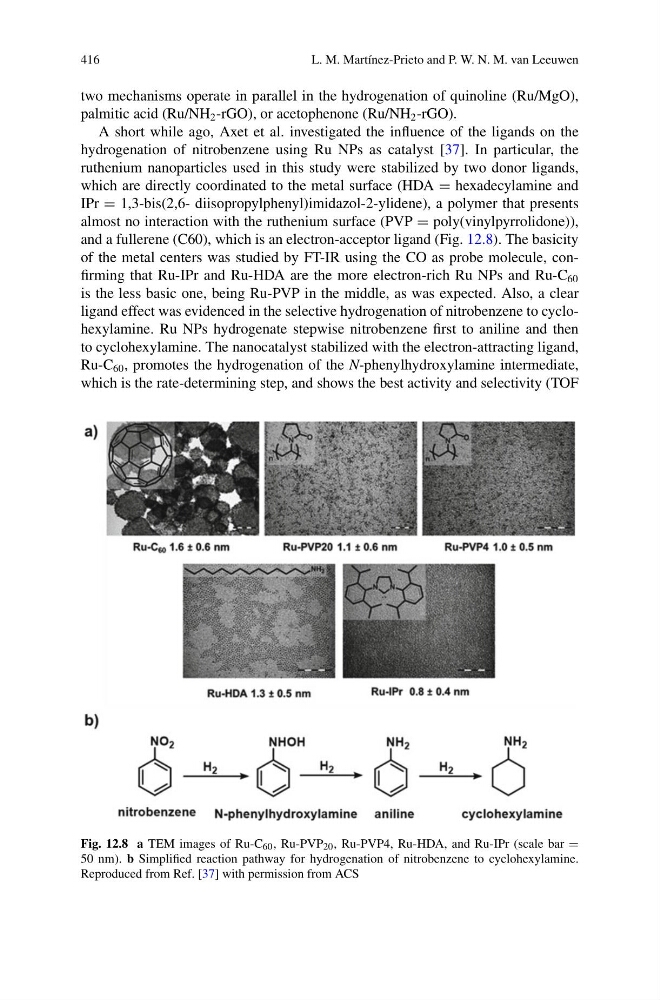
and a fullerene (C60), which is an electron-acceptor ligand (Fig. 12.8). The basicity
of the metal centers was studied by FT-IR using the CO as probe molecule, confirming that Ru-IPr and Ru-HDA are the more electron-rich Ru NPs and Ru-C 60
is the less basic one, being Ru-PVP in the middle, as was expected. Also, a clear
ligand effect was evidenced in the selective hydrogenation of nitrobenzene to cyclohexylamine. Ru NPs hydrogenate stepwise nitrobenzene first to aniline and then
to cyclohexylamine. The nanocatalyst stabilized with the electron-attracting ligand,
Ru-C 60 , promotes the hydrogenation of the N-phenylhydroxylamine intermediate,
which is the rate-determining step, and shows the best activity and selectivity (TOF
Fig. 12.8 a TEM images of Ru-C 60 , Ru-PVP 20 , Ru-PVP4, Ru-HDA, and Ru-IPr (scale bar =
50 nm). b Simplified reaction pathway for hydrogenation of nitrobenzene to cyclohexylamine.
Reproduced from Ref. [37] with permission from ACS
L. M. Martínez-Prieto and P. W. N. M. van Leeuwen
two mechanisms operate in parallel in the hydrogenation of quinoline (Ru/MgO),
palmitic acid (Ru/NH 2 -rGO), or acetophenone (Ru/NH 2 -rGO).
A short while ago, Axet et al. investigated the influence of the ligands on the
hydrogenation of nitrobenzene using Ru NPs as catalyst [37]. In particular, the
ruthenium nanoparticles used in this study were stabilized by two donor ligands,
which are directly coordinated to the metal surface (HDA = hexadecylamine and
IPr = 1,3-bis(2,6- diisopropylphenyl)imidazol-2-ylidene), a polymer that presents
almost no interaction with the ruthenium surface (PVP = poly(vinylpyrrolidone)),
and a fullerene (C60), which is an electron-acceptor ligand (Fig. 12.8). The basicity
of the metal centers was studied by FT-IR using the CO as probe molecule, confirming that Ru-IPr and Ru-HDA are the more electron-rich Ru NPs and Ru-C 60
is the less basic one, being Ru-PVP in the middle, as was expected. Also, a clear
ligand effect was evidenced in the selective hydrogenation of nitrobenzene to cyclohexylamine. Ru NPs hydrogenate stepwise nitrobenzene first to aniline and then
to cyclohexylamine. The nanocatalyst stabilized with the electron-attracting ligand,
Ru-C 60 , promotes the hydrogenation of the N-phenylhydroxylamine intermediate,
which is the rate-determining step, and shows the best activity and selectivity (TOF
Fig. 12.8 a TEM images of Ru-C 60 , Ru-PVP 20 , Ru-PVP4, Ru-HDA, and Ru-IPr (scale bar =
50 nm). b Simplified reaction pathway for hydrogenation of nitrobenzene to cyclohexylamine.
Reproduced from Ref. [37] with permission from ACS