

12 Ligand Effects in Ruthenium Nanoparticle Catalysis
415
coordination of CO, [31] and higher selectivity in the hydrogenation of styrene to
ethylbenzene. Therefore, by playing with the amount and the donor strength of ligand,
it is possible to obtain ultra-small Ru NPs, which present a reactivity at the frontier
between homogeneous and heterogeneous catalysts. Recently Martínez-Prieto et al.
also reported that it is possible to control the surface properties of the nanoparticles by
modulating the electronic character of the N-substituents of these amidinate ligands
[32]. It was evidenced how the catalytic behavior of Pt NPs on the hydrogenation of
activated ketones was influenced by the electron donor/acceptor (−Me, −OMe, −Cl)
groups in the N-aryl substituents (Fig. 12.6, right). The nanoparticles stabilized with
the strongest donor ligand (R = −OMe) demonstrated to be the most active catalyst,
while the slowest catalyst was the system containing the electron-withdrawing group
(R = −Cl). A comparable catalytic trend has been recently observed for Ni NPs
stabilized with the same donor/acceptor amidinate ligands in semi-hydrogenation
reactions of alkynes [33]. The latter two publications are manifest examples of how
small changes on the stabilizing ligands are capable of modifying the MNP catalytic
properties.
Although the next example is not strictly an ancillary ligand, the N-donor capacity of the stabilizing polymer, poly(4-vinylpyridine) (PVPy), strongly influences the
catalytic behavior of Ru NPs. In particular, Ru NPs immobilized on PVPy reported
by Sanchez-Delgado et al. display a peculiar reactivity in the hydrogenation of arenes
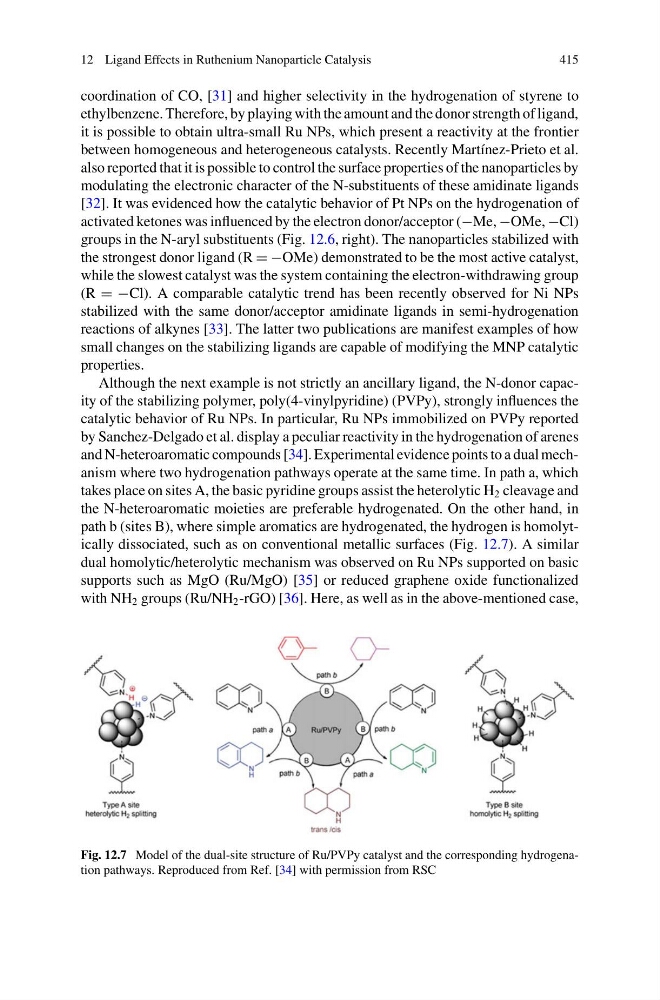
and N-heteroaromatic compounds [34]. Experimental evidence points to a dual mechanism where two hydrogenation pathways operate at the same time. In path a, which
takes place on sites A, the basic pyridine groups assist the heterolytic H 2 cleavage and
the N-heteroaromatic moieties are preferable hydrogenated. On the other hand, in
path b (sites B), where simple aromatics are hydrogenated, the hydrogen is homolytically dissociated, such as on conventional metallic surfaces (Fig. 12.7). A similar
dual homolytic/heterolytic mechanism was observed on Ru NPs supported on basic
supports such as MgO (Ru/MgO) [35] or reduced graphene oxide functionalized
with NH 2 groups (Ru/NH 2 -rGO) [36]. Here, as well as in the above-mentioned case,
Fig. 12.7 Model of the dual-site structure of Ru/PVPy catalyst and the corresponding hydrogenation pathways. Reproduced from Ref. [34] with permission from RSC
415
coordination of CO, [31] and higher selectivity in the hydrogenation of styrene to
ethylbenzene. Therefore, by playing with the amount and the donor strength of ligand,
it is possible to obtain ultra-small Ru NPs, which present a reactivity at the frontier
between homogeneous and heterogeneous catalysts. Recently Martínez-Prieto et al.
also reported that it is possible to control the surface properties of the nanoparticles by
modulating the electronic character of the N-substituents of these amidinate ligands
[32]. It was evidenced how the catalytic behavior of Pt NPs on the hydrogenation of
activated ketones was influenced by the electron donor/acceptor (−Me, −OMe, −Cl)
groups in the N-aryl substituents (Fig. 12.6, right). The nanoparticles stabilized with
the strongest donor ligand (R = −OMe) demonstrated to be the most active catalyst,
while the slowest catalyst was the system containing the electron-withdrawing group
(R = −Cl). A comparable catalytic trend has been recently observed for Ni NPs
stabilized with the same donor/acceptor amidinate ligands in semi-hydrogenation
reactions of alkynes [33]. The latter two publications are manifest examples of how
small changes on the stabilizing ligands are capable of modifying the MNP catalytic
properties.
Although the next example is not strictly an ancillary ligand, the N-donor capacity of the stabilizing polymer, poly(4-vinylpyridine) (PVPy), strongly influences the
catalytic behavior of Ru NPs. In particular, Ru NPs immobilized on PVPy reported
by Sanchez-Delgado et al. display a peculiar reactivity in the hydrogenation of arenes
and N-heteroaromatic compounds [34]. Experimental evidence points to a dual mechanism where two hydrogenation pathways operate at the same time. In path a, which
takes place on sites A, the basic pyridine groups assist the heterolytic H 2 cleavage and
the N-heteroaromatic moieties are preferable hydrogenated. On the other hand, in
path b (sites B), where simple aromatics are hydrogenated, the hydrogen is homolytically dissociated, such as on conventional metallic surfaces (Fig. 12.7). A similar
dual homolytic/heterolytic mechanism was observed on Ru NPs supported on basic
supports such as MgO (Ru/MgO) [35] or reduced graphene oxide functionalized
with NH 2 groups (Ru/NH 2 -rGO) [36]. Here, as well as in the above-mentioned case,
Fig. 12.7 Model of the dual-site structure of Ru/PVPy catalyst and the corresponding hydrogenation pathways. Reproduced from Ref. [34] with permission from RSC