

414
L. M. Martínez-Prieto and P. W. N. M. van Leeuwen
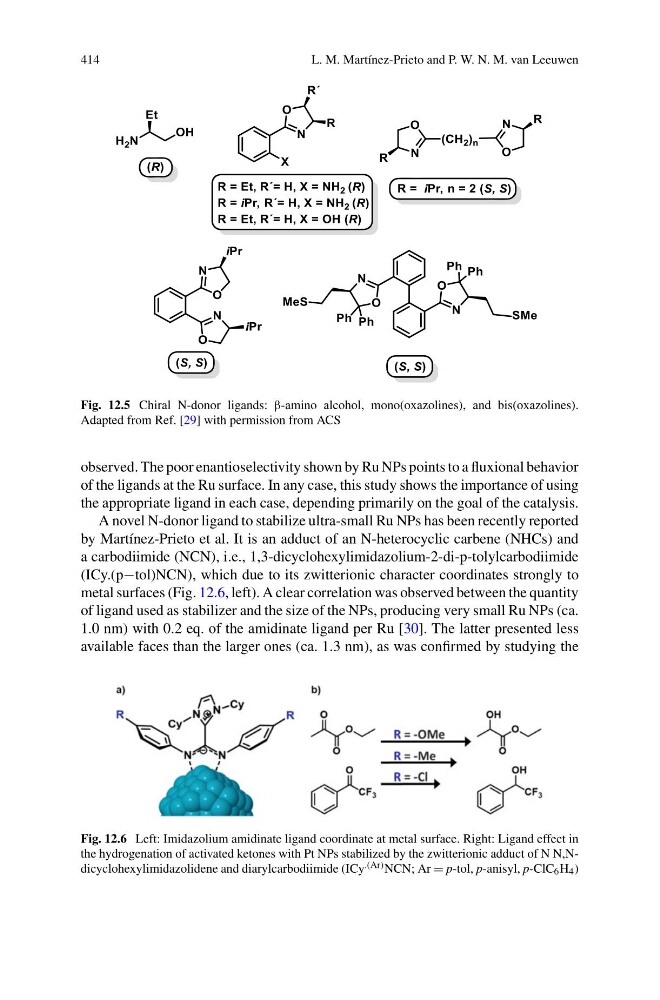
Fig. 12.5 Chiral N-donor ligands: β-amino alcohol, mono(oxazolines), and bis(oxazolines).
Adapted from Ref. [29] with permission from ACS
observed. The poor enantioselectivity shown by Ru NPs points to a fluxional behavior
of the ligands at the Ru surface. In any case, this study shows the importance of using
the appropriate ligand in each case, depending primarily on the goal of the catalysis.
A novel N-donor ligand to stabilize ultra-small Ru NPs has been recently reported
by Martínez-Prieto et al. It is an adduct of an N-heterocyclic carbene (NHCs) and
a carbodiimide (NCN), i.e., 1,3-dicyclohexylimidazolium-2-di-p-tolylcarbodiimide
(ICy.(p−tol)NCN), which due to its zwitterionic character coordinates strongly to
metal surfaces (Fig. 12.6, left). A clear correlation was observed between the quantity
of ligand used as stabilizer and the size of the NPs, producing very small Ru NPs (ca.
1.0 nm) with 0.2 eq. of the amidinate ligand per Ru [30]. The latter presented less
available faces than the larger ones (ca. 1.3 nm), as was confirmed by studying the
Fig. 12.6 Left: Imidazolium amidinate ligand coordinate at metal surface. Right: Ligand effect in
the hydrogenation of activated ketones with Pt NPs stabilized by the zwitterionic adduct of N N,Ndicyclohexylimidazolidene and diarylcarbodiimide (ICy .(Ar) NCN; Ar = p-tol, p-anisyl, p-ClC 6 H 4 )
L. M. Martínez-Prieto and P. W. N. M. van Leeuwen
Fig. 12.5 Chiral N-donor ligands: β-amino alcohol, mono(oxazolines), and bis(oxazolines).
Adapted from Ref. [29] with permission from ACS
observed. The poor enantioselectivity shown by Ru NPs points to a fluxional behavior
of the ligands at the Ru surface. In any case, this study shows the importance of using
the appropriate ligand in each case, depending primarily on the goal of the catalysis.
A novel N-donor ligand to stabilize ultra-small Ru NPs has been recently reported
by Martínez-Prieto et al. It is an adduct of an N-heterocyclic carbene (NHCs) and
a carbodiimide (NCN), i.e., 1,3-dicyclohexylimidazolium-2-di-p-tolylcarbodiimide
(ICy.(p−tol)NCN), which due to its zwitterionic character coordinates strongly to
metal surfaces (Fig. 12.6, left). A clear correlation was observed between the quantity
of ligand used as stabilizer and the size of the NPs, producing very small Ru NPs (ca.
1.0 nm) with 0.2 eq. of the amidinate ligand per Ru [30]. The latter presented less
available faces than the larger ones (ca. 1.3 nm), as was confirmed by studying the
Fig. 12.6 Left: Imidazolium amidinate ligand coordinate at metal surface. Right: Ligand effect in
the hydrogenation of activated ketones with Pt NPs stabilized by the zwitterionic adduct of N N,Ndicyclohexylimidazolidene and diarylcarbodiimide (ICy .(Ar) NCN; Ar = p-tol, p-anisyl, p-ClC 6 H 4 )