

12 Ligand Effects in Ruthenium Nanoparticle Catalysis
413
excess was observed in any case (less than 5%), interesting differences in terms of
activity were found; Ru NPs containing RaMeCD-Leu were more active than the
ones ligated by RaMeCD-Ala.
12.2.1.2 Nitrogen Donor Ligands
In contrast with amines, nitrogen donor compounds such as pyridines derivatives can
coordinate strongly to the ruthenium surface, as Philippot and co-workers reported
during the last years. It was observed that 4-(3-phenylpropyl)-pyridine-stabilized
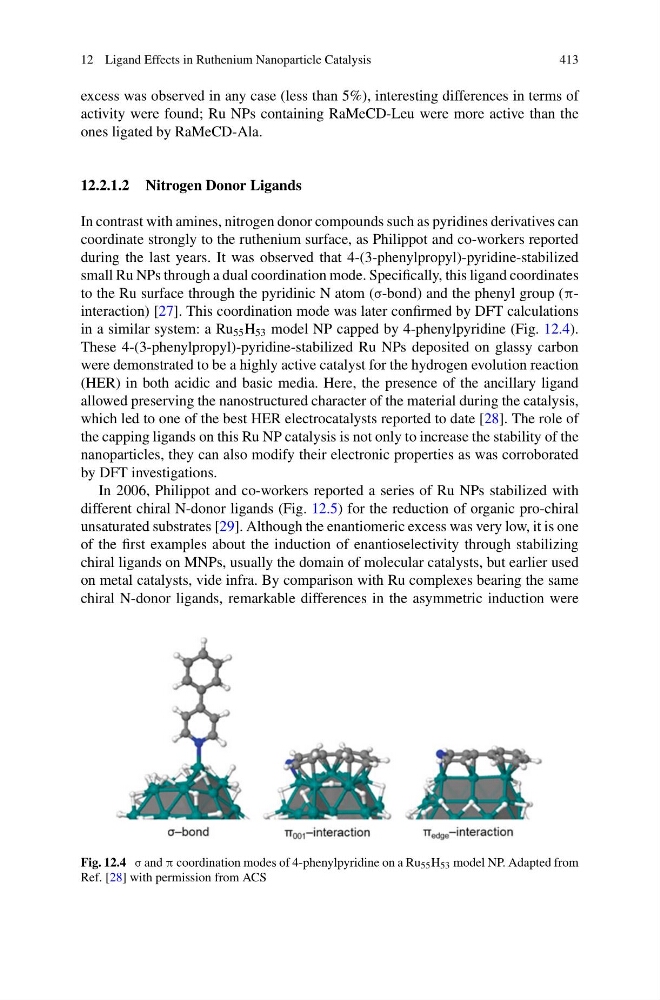
small Ru NPs through a dual coordination mode. Specifically, this ligand coordinates
to the Ru surface through the pyridinic N atom (σ-bond) and the phenyl group (πinteraction) [27]. This coordination mode was later confirmed by DFT calculations
in a similar system: a Ru 55 H 53 model NP capped by 4-phenylpyridine (Fig. 12.4).
These 4-(3-phenylpropyl)-pyridine-stabilized Ru NPs deposited on glassy carbon
were demonstrated to be a highly active catalyst for the hydrogen evolution reaction
(HER) in both acidic and basic media. Here, the presence of the ancillary ligand
allowed preserving the nanostructured character of the material during the catalysis,
which led to one of the best HER electrocatalysts reported to date [28]. The role of
the capping ligands on this Ru NP catalysis is not only to increase the stability of the
nanoparticles, they can also modify their electronic properties as was corroborated
by DFT investigations.
In 2006, Philippot and co-workers reported a series of Ru NPs stabilized with
different chiral N-donor ligands (Fig. 12.5) for the reduction of organic pro-chiral
unsaturated substrates [29]. Although the enantiomeric excess was very low, it is one
of the first examples about the induction of enantioselectivity through stabilizing
chiral ligands on MNPs, usually the domain of molecular catalysts, but earlier used
on metal catalysts, vide infra. By comparison with Ru complexes bearing the same
chiral N-donor ligands, remarkable differences in the asymmetric induction were
Fig. 12.4 σ and π coordination modes of 4-phenylpyridine on a Ru 55 H 53 model NP. Adapted from
Ref. [28] with permission from ACS
413
excess was observed in any case (less than 5%), interesting differences in terms of
activity were found; Ru NPs containing RaMeCD-Leu were more active than the
ones ligated by RaMeCD-Ala.
12.2.1.2 Nitrogen Donor Ligands
In contrast with amines, nitrogen donor compounds such as pyridines derivatives can
coordinate strongly to the ruthenium surface, as Philippot and co-workers reported
during the last years. It was observed that 4-(3-phenylpropyl)-pyridine-stabilized
small Ru NPs through a dual coordination mode. Specifically, this ligand coordinates
to the Ru surface through the pyridinic N atom (σ-bond) and the phenyl group (πinteraction) [27]. This coordination mode was later confirmed by DFT calculations
in a similar system: a Ru 55 H 53 model NP capped by 4-phenylpyridine (Fig. 12.4).
These 4-(3-phenylpropyl)-pyridine-stabilized Ru NPs deposited on glassy carbon
were demonstrated to be a highly active catalyst for the hydrogen evolution reaction
(HER) in both acidic and basic media. Here, the presence of the ancillary ligand
allowed preserving the nanostructured character of the material during the catalysis,
which led to one of the best HER electrocatalysts reported to date [28]. The role of
the capping ligands on this Ru NP catalysis is not only to increase the stability of the
nanoparticles, they can also modify their electronic properties as was corroborated
by DFT investigations.
In 2006, Philippot and co-workers reported a series of Ru NPs stabilized with
different chiral N-donor ligands (Fig. 12.5) for the reduction of organic pro-chiral
unsaturated substrates [29]. Although the enantiomeric excess was very low, it is one
of the first examples about the induction of enantioselectivity through stabilizing
chiral ligands on MNPs, usually the domain of molecular catalysts, but earlier used
on metal catalysts, vide infra. By comparison with Ru complexes bearing the same
chiral N-donor ligands, remarkable differences in the asymmetric induction were
Fig. 12.4 σ and π coordination modes of 4-phenylpyridine on a Ru 55 H 53 model NP. Adapted from
Ref. [28] with permission from ACS