

412
L. M. Martínez-Prieto and P. W. N. M. van Leeuwen
PPhH 2 , PPh 2 H and H 2 O), Salas et al. observed how these ligands influence the
catalytic activity and selectivity of the catalyst [25]. In particular, they showed that
σ-donor ligands (1-octylamine and H 2 O) increase the activity of the IL-stabilized Ru
NPs in the hydrogenation of unsaturated compounds (1,3-cyclohexadiene, limonene
and styrene), whereas π-acceptor ones (PPhH 2 and PPh 2 H) decrease it. This work
highlights how the activity of small Ru NPs can be controlled by the σ–π donor
character of the coordinating ligands, in the same way as in homogeneous catalysis.
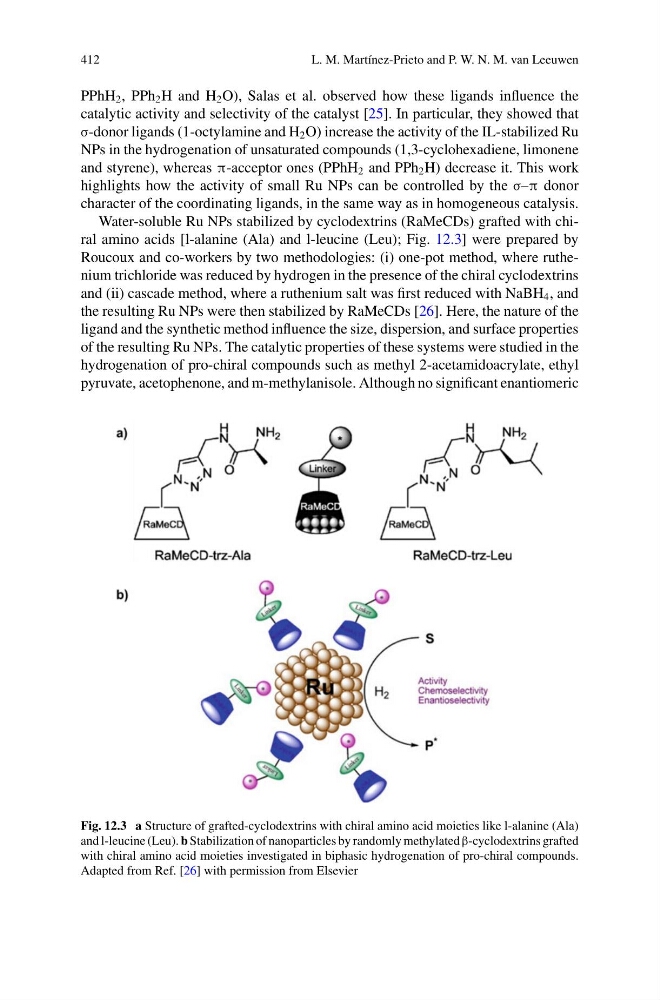
Water-soluble Ru NPs stabilized by cyclodextrins (RaMeCDs) grafted with chiral amino acids [l-alanine (Ala) and l-leucine (Leu); Fig. 12.3] were prepared by
Roucoux and co-workers by two methodologies: (i) one-pot method, where ruthenium trichloride was reduced by hydrogen in the presence of the chiral cyclodextrins
and (ii) cascade method, where a ruthenium salt was first reduced with NaBH 4 , and
the resulting Ru NPs were then stabilized by RaMeCDs [26]. Here, the nature of the
ligand and the synthetic method influence the size, dispersion, and surface properties
of the resulting Ru NPs. The catalytic properties of these systems were studied in the
hydrogenation of pro-chiral compounds such as methyl 2-acetamidoacrylate, ethyl
pyruvate, acetophenone, and m-methylanisole. Although no significant enantiomeric
Fig. 12.3 a Structure of grafted-cyclodextrins with chiral amino acid moieties like l-alanine (Ala)
and l-leucine (Leu). b Stabilization of nanoparticles by randomly methylated β-cyclodextrins grafted
with chiral amino acid moieties investigated in biphasic hydrogenation of pro-chiral compounds.
Adapted from Ref. [26] with permission from Elsevier
L. M. Martínez-Prieto and P. W. N. M. van Leeuwen
PPhH 2 , PPh 2 H and H 2 O), Salas et al. observed how these ligands influence the
catalytic activity and selectivity of the catalyst [25]. In particular, they showed that
σ-donor ligands (1-octylamine and H 2 O) increase the activity of the IL-stabilized Ru
NPs in the hydrogenation of unsaturated compounds (1,3-cyclohexadiene, limonene
and styrene), whereas π-acceptor ones (PPhH 2 and PPh 2 H) decrease it. This work
highlights how the activity of small Ru NPs can be controlled by the σ–π donor
character of the coordinating ligands, in the same way as in homogeneous catalysis.
Water-soluble Ru NPs stabilized by cyclodextrins (RaMeCDs) grafted with chiral amino acids [l-alanine (Ala) and l-leucine (Leu); Fig. 12.3] were prepared by
Roucoux and co-workers by two methodologies: (i) one-pot method, where ruthenium trichloride was reduced by hydrogen in the presence of the chiral cyclodextrins
and (ii) cascade method, where a ruthenium salt was first reduced with NaBH 4 , and
the resulting Ru NPs were then stabilized by RaMeCDs [26]. Here, the nature of the
ligand and the synthetic method influence the size, dispersion, and surface properties
of the resulting Ru NPs. The catalytic properties of these systems were studied in the
hydrogenation of pro-chiral compounds such as methyl 2-acetamidoacrylate, ethyl
pyruvate, acetophenone, and m-methylanisole. Although no significant enantiomeric
Fig. 12.3 a Structure of grafted-cyclodextrins with chiral amino acid moieties like l-alanine (Ala)
and l-leucine (Leu). b Stabilization of nanoparticles by randomly methylated β-cyclodextrins grafted
with chiral amino acid moieties investigated in biphasic hydrogenation of pro-chiral compounds.
Adapted from Ref. [26] with permission from Elsevier