

12 Ligand Effects in Ruthenium Nanoparticle Catalysis
417
= 136.9 h
−1 ; 95% selectivity toward aniline). On the contrary, Ru-IPr is the less
active and selective catalyst (TOF = 64.8 h
−1 ; 68% selectivity toward aniline). RuIPr together with Ru-HDA showed the highest selectivity in the hydrogenation of
aniline to cyclohexylamine (97 and 95%, respectively).
12.2.2 Alcohol and Oxygen Donor-Stabilized Ru NPs
12.2.2.1 Alcohols
Alcohols, and in particular polyols such as ethylene glycol, have been extensively
used in the synthesis of metal nanoparticles [38, 39]. Chaudret et al. obtained Ru
NPs by decomposition of Ru(COD)(COT) in neat alcohol or THF/alcohol mixtures,
without the necessity of any other stabilizer. Furthermore [40, 41], depending on
the type of alcohol (polarity and alkyl chain length) it was possible to control the
growth of the nanoparticles, obtaining Ru NPs with different sizes, shapes, and
reactivities. For example, Ru NPs prepared in a MeOH/THF (10/90) solvent mixture
showed catalytic activity in the hydrogenation of benzene to cyclohexane under mild
conditions.
Alcohols, as well as amines, are labile ligands that coordinate weakly at the metal
surface. For this reason, they are ideal stabilizers for synthetic procedures based on
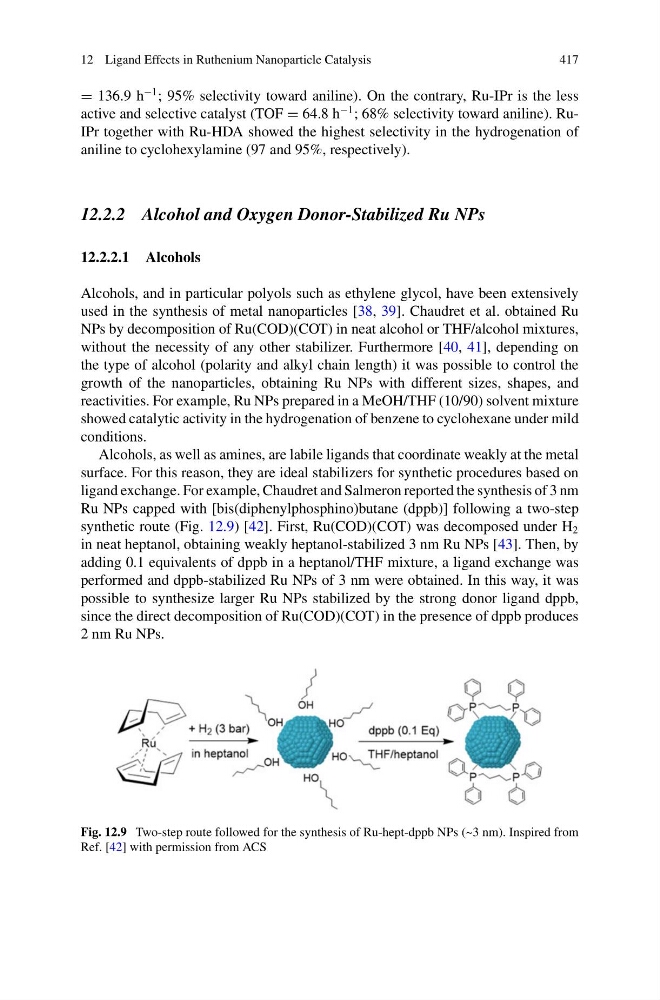
ligand exchange. For example, Chaudret and Salmeron reported the synthesis of 3 nm
Ru NPs capped with [bis(diphenylphosphino)butane (dppb)] following a two-step
synthetic route (Fig. 12.9) [42]. First, Ru(COD)(COT) was decomposed under H 2
in neat heptanol, obtaining weakly heptanol-stabilized 3 nm Ru NPs [43]. Then, by
adding 0.1 equivalents of dppb in a heptanol/THF mixture, a ligand exchange was
performed and dppb-stabilized Ru NPs of 3 nm were obtained. In this way, it was
possible to synthesize larger Ru NPs stabilized by the strong donor ligand dppb,
since the direct decomposition of Ru(COD)(COT) in the presence of dppb produces
2 nm Ru NPs.
Fig. 12.9 Two-step route followed for the synthesis of Ru-hept-dppb NPs (~3 nm). Inspired from
Ref. [42] with permission from ACS
417
= 136.9 h
−1 ; 95% selectivity toward aniline). On the contrary, Ru-IPr is the less
active and selective catalyst (TOF = 64.8 h
−1 ; 68% selectivity toward aniline). RuIPr together with Ru-HDA showed the highest selectivity in the hydrogenation of
aniline to cyclohexylamine (97 and 95%, respectively).
12.2.2 Alcohol and Oxygen Donor-Stabilized Ru NPs
12.2.2.1 Alcohols
Alcohols, and in particular polyols such as ethylene glycol, have been extensively
used in the synthesis of metal nanoparticles [38, 39]. Chaudret et al. obtained Ru
NPs by decomposition of Ru(COD)(COT) in neat alcohol or THF/alcohol mixtures,
without the necessity of any other stabilizer. Furthermore [40, 41], depending on
the type of alcohol (polarity and alkyl chain length) it was possible to control the
growth of the nanoparticles, obtaining Ru NPs with different sizes, shapes, and
reactivities. For example, Ru NPs prepared in a MeOH/THF (10/90) solvent mixture
showed catalytic activity in the hydrogenation of benzene to cyclohexane under mild
conditions.
Alcohols, as well as amines, are labile ligands that coordinate weakly at the metal
surface. For this reason, they are ideal stabilizers for synthetic procedures based on
ligand exchange. For example, Chaudret and Salmeron reported the synthesis of 3 nm
Ru NPs capped with [bis(diphenylphosphino)butane (dppb)] following a two-step
synthetic route (Fig. 12.9) [42]. First, Ru(COD)(COT) was decomposed under H 2
in neat heptanol, obtaining weakly heptanol-stabilized 3 nm Ru NPs [43]. Then, by
adding 0.1 equivalents of dppb in a heptanol/THF mixture, a ligand exchange was
performed and dppb-stabilized Ru NPs of 3 nm were obtained. In this way, it was
possible to synthesize larger Ru NPs stabilized by the strong donor ligand dppb,
since the direct decomposition of Ru(COD)(COT) in the presence of dppb produces
2 nm Ru NPs.
Fig. 12.9 Two-step route followed for the synthesis of Ru-hept-dppb NPs (~3 nm). Inspired from
Ref. [42] with permission from ACS