

392
I. Cano and P. W. N. M. van Leeuwen
MeO
O
O
OMe
OMe
MeO
O
O
OMe
OMe
(a)
(b)
Rh(TOA)/ -Al 2 O 3
Rh(TOA)/ -Al 2 O 3
25ºC, 1 bar H 2
25ºC, 1 bar H 2
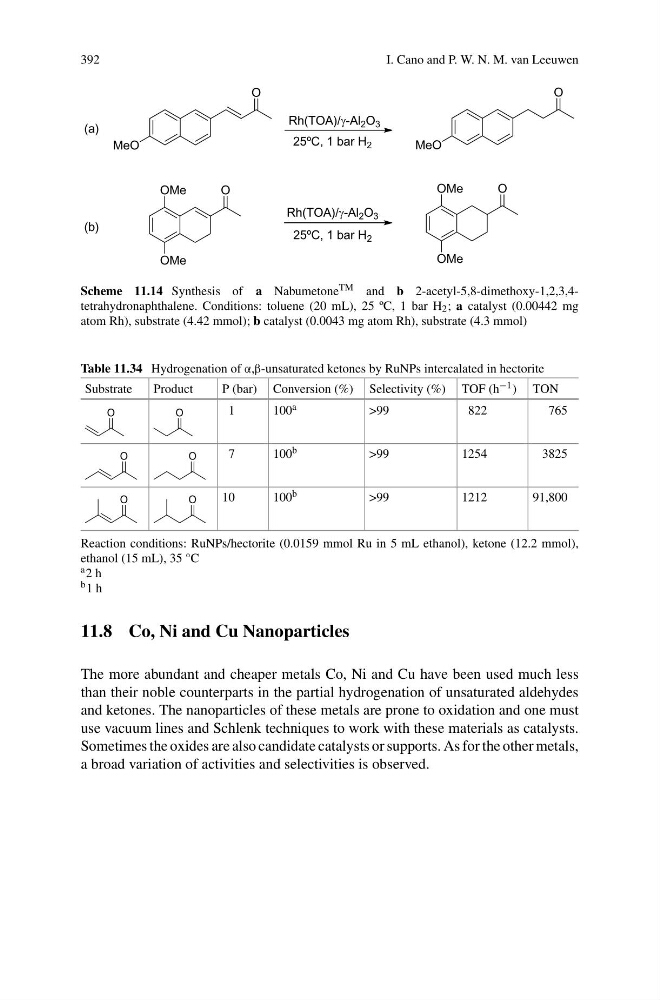
Scheme 11.14 Synthesis of a Nabumetone TM and b 2-acetyl-5,8-dimethoxy-1,2,3,4tetrahydronaphthalene. Conditions: toluene (20 mL), 25 ºC, 1 bar H 2 ; a catalyst (0.00442 mg
atom Rh), substrate (4.42 mmol); b catalyst (0.0043 mg atom Rh), substrate (4.3 mmol)
Table 11.34 Hydrogenation of α,β-unsaturated ketones by RuNPs intercalated in hectorite
Substrate
Product
P (bar) Conversion (%) Selectivity (%) TOF (h −1 ) TON
1
100 a
>99
822
765
7
100 b
>99
1254
3825
10
100 b
>99
1212
91,800
Reaction conditions: RuNPs/hectorite (0.0159 mmol Ru in 5 mL ethanol), ketone (12.2 mmol),
ethanol (15 mL), 35 °C
a 2 h
b 1 h
11.8 Co, Ni and Cu Nanoparticles
The more abundant and cheaper metals Co, Ni and Cu have been used much less
than their noble counterparts in the partial hydrogenation of unsaturated aldehydes
and ketones. The nanoparticles of these metals are prone to oxidation and one must
use vacuum lines and Schlenk techniques to work with these materials as catalysts.
Sometimes the oxides are also candidate catalysts or supports. As for the other metals,
a broad variation of activities and selectivities is observed.
I. Cano and P. W. N. M. van Leeuwen
MeO
O
O
OMe
OMe
MeO
O
O
OMe
OMe
(a)
(b)
Rh(TOA)/ -Al 2 O 3
Rh(TOA)/ -Al 2 O 3
25ºC, 1 bar H 2
25ºC, 1 bar H 2
Scheme 11.14 Synthesis of a Nabumetone TM and b 2-acetyl-5,8-dimethoxy-1,2,3,4tetrahydronaphthalene. Conditions: toluene (20 mL), 25 ºC, 1 bar H 2 ; a catalyst (0.00442 mg
atom Rh), substrate (4.42 mmol); b catalyst (0.0043 mg atom Rh), substrate (4.3 mmol)
Table 11.34 Hydrogenation of α,β-unsaturated ketones by RuNPs intercalated in hectorite
Substrate
Product
P (bar) Conversion (%) Selectivity (%) TOF (h −1 ) TON
1
100 a
>99
822
765
7
100 b
>99
1254
3825
10
100 b
>99
1212
91,800
Reaction conditions: RuNPs/hectorite (0.0159 mmol Ru in 5 mL ethanol), ketone (12.2 mmol),
ethanol (15 mL), 35 °C
a 2 h
b 1 h
11.8 Co, Ni and Cu Nanoparticles
The more abundant and cheaper metals Co, Ni and Cu have been used much less
than their noble counterparts in the partial hydrogenation of unsaturated aldehydes
and ketones. The nanoparticles of these metals are prone to oxidation and one must
use vacuum lines and Schlenk techniques to work with these materials as catalysts.
Sometimes the oxides are also candidate catalysts or supports. As for the other metals,
a broad variation of activities and selectivities is observed.