

11 Selective Hydrogenation of Aldehydes and Ketones
393
11.8.1 Cobalt NPs
In 2005 Qiao, Fan et al. reported on the use of amorphous Co/Fe/B species (approximately equal molar ratios) as catalysts for the hydrogenation of crotonaldehyde [118].
The catalyst was made by reduction of the corresponding chlorides with NaBH 4 ,
giving NPs of 9 nm size. Having established that Co/B was not very selective for
the reaction (20% crotyl alcohol at 89% conversion), the new catalyst was examined (ethanol, 100 °C, 10 bar H 2 ). The catalyst contains both zerovalent and cationic
Fe and Co. At 95% conversion, the selectivity for crotyl alcohol amounted to 67%,
slightly lower than the initial selectivity as slowly also the fully hydrogenated alcohol
(butanol) was formed.
An amorphous alloy Co–B (50 nm size) was obtained by reduction of Co salts with
NaBH 4 under sonication [119]. Sonication gave a much more active catalyst than the
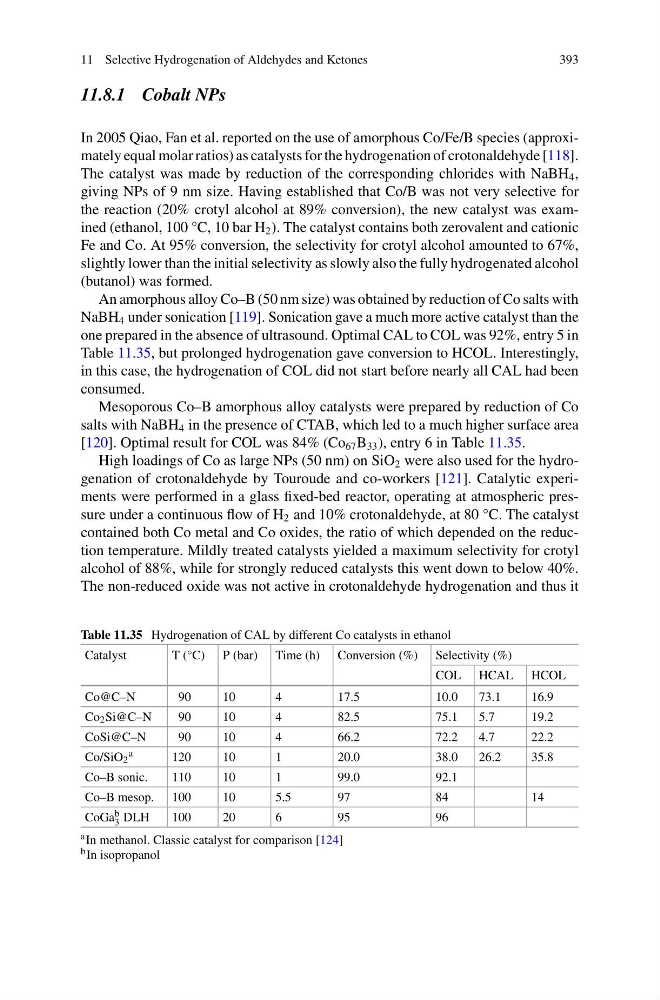
one prepared in the absence of ultrasound. Optimal CAL to COL was 92%, entry 5 in
Table 11.35, but prolonged hydrogenation gave conversion to HCOL. Interestingly,
in this case, the hydrogenation of COL did not start before nearly all CAL had been
consumed.
Mesoporous Co–B amorphous alloy catalysts were prepared by reduction of Co
salts with NaBH 4 in the presence of CTAB, which led to a much higher surface area
[120]. Optimal result for COL was 84% (Co 67 B 33 ), entry 6 in Table 11.35.
High loadings of Co as large NPs (50 nm) on SiO 2 were also used for the hydrogenation of crotonaldehyde by Touroude and co-workers [121]. Catalytic experiments were performed in a glass fixed-bed reactor, operating at atmospheric pressure under a continuous flow of H 2 and 10% crotonaldehyde, at 80 °C. The catalyst
contained both Co metal and Co oxides, the ratio of which depended on the reduction temperature. Mildly treated catalysts yielded a maximum selectivity for crotyl
alcohol of 88%, while for strongly reduced catalysts this went down to below 40%.
The non-reduced oxide was not active in crotonaldehyde hydrogenation and thus it
Table 11.35 Hydrogenation of CAL by different Co catalysts in ethanol
Catalyst
T (°C) P (bar) Time (h) Conversion (%) Selectivity (%)
COL HCAL HCOL
Co@C–N
90
10
4
17.5
10.0
73.1
16.9
Co 2 Si@C–N
90
10
4
82.5
75.1
5.7
19.2
CoSi@C–N
90
10
4
66.2
72.2
4.7
22.2
Co/SiO 2
a
120
10
1
20.0
38.0
26.2
35.8
Co–B sonic.
110
10
1
99.0
92.1
Co–B mesop. 100
10
5.5
97
84
14
CoGa b
3 DLH
100
20
6
95
96
a In methanol. Classic catalyst for comparison [124]
b In isopropanol
393
11.8.1 Cobalt NPs
In 2005 Qiao, Fan et al. reported on the use of amorphous Co/Fe/B species (approximately equal molar ratios) as catalysts for the hydrogenation of crotonaldehyde [118].
The catalyst was made by reduction of the corresponding chlorides with NaBH 4 ,
giving NPs of 9 nm size. Having established that Co/B was not very selective for
the reaction (20% crotyl alcohol at 89% conversion), the new catalyst was examined (ethanol, 100 °C, 10 bar H 2 ). The catalyst contains both zerovalent and cationic
Fe and Co. At 95% conversion, the selectivity for crotyl alcohol amounted to 67%,
slightly lower than the initial selectivity as slowly also the fully hydrogenated alcohol
(butanol) was formed.
An amorphous alloy Co–B (50 nm size) was obtained by reduction of Co salts with
NaBH 4 under sonication [119]. Sonication gave a much more active catalyst than the
one prepared in the absence of ultrasound. Optimal CAL to COL was 92%, entry 5 in
Table 11.35, but prolonged hydrogenation gave conversion to HCOL. Interestingly,
in this case, the hydrogenation of COL did not start before nearly all CAL had been
consumed.
Mesoporous Co–B amorphous alloy catalysts were prepared by reduction of Co
salts with NaBH 4 in the presence of CTAB, which led to a much higher surface area
[120]. Optimal result for COL was 84% (Co 67 B 33 ), entry 6 in Table 11.35.
High loadings of Co as large NPs (50 nm) on SiO 2 were also used for the hydrogenation of crotonaldehyde by Touroude and co-workers [121]. Catalytic experiments were performed in a glass fixed-bed reactor, operating at atmospheric pressure under a continuous flow of H 2 and 10% crotonaldehyde, at 80 °C. The catalyst
contained both Co metal and Co oxides, the ratio of which depended on the reduction temperature. Mildly treated catalysts yielded a maximum selectivity for crotyl
alcohol of 88%, while for strongly reduced catalysts this went down to below 40%.
The non-reduced oxide was not active in crotonaldehyde hydrogenation and thus it
Table 11.35 Hydrogenation of CAL by different Co catalysts in ethanol
Catalyst
T (°C) P (bar) Time (h) Conversion (%) Selectivity (%)
COL HCAL HCOL
Co@C–N
90
10
4
17.5
10.0
73.1
16.9
Co 2 Si@C–N
90
10
4
82.5
75.1
5.7
19.2
CoSi@C–N
90
10
4
66.2
72.2
4.7
22.2
Co/SiO 2
a
120
10
1
20.0
38.0
26.2
35.8
Co–B sonic.
110
10
1
99.0
92.1
Co–B mesop. 100
10
5.5
97
84
14
CoGa b
3 DLH
100
20
6
95
96
a In methanol. Classic catalyst for comparison [124]
b In isopropanol