

390
I. Cano and P. W. N. M. van Leeuwen
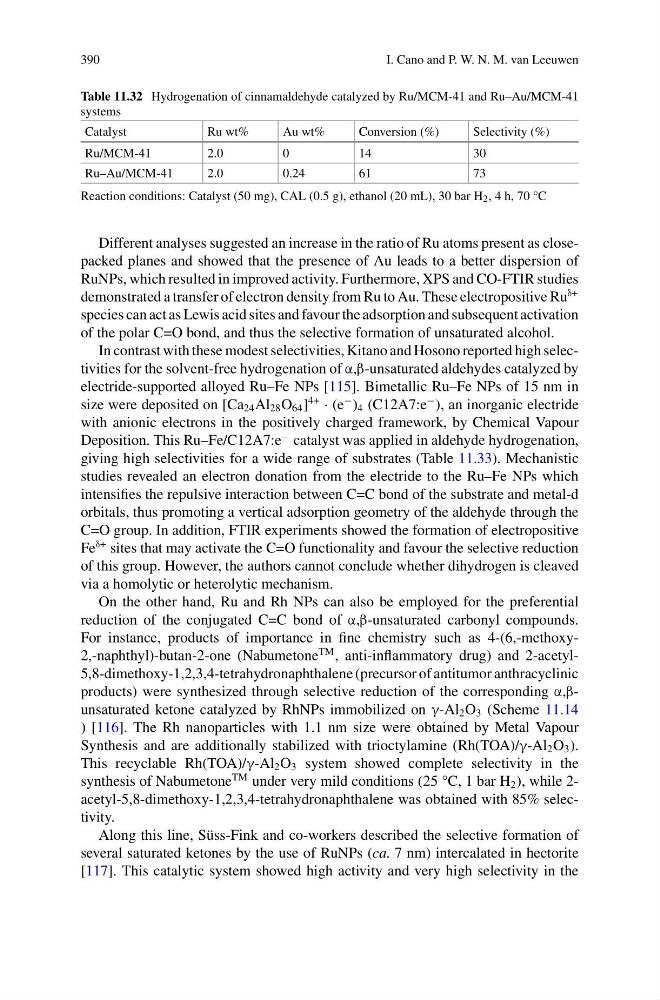
Table 11.32 Hydrogenation of cinnamaldehyde catalyzed by Ru/MCM-41 and Ru–Au/MCM-41
systems
Catalyst
Ru wt%
Au wt%
Conversion (%)
Selectivity (%)
Ru/MCM-41
2.0
0
14
30
Ru–Au/MCM-41
2.0
0.24
61
73
Reaction conditions: Catalyst (50 mg), CAL (0.5 g), ethanol (20 mL), 30 bar H 2 , 4 h, 70 °C
Different analyses suggested an increase in the ratio of Ru atoms present as closepacked planes and showed that the presence of Au leads to a better dispersion of
RuNPs, which resulted in improved activity. Furthermore, XPS and CO-FTIR studies
demonstrated a transfer of electron density from Ru to Au. These electropositive Ru
δ+
species can act as Lewis acid sites and favour the adsorption and subsequent activation
of the polar C=O bond, and thus the selective formation of unsaturated alcohol.
In contrast with these modest selectivities, Kitano and Hosono reported high selectivities for the solvent-free hydrogenation of α,β-unsaturated aldehydes catalyzed by
electride-supported alloyed Ru–Fe NPs [115]. Bimetallic Ru–Fe NPs of 15 nm in
size were deposited on [Ca 24 Al 28 O 64 ]
4+ · (e
− ) 4 (C12A7:e
− ), an inorganic electride
with anionic electrons in the positively charged framework, by Chemical Vapour
Deposition. This Ru–Fe/C12A7:e
− catalyst was applied in aldehyde hydrogenation,
giving high selectivities for a wide range of substrates (Table 11.33). Mechanistic
studies revealed an electron donation from the electride to the Ru–Fe NPs which
intensifies the repulsive interaction between C=C bond of the substrate and metal-d
orbitals, thus promoting a vertical adsorption geometry of the aldehyde through the
C=O group. In addition, FTIR experiments showed the formation of electropositive
Fe
δ+ sites that may activate the C=O functionality and favour the selective reduction
of this group. However, the authors cannot conclude whether dihydrogen is cleaved
via a homolytic or heterolytic mechanism.
On the other hand, Ru and Rh NPs can also be employed for the preferential
reduction of the conjugated C=C bond of α,β-unsaturated carbonyl compounds.
For instance, products of importance in fine chemistry such as 4-(6,-methoxy2,-naphthyl)-butan-2-one (Nabumetone
TM , anti-inflammatory drug) and 2-acetyl5,8-dimethoxy-1,2,3,4-tetrahydronaphthalene (precursor of antitumor anthracyclinic
products) were synthesized through selective reduction of the corresponding α,βunsaturated ketone catalyzed by RhNPs immobilized on γ-Al 2 O 3 (Scheme 11.14
) [116]. The Rh nanoparticles with 1.1 nm size were obtained by Metal Vapour
Synthesis and are additionally stabilized with trioctylamine (Rh(TOA)/γ-Al 2 O 3 ).
This recyclable Rh(TOA)/γ-Al 2 O 3 system showed complete selectivity in the
synthesis of Nabumetone
TM under very mild conditions (25 °C, 1 bar H 2 ), while 2acetyl-5,8-dimethoxy-1,2,3,4-tetrahydronaphthalene was obtained with 85% selectivity.
Along this line, Süss-Fink and co-workers described the selective formation of
several saturated ketones by the use of RuNPs (ca. 7 nm) intercalated in hectorite
[117]. This catalytic system showed high activity and very high selectivity in the
I. Cano and P. W. N. M. van Leeuwen
Table 11.32 Hydrogenation of cinnamaldehyde catalyzed by Ru/MCM-41 and Ru–Au/MCM-41
systems
Catalyst
Ru wt%
Au wt%
Conversion (%)
Selectivity (%)
Ru/MCM-41
2.0
0
14
30
Ru–Au/MCM-41
2.0
0.24
61
73
Reaction conditions: Catalyst (50 mg), CAL (0.5 g), ethanol (20 mL), 30 bar H 2 , 4 h, 70 °C
Different analyses suggested an increase in the ratio of Ru atoms present as closepacked planes and showed that the presence of Au leads to a better dispersion of
RuNPs, which resulted in improved activity. Furthermore, XPS and CO-FTIR studies
demonstrated a transfer of electron density from Ru to Au. These electropositive Ru
δ+
species can act as Lewis acid sites and favour the adsorption and subsequent activation
of the polar C=O bond, and thus the selective formation of unsaturated alcohol.
In contrast with these modest selectivities, Kitano and Hosono reported high selectivities for the solvent-free hydrogenation of α,β-unsaturated aldehydes catalyzed by
electride-supported alloyed Ru–Fe NPs [115]. Bimetallic Ru–Fe NPs of 15 nm in
size were deposited on [Ca 24 Al 28 O 64 ]
4+ · (e
− ) 4 (C12A7:e
− ), an inorganic electride
with anionic electrons in the positively charged framework, by Chemical Vapour
Deposition. This Ru–Fe/C12A7:e
− catalyst was applied in aldehyde hydrogenation,
giving high selectivities for a wide range of substrates (Table 11.33). Mechanistic
studies revealed an electron donation from the electride to the Ru–Fe NPs which
intensifies the repulsive interaction between C=C bond of the substrate and metal-d
orbitals, thus promoting a vertical adsorption geometry of the aldehyde through the
C=O group. In addition, FTIR experiments showed the formation of electropositive
Fe
δ+ sites that may activate the C=O functionality and favour the selective reduction
of this group. However, the authors cannot conclude whether dihydrogen is cleaved
via a homolytic or heterolytic mechanism.
On the other hand, Ru and Rh NPs can also be employed for the preferential
reduction of the conjugated C=C bond of α,β-unsaturated carbonyl compounds.
For instance, products of importance in fine chemistry such as 4-(6,-methoxy2,-naphthyl)-butan-2-one (Nabumetone
TM , anti-inflammatory drug) and 2-acetyl5,8-dimethoxy-1,2,3,4-tetrahydronaphthalene (precursor of antitumor anthracyclinic
products) were synthesized through selective reduction of the corresponding α,βunsaturated ketone catalyzed by RhNPs immobilized on γ-Al 2 O 3 (Scheme 11.14
) [116]. The Rh nanoparticles with 1.1 nm size were obtained by Metal Vapour
Synthesis and are additionally stabilized with trioctylamine (Rh(TOA)/γ-Al 2 O 3 ).
This recyclable Rh(TOA)/γ-Al 2 O 3 system showed complete selectivity in the
synthesis of Nabumetone
TM under very mild conditions (25 °C, 1 bar H 2 ), while 2acetyl-5,8-dimethoxy-1,2,3,4-tetrahydronaphthalene was obtained with 85% selectivity.
Along this line, Süss-Fink and co-workers described the selective formation of
several saturated ketones by the use of RuNPs (ca. 7 nm) intercalated in hectorite
[117]. This catalytic system showed high activity and very high selectivity in the