

11 Selective Hydrogenation of Aldehydes and Ketones
389
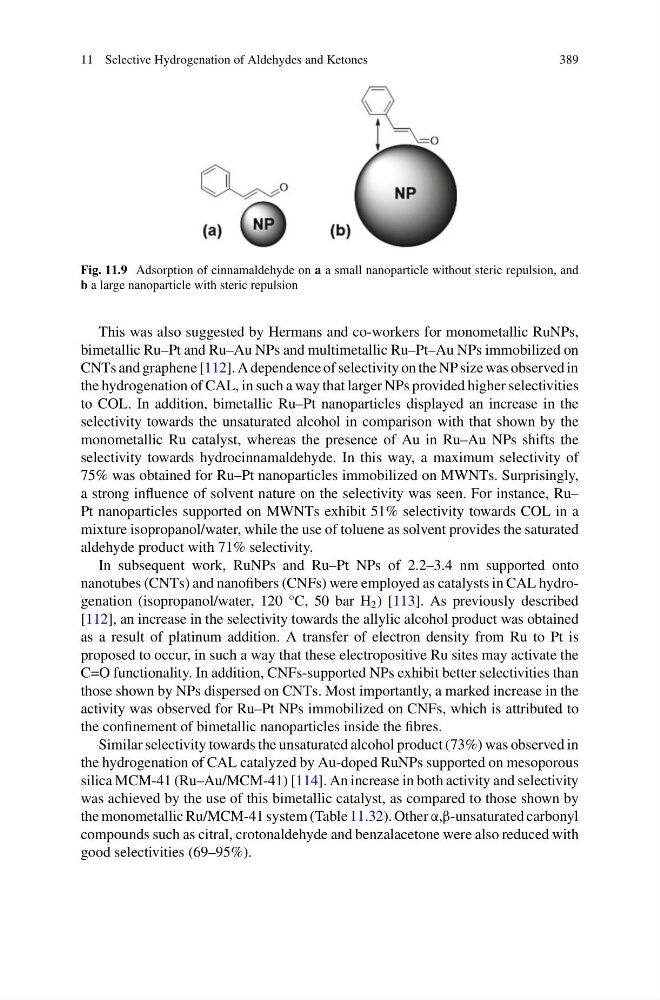
Fig. 11.9 Adsorption of cinnamaldehyde on a a small nanoparticle without steric repulsion, and
b a large nanoparticle with steric repulsion
This was also suggested by Hermans and co-workers for monometallic RuNPs,
bimetallic Ru–Pt and Ru–Au NPs and multimetallic Ru–Pt–Au NPs immobilized on
CNTs and graphene [112]. A dependence of selectivity on the NP size was observed in
the hydrogenation of CAL, in such a way that larger NPs provided higher selectivities
to COL. In addition, bimetallic Ru–Pt nanoparticles displayed an increase in the
selectivity towards the unsaturated alcohol in comparison with that shown by the
monometallic Ru catalyst, whereas the presence of Au in Ru–Au NPs shifts the
selectivity towards hydrocinnamaldehyde. In this way, a maximum selectivity of
75% was obtained for Ru–Pt nanoparticles immobilized on MWNTs. Surprisingly,
a strong influence of solvent nature on the selectivity was seen. For instance, Ru–
Pt nanoparticles supported on MWNTs exhibit 51% selectivity towards COL in a
mixture isopropanol/water, while the use of toluene as solvent provides the saturated
aldehyde product with 71% selectivity.
In subsequent work, RuNPs and Ru–Pt NPs of 2.2–3.4 nm supported onto
nanotubes (CNTs) and nanofibers (CNFs) were employed as catalysts in CAL hydrogenation (isopropanol/water, 120 °C, 50 bar H 2 ) [113]. As previously described
[112], an increase in the selectivity towards the allylic alcohol product was obtained
as a result of platinum addition. A transfer of electron density from Ru to Pt is
proposed to occur, in such a way that these electropositive Ru sites may activate the
C=O functionality. In addition, CNFs-supported NPs exhibit better selectivities than
those shown by NPs dispersed on CNTs. Most importantly, a marked increase in the
activity was observed for Ru–Pt NPs immobilized on CNFs, which is attributed to
the confinement of bimetallic nanoparticles inside the fibres.
Similar selectivity towards the unsaturated alcohol product (73%) was observed in
the hydrogenation of CAL catalyzed by Au-doped RuNPs supported on mesoporous
silica MCM-41 (Ru–Au/MCM-41) [114]. An increase in both activity and selectivity
was achieved by the use of this bimetallic catalyst, as compared to those shown by
the monometallic Ru/MCM-41 system (Table 11.32). Other α,β-unsaturated carbonyl
compounds such as citral, crotonaldehyde and benzalacetone were also reduced with
good selectivities (69–95%).
389
Fig. 11.9 Adsorption of cinnamaldehyde on a a small nanoparticle without steric repulsion, and
b a large nanoparticle with steric repulsion
This was also suggested by Hermans and co-workers for monometallic RuNPs,
bimetallic Ru–Pt and Ru–Au NPs and multimetallic Ru–Pt–Au NPs immobilized on
CNTs and graphene [112]. A dependence of selectivity on the NP size was observed in
the hydrogenation of CAL, in such a way that larger NPs provided higher selectivities
to COL. In addition, bimetallic Ru–Pt nanoparticles displayed an increase in the
selectivity towards the unsaturated alcohol in comparison with that shown by the
monometallic Ru catalyst, whereas the presence of Au in Ru–Au NPs shifts the
selectivity towards hydrocinnamaldehyde. In this way, a maximum selectivity of
75% was obtained for Ru–Pt nanoparticles immobilized on MWNTs. Surprisingly,
a strong influence of solvent nature on the selectivity was seen. For instance, Ru–
Pt nanoparticles supported on MWNTs exhibit 51% selectivity towards COL in a
mixture isopropanol/water, while the use of toluene as solvent provides the saturated
aldehyde product with 71% selectivity.
In subsequent work, RuNPs and Ru–Pt NPs of 2.2–3.4 nm supported onto
nanotubes (CNTs) and nanofibers (CNFs) were employed as catalysts in CAL hydrogenation (isopropanol/water, 120 °C, 50 bar H 2 ) [113]. As previously described
[112], an increase in the selectivity towards the allylic alcohol product was obtained
as a result of platinum addition. A transfer of electron density from Ru to Pt is
proposed to occur, in such a way that these electropositive Ru sites may activate the
C=O functionality. In addition, CNFs-supported NPs exhibit better selectivities than
those shown by NPs dispersed on CNTs. Most importantly, a marked increase in the
activity was observed for Ru–Pt NPs immobilized on CNFs, which is attributed to
the confinement of bimetallic nanoparticles inside the fibres.
Similar selectivity towards the unsaturated alcohol product (73%) was observed in
the hydrogenation of CAL catalyzed by Au-doped RuNPs supported on mesoporous
silica MCM-41 (Ru–Au/MCM-41) [114]. An increase in both activity and selectivity
was achieved by the use of this bimetallic catalyst, as compared to those shown by
the monometallic Ru/MCM-41 system (Table 11.32). Other α,β-unsaturated carbonyl
compounds such as citral, crotonaldehyde and benzalacetone were also reduced with
good selectivities (69–95%).