

388
I. Cano and P. W. N. M. van Leeuwen
Table 11.30 Vapour-phase hydrogenation of crotonaldehyde catalyzed by Ir/BN catalysts
Catalyst
Ir:Fe content (%)
TOF (h −1 )
Crotyl alcohol selectivity (%)
1Ir/BN
1:0
5.4
59.5
3Ir/BN
3:0
4.0
55.5
3Ir/0.01Fe/BN
3:0.01
9.0
61.9
3Ir/0.03Fe/BN
3:0.03
11.9
82.7
3Ir/0.05Fe/BN
3:0.05
24.1
84.4
3Ir/0.1Fe/BN
3:0.1
16.2
89.9
3Ir/0.30Fe/BN
3:0.3
7.9
91.2
Conditions: Catalyst (200 mg), H 2 flow (26 mL/min), crotonaldehyde (1%, 0.0106 bar), 80 °C.
Data recorded at 3 h of reaction. The Ir:Fe content refers to the wt% in the catalyst
11.7 Hydrogenation of Unsaturated Aldehydes and Ketones
Catalyzed by Rhodium and Ruthenium Nanoparticles
Because rhodium and ruthenium are very active metals as hydrogenation catalysts, the
chemoselective reduction of unsaturated carbonyl compounds mediated by rhodium
or ruthenium nanoparticles (RhNPs/RuNPs) is difficult to achieve and only a few
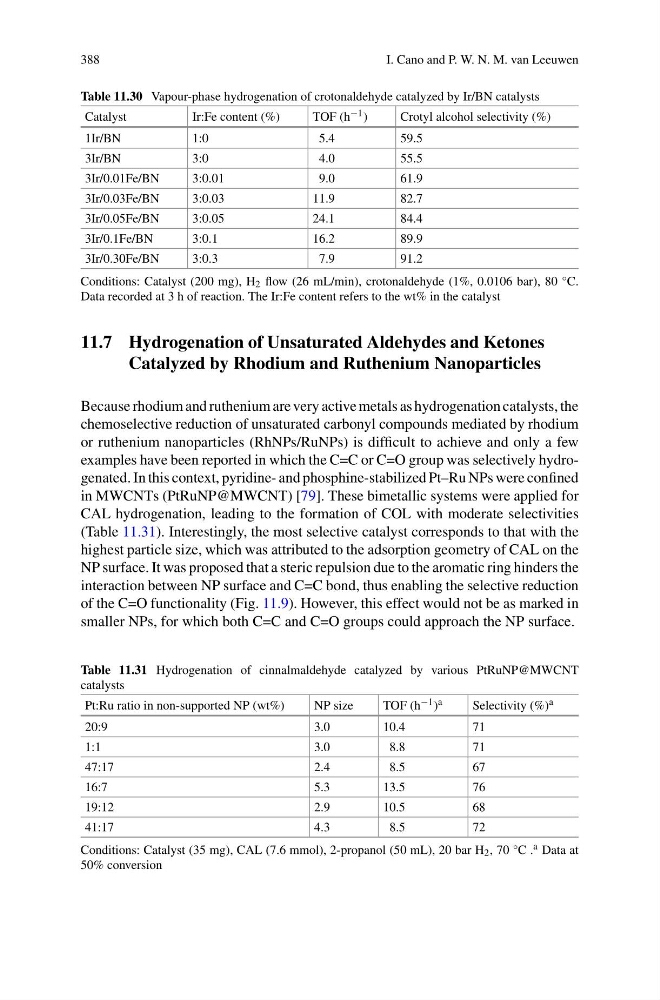
examples have been reported in which the C=C or C=O group was selectively hydrogenated. In this context, pyridine- and phosphine-stabilized Pt–Ru NPs were confined
in MWCNTs (PtRuNP@MWCNT) [79]. These bimetallic systems were applied for
CAL hydrogenation, leading to the formation of COL with moderate selectivities
(Table 11.31). Interestingly, the most selective catalyst corresponds to that with the
highest particle size, which was attributed to the adsorption geometry of CAL on the
NP surface. It was proposed that a steric repulsion due to the aromatic ring hinders the
interaction between NP surface and C=C bond, thus enabling the selective reduction
of the C=O functionality (Fig. 11.9). However, this effect would not be as marked in
smaller NPs, for which both C=C and C=O groups could approach the NP surface.
Table 11.31 Hydrogenation of cinnalmaldehyde catalyzed by various PtRuNP@MWCNT
catalysts
Pt:Ru ratio in non-supported NP (wt%)
NP size
TOF (h −1 ) a
Selectivity (%) a
20:9
3.0
10.4
71
1:1
3.0
8.8
71
47:17
2.4
8.5
67
16:7
5.3
13.5
76
19:12
2.9
10.5
68
41:17
4.3
8.5
72
Conditions: Catalyst (35 mg), CAL (7.6 mmol), 2-propanol (50 mL), 20 bar H 2 , 70 °C . a Data at
50% conversion
I. Cano and P. W. N. M. van Leeuwen
Table 11.30 Vapour-phase hydrogenation of crotonaldehyde catalyzed by Ir/BN catalysts
Catalyst
Ir:Fe content (%)
TOF (h −1 )
Crotyl alcohol selectivity (%)
1Ir/BN
1:0
5.4
59.5
3Ir/BN
3:0
4.0
55.5
3Ir/0.01Fe/BN
3:0.01
9.0
61.9
3Ir/0.03Fe/BN
3:0.03
11.9
82.7
3Ir/0.05Fe/BN
3:0.05
24.1
84.4
3Ir/0.1Fe/BN
3:0.1
16.2
89.9
3Ir/0.30Fe/BN
3:0.3
7.9
91.2
Conditions: Catalyst (200 mg), H 2 flow (26 mL/min), crotonaldehyde (1%, 0.0106 bar), 80 °C.
Data recorded at 3 h of reaction. The Ir:Fe content refers to the wt% in the catalyst
11.7 Hydrogenation of Unsaturated Aldehydes and Ketones
Catalyzed by Rhodium and Ruthenium Nanoparticles
Because rhodium and ruthenium are very active metals as hydrogenation catalysts, the
chemoselective reduction of unsaturated carbonyl compounds mediated by rhodium
or ruthenium nanoparticles (RhNPs/RuNPs) is difficult to achieve and only a few
examples have been reported in which the C=C or C=O group was selectively hydrogenated. In this context, pyridine- and phosphine-stabilized Pt–Ru NPs were confined
in MWCNTs (PtRuNP@MWCNT) [79]. These bimetallic systems were applied for
CAL hydrogenation, leading to the formation of COL with moderate selectivities
(Table 11.31). Interestingly, the most selective catalyst corresponds to that with the
highest particle size, which was attributed to the adsorption geometry of CAL on the
NP surface. It was proposed that a steric repulsion due to the aromatic ring hinders the
interaction between NP surface and C=C bond, thus enabling the selective reduction
of the C=O functionality (Fig. 11.9). However, this effect would not be as marked in
smaller NPs, for which both C=C and C=O groups could approach the NP surface.
Table 11.31 Hydrogenation of cinnalmaldehyde catalyzed by various PtRuNP@MWCNT
catalysts
Pt:Ru ratio in non-supported NP (wt%)
NP size
TOF (h −1 ) a
Selectivity (%) a
20:9
3.0
10.4
71
1:1
3.0
8.8
71
47:17
2.4
8.5
67
16:7
5.3
13.5
76
19:12
2.9
10.5
68
41:17
4.3
8.5
72
Conditions: Catalyst (35 mg), CAL (7.6 mmol), 2-propanol (50 mL), 20 bar H 2 , 70 °C . a Data at
50% conversion