

11 Selective Hydrogenation of Aldehydes and Ketones
385
H 2
Fe 2+
O 2Ir 4+
Mg
O
Ir 0
Ir 0
O
R
Fe 2+
O 2Ir 4+
Mg
O
Ir 0
Ir 0
H -
H -
Fe 2+
O 2Ir 4+
Mg
O
Ir 0
Ir 0
H -
H -
O
R
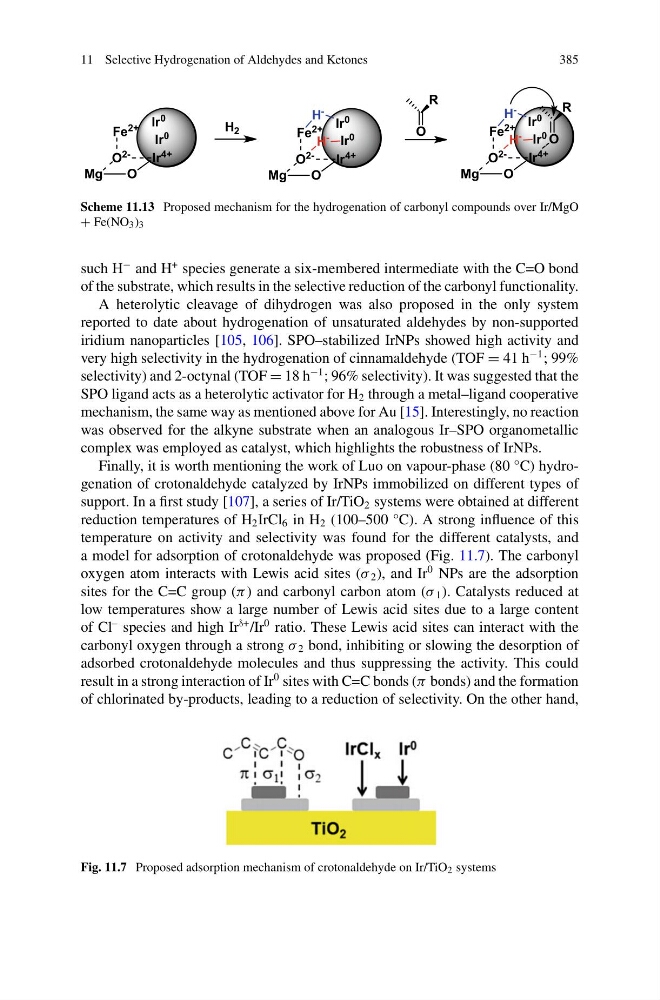
Scheme 11.13 Proposed mechanism for the hydrogenation of carbonyl compounds over Ir/MgO
+ Fe(NO 3 ) 3
such H
− and H
+ species generate a six-membered intermediate with the C=O bond
of the substrate, which results in the selective reduction of the carbonyl functionality.
A heterolytic cleavage of dihydrogen was also proposed in the only system
reported to date about hydrogenation of unsaturated aldehydes by non-supported
iridium nanoparticles [105, 106]. SPO–stabilized IrNPs showed high activity and
very high selectivity in the hydrogenation of cinnamaldehyde (TOF = 41 h
−1 ; 99%
selectivity) and 2-octynal (TOF = 18 h
−1 ; 96% selectivity). It was suggested that the
SPO ligand acts as a heterolytic activator for H 2 through a metal–ligand cooperative
mechanism, the same way as mentioned above for Au [15]. Interestingly, no reaction
was observed for the alkyne substrate when an analogous Ir–SPO organometallic
complex was employed as catalyst, which highlights the robustness of IrNPs.
Finally, it is worth mentioning the work of Luo on vapour-phase (80 °C) hydrogenation of crotonaldehyde catalyzed by IrNPs immobilized on different types of
support. In a first study [107], a series of Ir/TiO 2 systems were obtained at different
reduction temperatures of H 2 IrCl 6 in H 2 (100–500 °C). A strong influence of this
temperature on activity and selectivity was found for the different catalysts, and
a model for adsorption of crotonaldehyde was proposed (Fig. 11.7). The carbonyl
oxygen atom interacts with Lewis acid sites (σ 2 ), and Ir
0 NPs are the adsorption
sites for the C=C group (π ) and carbonyl carbon atom (σ 1 ). Catalysts reduced at
low temperatures show a large number of Lewis acid sites due to a large content
of Cl
– species and high Ir
δ+ /Ir
0 ratio. These Lewis acid sites can interact with the
carbonyl oxygen through a strong σ 2 bond, inhibiting or slowing the desorption of
adsorbed crotonaldehyde molecules and thus suppressing the activity. This could
result in a strong interaction of Ir
0 sites with C=C bonds (π bonds) and the formation
of chlorinated by-products, leading to a reduction of selectivity. On the other hand,
Fig. 11.7 Proposed adsorption mechanism of crotonaldehyde on Ir/TiO 2 systems
385
H 2
Fe 2+
O 2Ir 4+
Mg
O
Ir 0
Ir 0
O
R
Fe 2+
O 2Ir 4+
Mg
O
Ir 0
Ir 0
H -
H -
Fe 2+
O 2Ir 4+
Mg
O
Ir 0
Ir 0
H -
H -
O
R
Scheme 11.13 Proposed mechanism for the hydrogenation of carbonyl compounds over Ir/MgO
+ Fe(NO 3 ) 3
such H
− and H
+ species generate a six-membered intermediate with the C=O bond
of the substrate, which results in the selective reduction of the carbonyl functionality.
A heterolytic cleavage of dihydrogen was also proposed in the only system
reported to date about hydrogenation of unsaturated aldehydes by non-supported
iridium nanoparticles [105, 106]. SPO–stabilized IrNPs showed high activity and
very high selectivity in the hydrogenation of cinnamaldehyde (TOF = 41 h
−1 ; 99%
selectivity) and 2-octynal (TOF = 18 h
−1 ; 96% selectivity). It was suggested that the
SPO ligand acts as a heterolytic activator for H 2 through a metal–ligand cooperative
mechanism, the same way as mentioned above for Au [15]. Interestingly, no reaction
was observed for the alkyne substrate when an analogous Ir–SPO organometallic
complex was employed as catalyst, which highlights the robustness of IrNPs.
Finally, it is worth mentioning the work of Luo on vapour-phase (80 °C) hydrogenation of crotonaldehyde catalyzed by IrNPs immobilized on different types of
support. In a first study [107], a series of Ir/TiO 2 systems were obtained at different
reduction temperatures of H 2 IrCl 6 in H 2 (100–500 °C). A strong influence of this
temperature on activity and selectivity was found for the different catalysts, and
a model for adsorption of crotonaldehyde was proposed (Fig. 11.7). The carbonyl
oxygen atom interacts with Lewis acid sites (σ 2 ), and Ir
0 NPs are the adsorption
sites for the C=C group (π ) and carbonyl carbon atom (σ 1 ). Catalysts reduced at
low temperatures show a large number of Lewis acid sites due to a large content
of Cl
– species and high Ir
δ+ /Ir
0 ratio. These Lewis acid sites can interact with the
carbonyl oxygen through a strong σ 2 bond, inhibiting or slowing the desorption of
adsorbed crotonaldehyde molecules and thus suppressing the activity. This could
result in a strong interaction of Ir
0 sites with C=C bonds (π bonds) and the formation
of chlorinated by-products, leading to a reduction of selectivity. On the other hand,
Fig. 11.7 Proposed adsorption mechanism of crotonaldehyde on Ir/TiO 2 systems