

384
I. Cano and P. W. N. M. van Leeuwen
polarized double bonds such as carbonyl groups. In this context, Tomishige and coworkers employed oxidized Re clusters (ReO χ ) to partially cover IrNPs supported
on SiO 2 [103]. The Ir atoms and the oxide anions of ReO χ operate in tandem to
heterolytically cleave the H 2 molecule into H
+ and H
− , thus favouring the transfer of
these species to the C=O group that coordinates to the Re cation. This Ir–ReO χ /SiO 2
system is very active (initial TOF = 2016 h
−1 in crotonaldehyde hydrogenation,
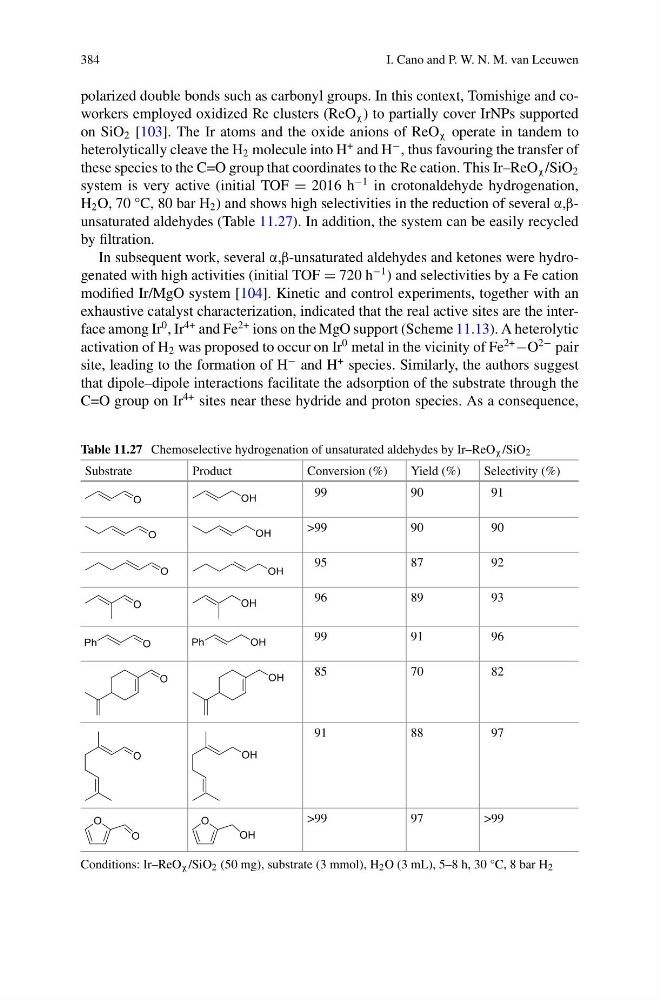
H 2 O, 70 °C, 80 bar H 2 ) and shows high selectivities in the reduction of several α,βunsaturated aldehydes (Table 11.27). In addition, the system can be easily recycled
by filtration.
In subsequent work, several α,β-unsaturated aldehydes and ketones were hydrogenated with high activities (initial TOF = 720 h
−1 ) and selectivities by a Fe cation
modified Ir/MgO system [104]. Kinetic and control experiments, together with an
exhaustive catalyst characterization, indicated that the real active sites are the interface among Ir
0 , Ir
4+ and Fe
2+ ions on the MgO support (Scheme 11.13). A heterolytic
activation of H 2 was proposed to occur on Ir
0 metal in the vicinity of Fe
2+
−O
2− pair
site, leading to the formation of H
− and H
+ species. Similarly, the authors suggest
that dipole–dipole interactions facilitate the adsorption of the substrate through the
C=O group on Ir
4+ sites near these hydride and proton species. As a consequence,
Table 11.27 Chemoselective hydrogenation of unsaturated aldehydes by Ir–ReO χ /SiO 2
Substrate
Product
Conversion (%)
Yield (%)
Selectivity (%)
99
90
91
>99
90
90
95
87
92
96
89
93
99
91
96
85
70
82
91
88
97
>99
97
>99
Conditions: Ir–ReO χ /SiO 2 (50 mg), substrate (3 mmol), H 2 O (3 mL), 5–8 h, 30 °C, 8 bar H 2
I. Cano and P. W. N. M. van Leeuwen
polarized double bonds such as carbonyl groups. In this context, Tomishige and coworkers employed oxidized Re clusters (ReO χ ) to partially cover IrNPs supported
on SiO 2 [103]. The Ir atoms and the oxide anions of ReO χ operate in tandem to
heterolytically cleave the H 2 molecule into H
+ and H
− , thus favouring the transfer of
these species to the C=O group that coordinates to the Re cation. This Ir–ReO χ /SiO 2
system is very active (initial TOF = 2016 h
−1 in crotonaldehyde hydrogenation,
H 2 O, 70 °C, 80 bar H 2 ) and shows high selectivities in the reduction of several α,βunsaturated aldehydes (Table 11.27). In addition, the system can be easily recycled
by filtration.
In subsequent work, several α,β-unsaturated aldehydes and ketones were hydrogenated with high activities (initial TOF = 720 h
−1 ) and selectivities by a Fe cation
modified Ir/MgO system [104]. Kinetic and control experiments, together with an
exhaustive catalyst characterization, indicated that the real active sites are the interface among Ir
0 , Ir
4+ and Fe
2+ ions on the MgO support (Scheme 11.13). A heterolytic
activation of H 2 was proposed to occur on Ir
0 metal in the vicinity of Fe
2+
−O
2− pair
site, leading to the formation of H
− and H
+ species. Similarly, the authors suggest
that dipole–dipole interactions facilitate the adsorption of the substrate through the
C=O group on Ir
4+ sites near these hydride and proton species. As a consequence,
Table 11.27 Chemoselective hydrogenation of unsaturated aldehydes by Ir–ReO χ /SiO 2
Substrate
Product
Conversion (%)
Yield (%)
Selectivity (%)
99
90
91
>99
90
90
95
87
92
96
89
93
99
91
96
85
70
82
91
88
97
>99
97
>99
Conditions: Ir–ReO χ /SiO 2 (50 mg), substrate (3 mmol), H 2 O (3 mL), 5–8 h, 30 °C, 8 bar H 2