

11 Selective Hydrogenation of Aldehydes and Ketones
383
11.6 Hydrogenation of Unsaturated Aldehydes
and Ketones Catalyzed by Iridium Nanoparticles
Among the transition-metal nanoparticles usually employed in hydrogenation catalysis, iridium has attracted large interest due to its high activity and low tendency
to oxidation under atmospheric conditions. However, iridium nanoparticles (IrNPs)
have shown limited efficacy in the selective hydrogenation of unsaturated carbonyl
compounds, although great efforts have been made in recent years to develop highly
chemoselective IrNPs-based systems. The majority of these systems consist of IrNPs
immobilized on oxide supports or oxygenated surfaces, for which the hydrogenation
process occasionally occurs through a metal–support interaction.
Faria and co-workers reported moderate selectivity to the COL product (68%)
in the hydrogenation of CAL catalyzed by IrNPs supported on MWCNTs [101].
Interestingly, removal of oxygenated surface groups used to anchor the IrNPs gave
an increase in the selectivity (from 56 to 68%). The authors suggest that this process
may produce a transfer of electron density from the graphite sheets to the metal
and therefore lead to a stronger metal–support interaction. This increase in the electron density on the metal could hinder the hydrogenation of the C=C group due to
repulsion effects, thus favouring the formation of the unsaturated alcohol.
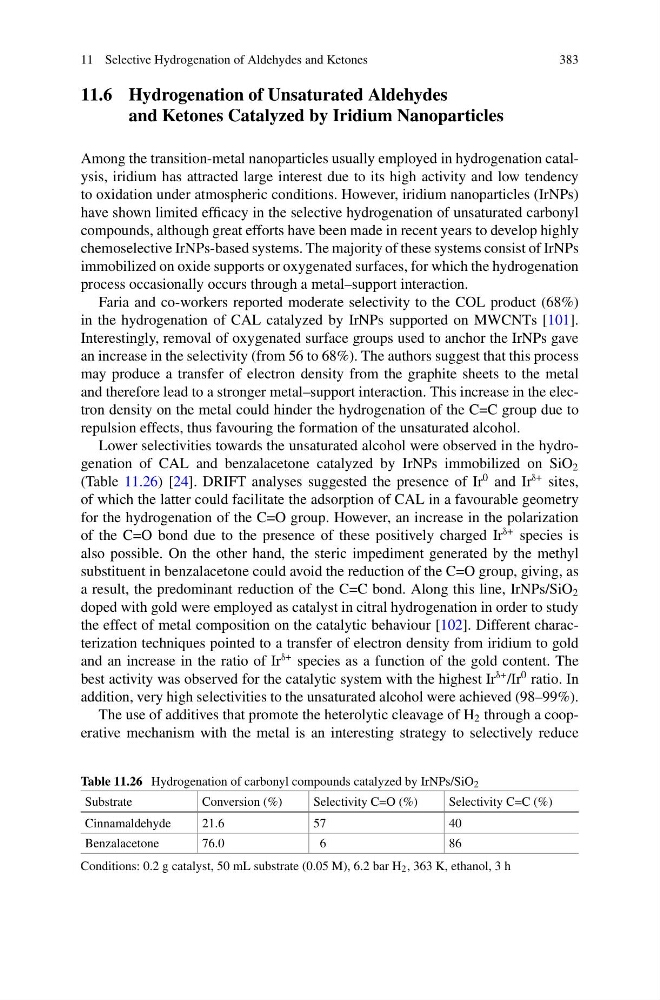
Lower selectivities towards the unsaturated alcohol were observed in the hydrogenation of CAL and benzalacetone catalyzed by IrNPs immobilized on SiO 2
(Table 11.26) [24]. DRIFT analyses suggested the presence of Ir
0 and Ir
δ+ sites,
of which the latter could facilitate the adsorption of CAL in a favourable geometry
for the hydrogenation of the C=O group. However, an increase in the polarization
of the C=O bond due to the presence of these positively charged Ir
δ+ species is
also possible. On the other hand, the steric impediment generated by the methyl
substituent in benzalacetone could avoid the reduction of the C=O group, giving, as
a result, the predominant reduction of the C=C bond. Along this line, IrNPs/SiO 2
doped with gold were employed as catalyst in citral hydrogenation in order to study
the effect of metal composition on the catalytic behaviour [102]. Different characterization techniques pointed to a transfer of electron density from iridium to gold
and an increase in the ratio of Ir
δ+ species as a function of the gold content. The
best activity was observed for the catalytic system with the highest Ir
δ+ /Ir
0 ratio. In
addition, very high selectivities to the unsaturated alcohol were achieved (98–99%).
The use of additives that promote the heterolytic cleavage of H 2 through a cooperative mechanism with the metal is an interesting strategy to selectively reduce
Table 11.26 Hydrogenation of carbonyl compounds catalyzed by IrNPs/SiO 2
Substrate
Conversion (%)
Selectivity C=O (%)
Selectivity C=C (%)
Cinnamaldehyde
21.6
57
40
Benzalacetone
76.0
6
86
Conditions: 0.2 g catalyst, 50 mL substrate (0.05 M), 6.2 bar H 2 , 363 K, ethanol, 3 h
383
11.6 Hydrogenation of Unsaturated Aldehydes
and Ketones Catalyzed by Iridium Nanoparticles
Among the transition-metal nanoparticles usually employed in hydrogenation catalysis, iridium has attracted large interest due to its high activity and low tendency
to oxidation under atmospheric conditions. However, iridium nanoparticles (IrNPs)
have shown limited efficacy in the selective hydrogenation of unsaturated carbonyl
compounds, although great efforts have been made in recent years to develop highly
chemoselective IrNPs-based systems. The majority of these systems consist of IrNPs
immobilized on oxide supports or oxygenated surfaces, for which the hydrogenation
process occasionally occurs through a metal–support interaction.
Faria and co-workers reported moderate selectivity to the COL product (68%)
in the hydrogenation of CAL catalyzed by IrNPs supported on MWCNTs [101].
Interestingly, removal of oxygenated surface groups used to anchor the IrNPs gave
an increase in the selectivity (from 56 to 68%). The authors suggest that this process
may produce a transfer of electron density from the graphite sheets to the metal
and therefore lead to a stronger metal–support interaction. This increase in the electron density on the metal could hinder the hydrogenation of the C=C group due to
repulsion effects, thus favouring the formation of the unsaturated alcohol.
Lower selectivities towards the unsaturated alcohol were observed in the hydrogenation of CAL and benzalacetone catalyzed by IrNPs immobilized on SiO 2
(Table 11.26) [24]. DRIFT analyses suggested the presence of Ir
0 and Ir
δ+ sites,
of which the latter could facilitate the adsorption of CAL in a favourable geometry
for the hydrogenation of the C=O group. However, an increase in the polarization
of the C=O bond due to the presence of these positively charged Ir
δ+ species is
also possible. On the other hand, the steric impediment generated by the methyl
substituent in benzalacetone could avoid the reduction of the C=O group, giving, as
a result, the predominant reduction of the C=C bond. Along this line, IrNPs/SiO 2
doped with gold were employed as catalyst in citral hydrogenation in order to study
the effect of metal composition on the catalytic behaviour [102]. Different characterization techniques pointed to a transfer of electron density from iridium to gold
and an increase in the ratio of Ir
δ+ species as a function of the gold content. The
best activity was observed for the catalytic system with the highest Ir
δ+ /Ir
0 ratio. In
addition, very high selectivities to the unsaturated alcohol were achieved (98–99%).
The use of additives that promote the heterolytic cleavage of H 2 through a cooperative mechanism with the metal is an interesting strategy to selectively reduce
Table 11.26 Hydrogenation of carbonyl compounds catalyzed by IrNPs/SiO 2
Substrate
Conversion (%)
Selectivity C=O (%)
Selectivity C=C (%)
Cinnamaldehyde
21.6
57
40
Benzalacetone
76.0
6
86
Conditions: 0.2 g catalyst, 50 mL substrate (0.05 M), 6.2 bar H 2 , 363 K, ethanol, 3 h