

386
I. Cano and P. W. N. M. van Leeuwen
the authors proposed, high reduction temperatures (e.g. 500 °C) lead to a weak Lewis
acid character of the active sites due to a high Ir
0 /Ir
δ+ ratio, which results in a strong
σ 1 interaction with the carbonyl carbon that hinders the desorption of crotonaldehyde. Furthermore, the electron density on Ir
0 species and the IrNP size increase with
the reduction temperature. These electron-enriched Ir
0 sites can promote the interaction with the electron-deficient carbonyl carbon and be beneficial for the selectivity.
However, large IrNPs can interact simultaneously with both C=C (π ) and C=O (σ 1 )
groups and thus lead to a decreased selectivity.
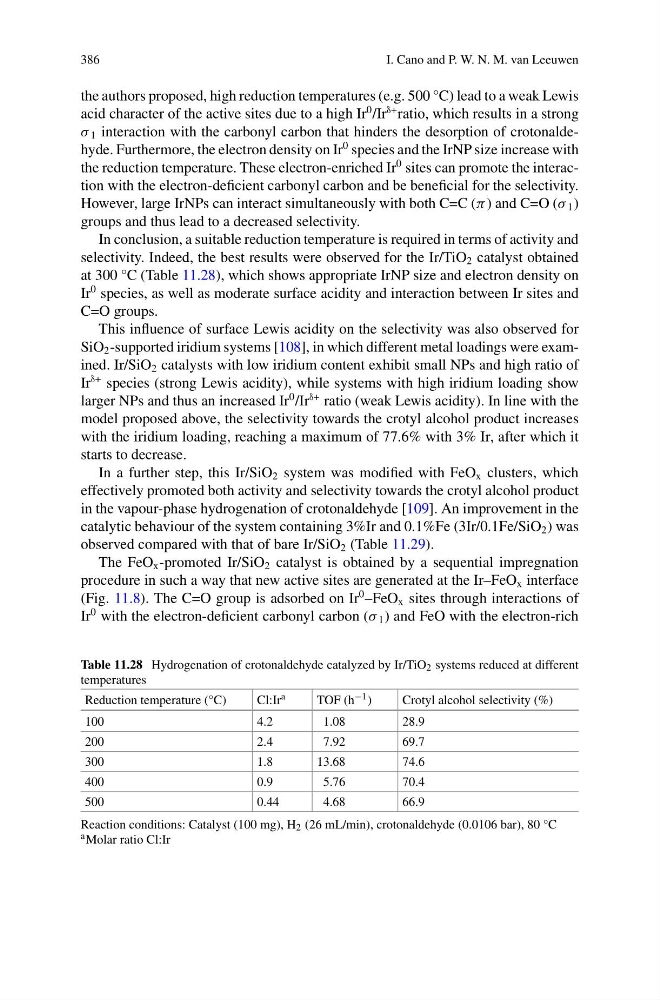
In conclusion, a suitable reduction temperature is required in terms of activity and
selectivity. Indeed, the best results were observed for the Ir/TiO 2 catalyst obtained
at 300 °C (Table 11.28), which shows appropriate IrNP size and electron density on
Ir
0 species, as well as moderate surface acidity and interaction between Ir sites and
C=O groups.
This influence of surface Lewis acidity on the selectivity was also observed for
SiO 2 -supported iridium systems [108], in which different metal loadings were examined. Ir/SiO 2 catalysts with low iridium content exhibit small NPs and high ratio of
Ir
δ+ species (strong Lewis acidity), while systems with high iridium loading show
larger NPs and thus an increased Ir
0 /Ir
δ+ ratio (weak Lewis acidity). In line with the
model proposed above, the selectivity towards the crotyl alcohol product increases
with the iridium loading, reaching a maximum of 77.6% with 3% Ir, after which it
starts to decrease.
In a further step, this Ir/SiO 2 system was modified with FeO x clusters, which
effectively promoted both activity and selectivity towards the crotyl alcohol product
in the vapour-phase hydrogenation of crotonaldehyde [109]. An improvement in the
catalytic behaviour of the system containing 3%Ir and 0.1%Fe (3Ir/0.1Fe/SiO 2 ) was
observed compared with that of bare Ir/SiO 2 (Table 11.29).
The FeO x -promoted Ir/SiO 2 catalyst is obtained by a sequential impregnation
procedure in such a way that new active sites are generated at the Ir–FeO x interface
(Fig. 11.8). The C=O group is adsorbed on Ir
0 –FeO x sites through interactions of
Ir
0 with the electron-deficient carbonyl carbon (σ 1 ) and FeO with the electron-rich
Table 11.28 Hydrogenation of crotonaldehyde catalyzed by Ir/TiO 2 systems reduced at different
temperatures
Reduction temperature (°C)
Cl:Ir a
TOF (h −1 )
Crotyl alcohol selectivity (%)
100
4.2
1.08
28.9
200
2.4
7.92
69.7
300
1.8
13.68
74.6
400
0.9
5.76
70.4
500
0.44
4.68
66.9
Reaction conditions: Catalyst (100 mg), H 2 (26 mL/min), crotonaldehyde (0.0106 bar), 80 °C
a Molar ratio Cl:Ir
I. Cano and P. W. N. M. van Leeuwen
the authors proposed, high reduction temperatures (e.g. 500 °C) lead to a weak Lewis
acid character of the active sites due to a high Ir
0 /Ir
δ+ ratio, which results in a strong
σ 1 interaction with the carbonyl carbon that hinders the desorption of crotonaldehyde. Furthermore, the electron density on Ir
0 species and the IrNP size increase with
the reduction temperature. These electron-enriched Ir
0 sites can promote the interaction with the electron-deficient carbonyl carbon and be beneficial for the selectivity.
However, large IrNPs can interact simultaneously with both C=C (π ) and C=O (σ 1 )
groups and thus lead to a decreased selectivity.
In conclusion, a suitable reduction temperature is required in terms of activity and
selectivity. Indeed, the best results were observed for the Ir/TiO 2 catalyst obtained
at 300 °C (Table 11.28), which shows appropriate IrNP size and electron density on
Ir
0 species, as well as moderate surface acidity and interaction between Ir sites and
C=O groups.
This influence of surface Lewis acidity on the selectivity was also observed for
SiO 2 -supported iridium systems [108], in which different metal loadings were examined. Ir/SiO 2 catalysts with low iridium content exhibit small NPs and high ratio of
Ir
δ+ species (strong Lewis acidity), while systems with high iridium loading show
larger NPs and thus an increased Ir
0 /Ir
δ+ ratio (weak Lewis acidity). In line with the
model proposed above, the selectivity towards the crotyl alcohol product increases
with the iridium loading, reaching a maximum of 77.6% with 3% Ir, after which it
starts to decrease.
In a further step, this Ir/SiO 2 system was modified with FeO x clusters, which
effectively promoted both activity and selectivity towards the crotyl alcohol product
in the vapour-phase hydrogenation of crotonaldehyde [109]. An improvement in the
catalytic behaviour of the system containing 3%Ir and 0.1%Fe (3Ir/0.1Fe/SiO 2 ) was
observed compared with that of bare Ir/SiO 2 (Table 11.29).
The FeO x -promoted Ir/SiO 2 catalyst is obtained by a sequential impregnation
procedure in such a way that new active sites are generated at the Ir–FeO x interface
(Fig. 11.8). The C=O group is adsorbed on Ir
0 –FeO x sites through interactions of
Ir
0 with the electron-deficient carbonyl carbon (σ 1 ) and FeO with the electron-rich
Table 11.28 Hydrogenation of crotonaldehyde catalyzed by Ir/TiO 2 systems reduced at different
temperatures
Reduction temperature (°C)
Cl:Ir a
TOF (h −1 )
Crotyl alcohol selectivity (%)
100
4.2
1.08
28.9
200
2.4
7.92
69.7
300
1.8
13.68
74.6
400
0.9
5.76
70.4
500
0.44
4.68
66.9
Reaction conditions: Catalyst (100 mg), H 2 (26 mL/min), crotonaldehyde (0.0106 bar), 80 °C
a Molar ratio Cl:Ir