

11 Selective Hydrogenation of Aldehydes and Ketones
377
selectivity to crotyl alcohol in gas-phase hydrogenation of acrolein [77]. The use of
chloride and tin as promoters led to an improvement in the selectivity to crotyl alcohol
up to 25%. In the last decades, single-walled carbon nanotubes (CNT or SWCNT),
multiwalled CNTs (MWCNTs), and graphite nanofibers (GNFs) have been a material
of choice as support and comparisons were made with commercial activated carbon
(AC). Thus, Serp and co-workers deposited several metals on these new materials
and studied their properties as catalysts for cinnamaldehyde to cinnamyl alcohol
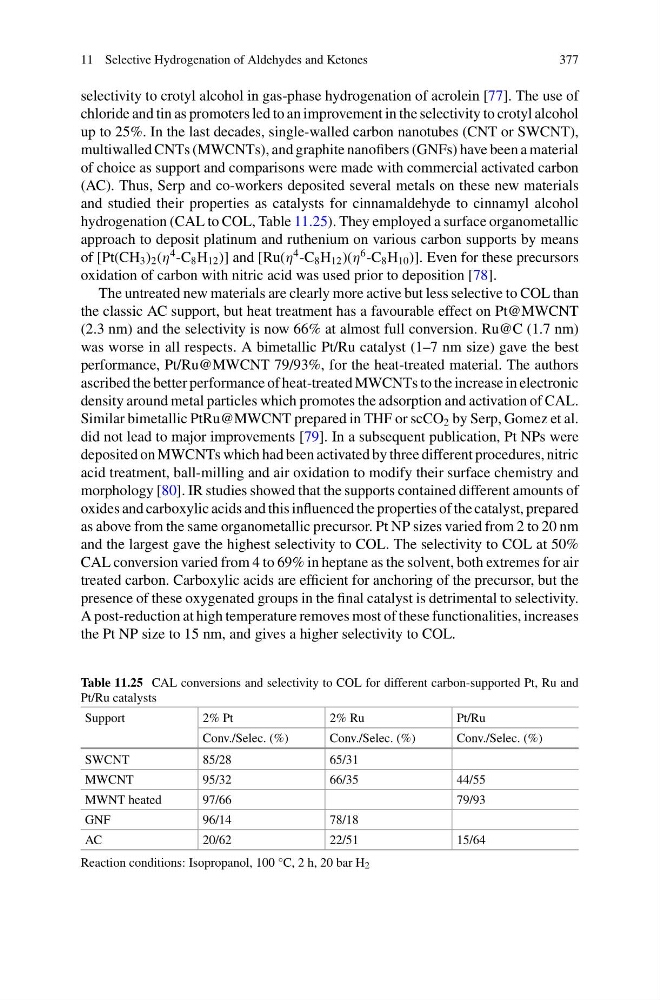
hydrogenation (CAL to COL, Table 11.25). They employed a surface organometallic
approach to deposit platinum and ruthenium on various carbon supports by means
of [Pt(CH 3 ) 2 (η
4 -C 8 H 12 )] and [Ru(η
4 -C 8 H 12 )(η
6 -C 8 H 10 )]. Even for these precursors
oxidation of carbon with nitric acid was used prior to deposition [78].
The untreated new materials are clearly more active but less selective to COL than
the classic AC support, but heat treatment has a favourable effect on Pt@MWCNT
(2.3 nm) and the selectivity is now 66% at almost full conversion. Ru@C (1.7 nm)
was worse in all respects. A bimetallic Pt/Ru catalyst (1–7 nm size) gave the best
performance, Pt/Ru@MWCNT 79/93%, for the heat-treated material. The authors
ascribed the better performance of heat-treated MWCNTs to the increase in electronic
density around metal particles which promotes the adsorption and activation of CAL.
Similar bimetallic PtRu@MWCNT prepared in THF or scCO 2 by Serp, Gomez et al.
did not lead to major improvements [79]. In a subsequent publication, Pt NPs were
deposited on MWCNTs which had been activated by three different procedures, nitric
acid treatment, ball-milling and air oxidation to modify their surface chemistry and
morphology [80]. IR studies showed that the supports contained different amounts of
oxides and carboxylic acids and this influenced the properties of the catalyst, prepared
as above from the same organometallic precursor. Pt NP sizes varied from 2 to 20 nm
and the largest gave the highest selectivity to COL. The selectivity to COL at 50%
CAL conversion varied from 4 to 69% in heptane as the solvent, both extremes for air
treated carbon. Carboxylic acids are efficient for anchoring of the precursor, but the
presence of these oxygenated groups in the final catalyst is detrimental to selectivity.
A post-reduction at high temperature removes most of these functionalities, increases
the Pt NP size to 15 nm, and gives a higher selectivity to COL.
Table 11.25 CAL conversions and selectivity to COL for different carbon-supported Pt, Ru and
Pt/Ru catalysts
Support
2% Pt
2% Ru
Pt/Ru
Conv./Selec. (%)
Conv./Selec. (%)
Conv./Selec. (%)
SWCNT
85/28
65/31
MWCNT
95/32
66/35
44/55
MWNT heated
97/66
79/93
GNF
96/14
78/18
AC
20/62
22/51
15/64
Reaction conditions: Isopropanol, 100 °C, 2 h, 20 bar H 2
377
selectivity to crotyl alcohol in gas-phase hydrogenation of acrolein [77]. The use of
chloride and tin as promoters led to an improvement in the selectivity to crotyl alcohol
up to 25%. In the last decades, single-walled carbon nanotubes (CNT or SWCNT),
multiwalled CNTs (MWCNTs), and graphite nanofibers (GNFs) have been a material
of choice as support and comparisons were made with commercial activated carbon
(AC). Thus, Serp and co-workers deposited several metals on these new materials
and studied their properties as catalysts for cinnamaldehyde to cinnamyl alcohol
hydrogenation (CAL to COL, Table 11.25). They employed a surface organometallic
approach to deposit platinum and ruthenium on various carbon supports by means
of [Pt(CH 3 ) 2 (η
4 -C 8 H 12 )] and [Ru(η
4 -C 8 H 12 )(η
6 -C 8 H 10 )]. Even for these precursors
oxidation of carbon with nitric acid was used prior to deposition [78].
The untreated new materials are clearly more active but less selective to COL than
the classic AC support, but heat treatment has a favourable effect on Pt@MWCNT
(2.3 nm) and the selectivity is now 66% at almost full conversion. Ru@C (1.7 nm)
was worse in all respects. A bimetallic Pt/Ru catalyst (1–7 nm size) gave the best
performance, Pt/Ru@MWCNT 79/93%, for the heat-treated material. The authors
ascribed the better performance of heat-treated MWCNTs to the increase in electronic
density around metal particles which promotes the adsorption and activation of CAL.
Similar bimetallic PtRu@MWCNT prepared in THF or scCO 2 by Serp, Gomez et al.
did not lead to major improvements [79]. In a subsequent publication, Pt NPs were
deposited on MWCNTs which had been activated by three different procedures, nitric
acid treatment, ball-milling and air oxidation to modify their surface chemistry and
morphology [80]. IR studies showed that the supports contained different amounts of
oxides and carboxylic acids and this influenced the properties of the catalyst, prepared
as above from the same organometallic precursor. Pt NP sizes varied from 2 to 20 nm
and the largest gave the highest selectivity to COL. The selectivity to COL at 50%
CAL conversion varied from 4 to 69% in heptane as the solvent, both extremes for air
treated carbon. Carboxylic acids are efficient for anchoring of the precursor, but the
presence of these oxygenated groups in the final catalyst is detrimental to selectivity.
A post-reduction at high temperature removes most of these functionalities, increases
the Pt NP size to 15 nm, and gives a higher selectivity to COL.
Table 11.25 CAL conversions and selectivity to COL for different carbon-supported Pt, Ru and
Pt/Ru catalysts
Support
2% Pt
2% Ru
Pt/Ru
Conv./Selec. (%)
Conv./Selec. (%)
Conv./Selec. (%)
SWCNT
85/28
65/31
MWCNT
95/32
66/35
44/55
MWNT heated
97/66
79/93
GNF
96/14
78/18
AC
20/62
22/51
15/64
Reaction conditions: Isopropanol, 100 °C, 2 h, 20 bar H 2