

376
I. Cano and P. W. N. M. van Leeuwen
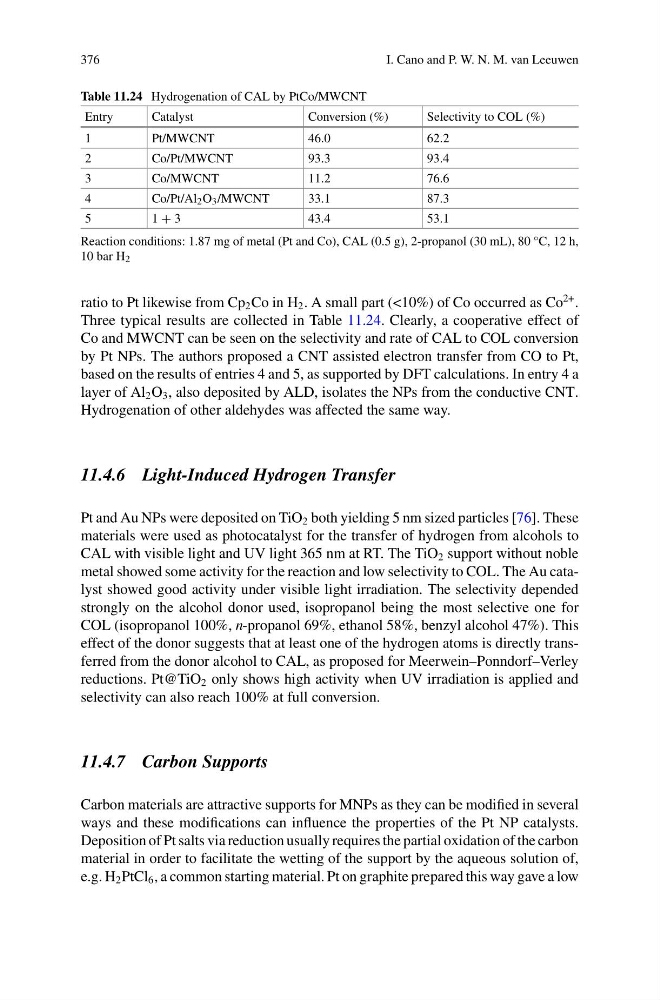
Table 11.24 Hydrogenation of CAL by PtCo/MWCNT
Entry
Catalyst
Conversion (%)
Selectivity to COL (%)
1
Pt/MWCNT
46.0
62.2
2
Co/Pt/MWCNT
93.3
93.4
3
Co/MWCNT
11.2
76.6
4
Co/Pt/Al 2 O 3 /MWCNT
33.1
87.3
5
1 + 3
43.4
53.1
Reaction conditions: 1.87 mg of metal (Pt and Co), CAL (0.5 g), 2-propanol (30 mL), 80 °C, 12 h,
10 bar H 2
ratio to Pt likewise from Cp 2 Co in H 2 . A small part (<10%) of Co occurred as Co
2+ .
Three typical results are collected in Table 11.24. Clearly, a cooperative effect of
Co and MWCNT can be seen on the selectivity and rate of CAL to COL conversion
by Pt NPs. The authors proposed a CNT assisted electron transfer from CO to Pt,
based on the results of entries 4 and 5, as supported by DFT calculations. In entry 4 a
layer of Al 2 O 3 , also deposited by ALD, isolates the NPs from the conductive CNT.
Hydrogenation of other aldehydes was affected the same way.
11.4.6 Light-Induced Hydrogen Transfer
Pt and Au NPs were deposited on TiO 2 both yielding 5 nm sized particles [76]. These
materials were used as photocatalyst for the transfer of hydrogen from alcohols to
CAL with visible light and UV light 365 nm at RT. The TiO 2 support without noble
metal showed some activity for the reaction and low selectivity to COL. The Au catalyst showed good activity under visible light irradiation. The selectivity depended
strongly on the alcohol donor used, isopropanol being the most selective one for
COL (isopropanol 100%, n-propanol 69%, ethanol 58%, benzyl alcohol 47%). This
effect of the donor suggests that at least one of the hydrogen atoms is directly transferred from the donor alcohol to CAL, as proposed for Meerwein–Ponndorf–Verley
reductions. Pt@TiO 2 only shows high activity when UV irradiation is applied and
selectivity can also reach 100% at full conversion.
11.4.7 Carbon Supports
Carbon materials are attractive supports for MNPs as they can be modified in several
ways and these modifications can influence the properties of the Pt NP catalysts.
Deposition of Pt salts via reduction usually requires the partial oxidation of the carbon
material in order to facilitate the wetting of the support by the aqueous solution of,
e.g. H 2 PtCl 6 , a common starting material. Pt on graphite prepared this way gave a low
I. Cano and P. W. N. M. van Leeuwen
Table 11.24 Hydrogenation of CAL by PtCo/MWCNT
Entry
Catalyst
Conversion (%)
Selectivity to COL (%)
1
Pt/MWCNT
46.0
62.2
2
Co/Pt/MWCNT
93.3
93.4
3
Co/MWCNT
11.2
76.6
4
Co/Pt/Al 2 O 3 /MWCNT
33.1
87.3
5
1 + 3
43.4
53.1
Reaction conditions: 1.87 mg of metal (Pt and Co), CAL (0.5 g), 2-propanol (30 mL), 80 °C, 12 h,
10 bar H 2
ratio to Pt likewise from Cp 2 Co in H 2 . A small part (<10%) of Co occurred as Co
2+ .
Three typical results are collected in Table 11.24. Clearly, a cooperative effect of
Co and MWCNT can be seen on the selectivity and rate of CAL to COL conversion
by Pt NPs. The authors proposed a CNT assisted electron transfer from CO to Pt,
based on the results of entries 4 and 5, as supported by DFT calculations. In entry 4 a
layer of Al 2 O 3 , also deposited by ALD, isolates the NPs from the conductive CNT.
Hydrogenation of other aldehydes was affected the same way.
11.4.6 Light-Induced Hydrogen Transfer
Pt and Au NPs were deposited on TiO 2 both yielding 5 nm sized particles [76]. These
materials were used as photocatalyst for the transfer of hydrogen from alcohols to
CAL with visible light and UV light 365 nm at RT. The TiO 2 support without noble
metal showed some activity for the reaction and low selectivity to COL. The Au catalyst showed good activity under visible light irradiation. The selectivity depended
strongly on the alcohol donor used, isopropanol being the most selective one for
COL (isopropanol 100%, n-propanol 69%, ethanol 58%, benzyl alcohol 47%). This
effect of the donor suggests that at least one of the hydrogen atoms is directly transferred from the donor alcohol to CAL, as proposed for Meerwein–Ponndorf–Verley
reductions. Pt@TiO 2 only shows high activity when UV irradiation is applied and
selectivity can also reach 100% at full conversion.
11.4.7 Carbon Supports
Carbon materials are attractive supports for MNPs as they can be modified in several
ways and these modifications can influence the properties of the Pt NP catalysts.
Deposition of Pt salts via reduction usually requires the partial oxidation of the carbon
material in order to facilitate the wetting of the support by the aqueous solution of,
e.g. H 2 PtCl 6 , a common starting material. Pt on graphite prepared this way gave a low