

11 Selective Hydrogenation of Aldehydes and Ketones
375
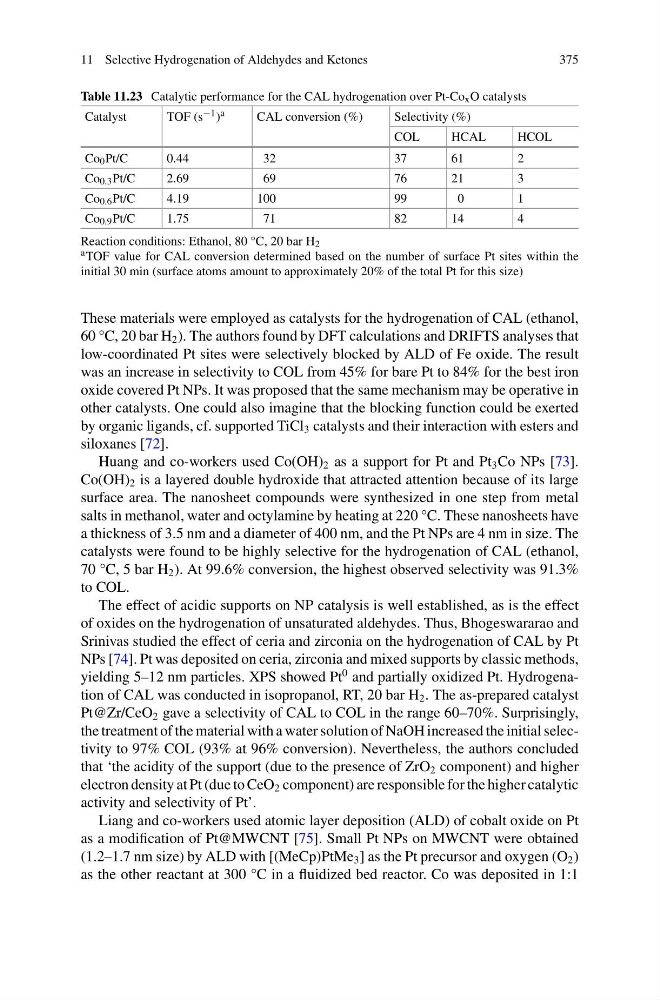
Table 11.23 Catalytic performance for the CAL hydrogenation over Pt-Co x O catalysts
Catalyst
TOF (s −1 ) a
CAL conversion (%)
Selectivity (%)
COL
HCAL
HCOL
Co 0 Pt/C
0.44
32
37
61
2
Co 0.3 Pt/C
2.69
69
76
21
3
Co 0.6 Pt/C
4.19
100
99
0
1
Co 0.9 Pt/C
1.75
71
82
14
4
Reaction conditions: Ethanol, 80 °C, 20 bar H 2
a TOF value for CAL conversion determined based on the number of surface Pt sites within the
initial 30 min (surface atoms amount to approximately 20% of the total Pt for this size)
These materials were employed as catalysts for the hydrogenation of CAL (ethanol,
60 °C, 20 bar H 2 ). The authors found by DFT calculations and DRIFTS analyses that
low-coordinated Pt sites were selectively blocked by ALD of Fe oxide. The result
was an increase in selectivity to COL from 45% for bare Pt to 84% for the best iron
oxide covered Pt NPs. It was proposed that the same mechanism may be operative in
other catalysts. One could also imagine that the blocking function could be exerted
by organic ligands, cf. supported TiCl 3 catalysts and their interaction with esters and
siloxanes [72].
Huang and co-workers used Co(OH) 2 as a support for Pt and Pt 3 Co NPs [73].
Co(OH) 2 is a layered double hydroxide that attracted attention because of its large
surface area. The nanosheet compounds were synthesized in one step from metal
salts in methanol, water and octylamine by heating at 220 °C. These nanosheets have
a thickness of 3.5 nm and a diameter of 400 nm, and the Pt NPs are 4 nm in size. The
catalysts were found to be highly selective for the hydrogenation of CAL (ethanol,
70 °C, 5 bar H 2 ). At 99.6% conversion, the highest observed selectivity was 91.3%
to COL.
The effect of acidic supports on NP catalysis is well established, as is the effect
of oxides on the hydrogenation of unsaturated aldehydes. Thus, Bhogeswararao and
Srinivas studied the effect of ceria and zirconia on the hydrogenation of CAL by Pt
NPs [74]. Pt was deposited on ceria, zirconia and mixed supports by classic methods,
yielding 5–12 nm particles. XPS showed Pt
0 and partially oxidized Pt. Hydrogenation of CAL was conducted in isopropanol, RT, 20 bar H 2 . The as-prepared catalyst
Pt@Zr/CeO 2 gave a selectivity of CAL to COL in the range 60–70%. Surprisingly,
the treatment of the material with a water solution of NaOH increased the initial selectivity to 97% COL (93% at 96% conversion). Nevertheless, the authors concluded
that ‘the acidity of the support (due to the presence of ZrO 2 component) and higher
electron density at Pt (due to CeO 2 component) are responsible for the higher catalytic
activity and selectivity of Pt’.
Liang and co-workers used atomic layer deposition (ALD) of cobalt oxide on Pt
as a modification of Pt@MWCNT [75]. Small Pt NPs on MWCNT were obtained
(1.2–1.7 nm size) by ALD with [(MeCp)PtMe 3 ] as the Pt precursor and oxygen (O 2 )
as the other reactant at 300 °C in a fluidized bed reactor. Co was deposited in 1:1
375
Table 11.23 Catalytic performance for the CAL hydrogenation over Pt-Co x O catalysts
Catalyst
TOF (s −1 ) a
CAL conversion (%)
Selectivity (%)
COL
HCAL
HCOL
Co 0 Pt/C
0.44
32
37
61
2
Co 0.3 Pt/C
2.69
69
76
21
3
Co 0.6 Pt/C
4.19
100
99
0
1
Co 0.9 Pt/C
1.75
71
82
14
4
Reaction conditions: Ethanol, 80 °C, 20 bar H 2
a TOF value for CAL conversion determined based on the number of surface Pt sites within the
initial 30 min (surface atoms amount to approximately 20% of the total Pt for this size)
These materials were employed as catalysts for the hydrogenation of CAL (ethanol,
60 °C, 20 bar H 2 ). The authors found by DFT calculations and DRIFTS analyses that
low-coordinated Pt sites were selectively blocked by ALD of Fe oxide. The result
was an increase in selectivity to COL from 45% for bare Pt to 84% for the best iron
oxide covered Pt NPs. It was proposed that the same mechanism may be operative in
other catalysts. One could also imagine that the blocking function could be exerted
by organic ligands, cf. supported TiCl 3 catalysts and their interaction with esters and
siloxanes [72].
Huang and co-workers used Co(OH) 2 as a support for Pt and Pt 3 Co NPs [73].
Co(OH) 2 is a layered double hydroxide that attracted attention because of its large
surface area. The nanosheet compounds were synthesized in one step from metal
salts in methanol, water and octylamine by heating at 220 °C. These nanosheets have
a thickness of 3.5 nm and a diameter of 400 nm, and the Pt NPs are 4 nm in size. The
catalysts were found to be highly selective for the hydrogenation of CAL (ethanol,
70 °C, 5 bar H 2 ). At 99.6% conversion, the highest observed selectivity was 91.3%
to COL.
The effect of acidic supports on NP catalysis is well established, as is the effect
of oxides on the hydrogenation of unsaturated aldehydes. Thus, Bhogeswararao and
Srinivas studied the effect of ceria and zirconia on the hydrogenation of CAL by Pt
NPs [74]. Pt was deposited on ceria, zirconia and mixed supports by classic methods,
yielding 5–12 nm particles. XPS showed Pt
0 and partially oxidized Pt. Hydrogenation of CAL was conducted in isopropanol, RT, 20 bar H 2 . The as-prepared catalyst
Pt@Zr/CeO 2 gave a selectivity of CAL to COL in the range 60–70%. Surprisingly,
the treatment of the material with a water solution of NaOH increased the initial selectivity to 97% COL (93% at 96% conversion). Nevertheless, the authors concluded
that ‘the acidity of the support (due to the presence of ZrO 2 component) and higher
electron density at Pt (due to CeO 2 component) are responsible for the higher catalytic
activity and selectivity of Pt’.
Liang and co-workers used atomic layer deposition (ALD) of cobalt oxide on Pt
as a modification of Pt@MWCNT [75]. Small Pt NPs on MWCNT were obtained
(1.2–1.7 nm size) by ALD with [(MeCp)PtMe 3 ] as the Pt precursor and oxygen (O 2 )
as the other reactant at 300 °C in a fluidized bed reactor. Co was deposited in 1:1