

378
I. Cano and P. W. N. M. van Leeuwen
Hou and co-workers reported on the use of small Pt NPs (2.5 nm size) deposited
on the surface of few-layered reduced graphene oxide (RGO). The Pt NPs were
obtained via direct ethylene glycol reduction of H 2 PtCl 6 in aqueous solution [81]. In
the series of alcohol solvents, the rate decreased drastically in methanol to 2-pentanol,
but the selectivity increased from 74 to 94% (20 bar H 2 , 70 °C). Ethanol, with 74%
conversion in 2 h and selectivity 85% at 0.04% Pt (TOF = 27 min
−1 ), showed the
best compromise. In addition, the selectivity is retained at full conversion.
Han et al. compared similar catalysts on CNT (Pt NPs of 3.5 nm size) and
RGO@SiO 2 (3 nm) obtained from H 2 PtCl 6 in aqueous solution by NaBH 4 reduction
[82]. CAL hydrogenation was carried out under the same conditions as the next report.
The Pt/CNT catalyst showed 62% selectivity to COL, whereas the Pt/RGO@SiO 2
system only 48%, which seems in line with the explanations given below and above.
Li, Zaera, Zhu and co-workers used Pt NPs supported on graphene as catalyst for
CAL hydrogenation [83]. Pt NPs on several homo-made graphenes were generated
by sodium borohydride reduction of chloroplatinic acid in water. Mean particle sizes
of 3–4 nm were obtained. Catalysis was carried out at 10 bar H 2 , in isopropanol as
solvent at 60 °C. The best result was 88% selectivity to COL at 92% conversion. One
factor of importance to be mentioned is the high amount of Pt
0 for the best catalyst.
DFT studies indicated the bonding of C=O functions to Pt
0 is stronger than that
of C=C bonds. Higher crystalline graphene gave higher selectivity to COL, which
might be due to stronger phenyl coordination to the support, dragging the C=C bond
away from Pt on the Pt-graphene edges.
A highly active Pt catalyst on porous support of SiC/C was reported by Li et al.
[84]. The catalyst was prepared from chloroplatinic acid in water and reduction by
sodium formate giving Pt NPs of 2.2–2.6 nm. Heat treatment under hydrogen was
applied at 400 °C. From a range of supports tested this one gave the most active
catalyst for CAL to COL hydrogenation at 25 °C, in isopropanol, 20 bar H 2 , TOF
2400 h
−1 . At 40 °C, the TOF was twice as high. However, the selectivity was lower
than those described in the previous report (80%). In contrast to the previous study,
the high preference for COL was assigned to the cationic Pt ions at the surface as
found by XPS.
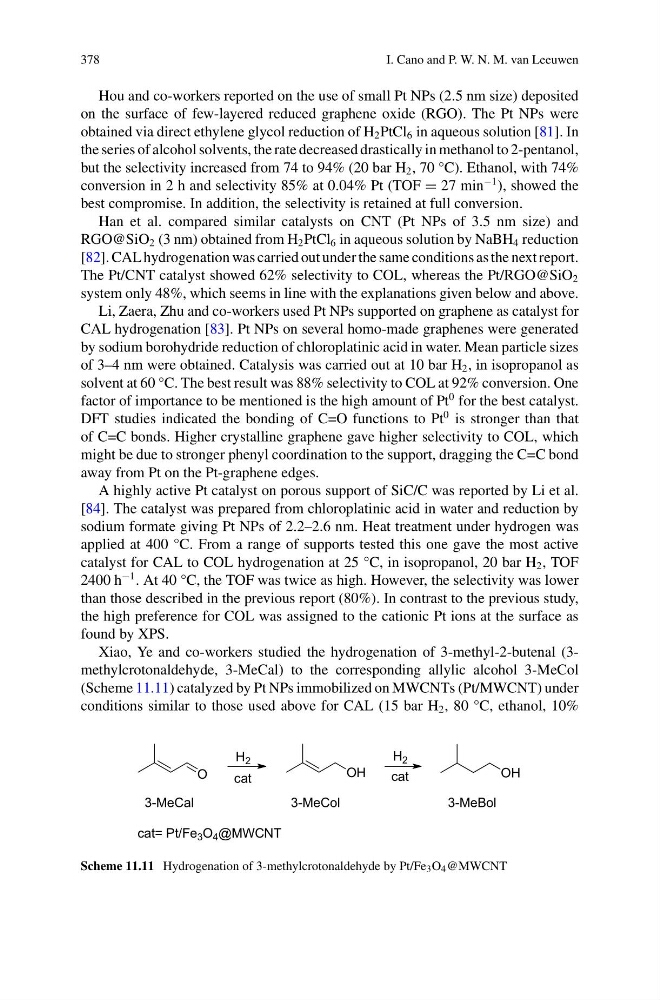
Xiao, Ye and co-workers studied the hydrogenation of 3-methyl-2-butenal (3methylcrotonaldehyde, 3-MeCal) to the corresponding allylic alcohol 3-MeCol
(Scheme 11.11) catalyzed by Pt NPs immobilized on MWCNTs (Pt/MWCNT) under
conditions similar to those used above for CAL (15 bar H 2 , 80 °C, ethanol, 10%
O
3-MeCal
3-MeCol
3-MeBol
OH
OH
H 2
H 2
cat
cat
cat= Pt/Fe 3 O 4 @MWCNT
Scheme 11.11 Hydrogenation of 3-methylcrotonaldehyde by Pt/Fe 3 O 4 @MWCNT
I. Cano and P. W. N. M. van Leeuwen
Hou and co-workers reported on the use of small Pt NPs (2.5 nm size) deposited
on the surface of few-layered reduced graphene oxide (RGO). The Pt NPs were
obtained via direct ethylene glycol reduction of H 2 PtCl 6 in aqueous solution [81]. In
the series of alcohol solvents, the rate decreased drastically in methanol to 2-pentanol,
but the selectivity increased from 74 to 94% (20 bar H 2 , 70 °C). Ethanol, with 74%
conversion in 2 h and selectivity 85% at 0.04% Pt (TOF = 27 min
−1 ), showed the
best compromise. In addition, the selectivity is retained at full conversion.
Han et al. compared similar catalysts on CNT (Pt NPs of 3.5 nm size) and
RGO@SiO 2 (3 nm) obtained from H 2 PtCl 6 in aqueous solution by NaBH 4 reduction
[82]. CAL hydrogenation was carried out under the same conditions as the next report.
The Pt/CNT catalyst showed 62% selectivity to COL, whereas the Pt/RGO@SiO 2
system only 48%, which seems in line with the explanations given below and above.
Li, Zaera, Zhu and co-workers used Pt NPs supported on graphene as catalyst for
CAL hydrogenation [83]. Pt NPs on several homo-made graphenes were generated
by sodium borohydride reduction of chloroplatinic acid in water. Mean particle sizes
of 3–4 nm were obtained. Catalysis was carried out at 10 bar H 2 , in isopropanol as
solvent at 60 °C. The best result was 88% selectivity to COL at 92% conversion. One
factor of importance to be mentioned is the high amount of Pt
0 for the best catalyst.
DFT studies indicated the bonding of C=O functions to Pt
0 is stronger than that
of C=C bonds. Higher crystalline graphene gave higher selectivity to COL, which
might be due to stronger phenyl coordination to the support, dragging the C=C bond
away from Pt on the Pt-graphene edges.
A highly active Pt catalyst on porous support of SiC/C was reported by Li et al.
[84]. The catalyst was prepared from chloroplatinic acid in water and reduction by
sodium formate giving Pt NPs of 2.2–2.6 nm. Heat treatment under hydrogen was
applied at 400 °C. From a range of supports tested this one gave the most active
catalyst for CAL to COL hydrogenation at 25 °C, in isopropanol, 20 bar H 2 , TOF
2400 h
−1 . At 40 °C, the TOF was twice as high. However, the selectivity was lower
than those described in the previous report (80%). In contrast to the previous study,
the high preference for COL was assigned to the cationic Pt ions at the surface as
found by XPS.
Xiao, Ye and co-workers studied the hydrogenation of 3-methyl-2-butenal (3methylcrotonaldehyde, 3-MeCal) to the corresponding allylic alcohol 3-MeCol
(Scheme 11.11) catalyzed by Pt NPs immobilized on MWCNTs (Pt/MWCNT) under
conditions similar to those used above for CAL (15 bar H 2 , 80 °C, ethanol, 10%
O
3-MeCal
3-MeCol
3-MeBol
OH
OH
H 2
H 2
cat
cat
cat= Pt/Fe 3 O 4 @MWCNT
Scheme 11.11 Hydrogenation of 3-methylcrotonaldehyde by Pt/Fe 3 O 4 @MWCNT