

372
I. Cano and P. W. N. M. van Leeuwen
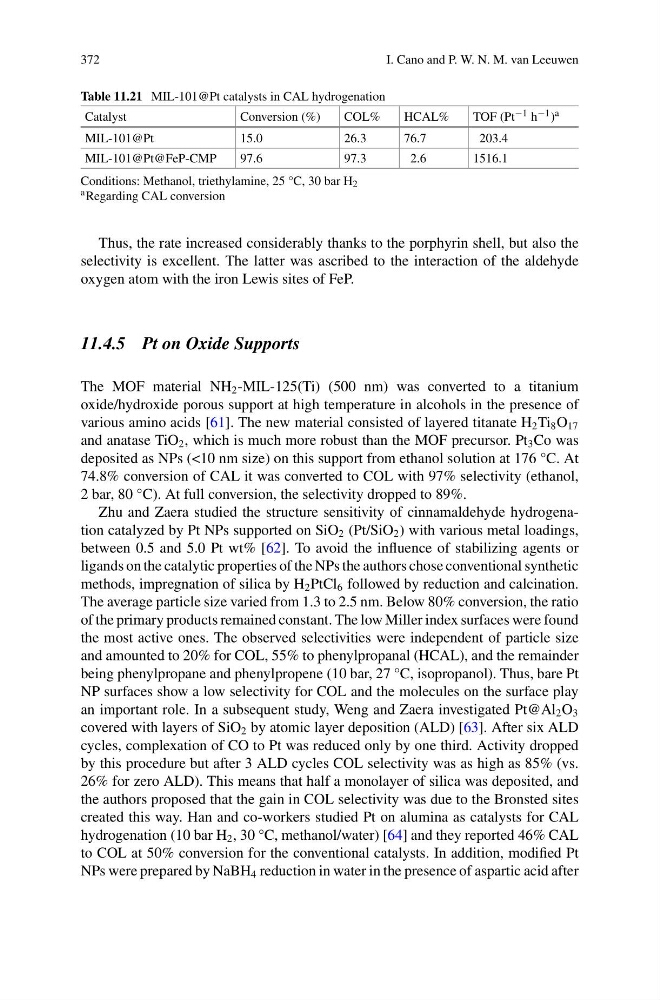
Table 11.21 MIL-101@Pt catalysts in CAL hydrogenation
Catalyst
Conversion (%)
COL%
HCAL%
TOF (Pt −1 h −1 ) a
MIL-101@Pt
15.0
26.3
76.7
203.4
MIL-101@Pt@FeP-CMP
97.6
97.3
2.6
1516.1
Conditions: Methanol, triethylamine, 25 °C, 30 bar H 2
a Regarding CAL conversion
Thus, the rate increased considerably thanks to the porphyrin shell, but also the
selectivity is excellent. The latter was ascribed to the interaction of the aldehyde
oxygen atom with the iron Lewis sites of FeP.
11.4.5 Pt on Oxide Supports
The MOF material NH 2 -MIL-125(Ti) (500 nm) was converted to a titanium
oxide/hydroxide porous support at high temperature in alcohols in the presence of
various amino acids [61]. The new material consisted of layered titanate H 2 Ti 8 O 17
and anatase TiO 2 , which is much more robust than the MOF precursor. Pt 3 Co was
deposited as NPs (<10 nm size) on this support from ethanol solution at 176 °C. At
74.8% conversion of CAL it was converted to COL with 97% selectivity (ethanol,
2 bar, 80 °C). At full conversion, the selectivity dropped to 89%.
Zhu and Zaera studied the structure sensitivity of cinnamaldehyde hydrogenation catalyzed by Pt NPs supported on SiO 2 (Pt/SiO 2 ) with various metal loadings,
between 0.5 and 5.0 Pt wt% [62]. To avoid the influence of stabilizing agents or
ligands on the catalytic properties of the NPs the authors chose conventional synthetic
methods, impregnation of silica by H 2 PtCl 6 followed by reduction and calcination.
The average particle size varied from 1.3 to 2.5 nm. Below 80% conversion, the ratio
of the primary products remained constant. The low Miller index surfaces were found
the most active ones. The observed selectivities were independent of particle size
and amounted to 20% for COL, 55% to phenylpropanal (HCAL), and the remainder
being phenylpropane and phenylpropene (10 bar, 27 °C, isopropanol). Thus, bare Pt
NP surfaces show a low selectivity for COL and the molecules on the surface play
an important role. In a subsequent study, Weng and Zaera investigated Pt@Al 2 O 3
covered with layers of SiO 2 by atomic layer deposition (ALD) [63]. After six ALD
cycles, complexation of CO to Pt was reduced only by one third. Activity dropped
by this procedure but after 3 ALD cycles COL selectivity was as high as 85% (vs.
26% for zero ALD). This means that half a monolayer of silica was deposited, and
the authors proposed that the gain in COL selectivity was due to the Bronsted sites
created this way. Han and co-workers studied Pt on alumina as catalysts for CAL
hydrogenation (10 bar H 2 , 30 °C, methanol/water) [64] and they reported 46% CAL
to COL at 50% conversion for the conventional catalysts. In addition, modified Pt
NPs were prepared by NaBH 4 reduction in water in the presence of aspartic acid after
I. Cano and P. W. N. M. van Leeuwen
Table 11.21 MIL-101@Pt catalysts in CAL hydrogenation
Catalyst
Conversion (%)
COL%
HCAL%
TOF (Pt −1 h −1 ) a
MIL-101@Pt
15.0
26.3
76.7
203.4
MIL-101@Pt@FeP-CMP
97.6
97.3
2.6
1516.1
Conditions: Methanol, triethylamine, 25 °C, 30 bar H 2
a Regarding CAL conversion
Thus, the rate increased considerably thanks to the porphyrin shell, but also the
selectivity is excellent. The latter was ascribed to the interaction of the aldehyde
oxygen atom with the iron Lewis sites of FeP.
11.4.5 Pt on Oxide Supports
The MOF material NH 2 -MIL-125(Ti) (500 nm) was converted to a titanium
oxide/hydroxide porous support at high temperature in alcohols in the presence of
various amino acids [61]. The new material consisted of layered titanate H 2 Ti 8 O 17
and anatase TiO 2 , which is much more robust than the MOF precursor. Pt 3 Co was
deposited as NPs (<10 nm size) on this support from ethanol solution at 176 °C. At
74.8% conversion of CAL it was converted to COL with 97% selectivity (ethanol,
2 bar, 80 °C). At full conversion, the selectivity dropped to 89%.
Zhu and Zaera studied the structure sensitivity of cinnamaldehyde hydrogenation catalyzed by Pt NPs supported on SiO 2 (Pt/SiO 2 ) with various metal loadings,
between 0.5 and 5.0 Pt wt% [62]. To avoid the influence of stabilizing agents or
ligands on the catalytic properties of the NPs the authors chose conventional synthetic
methods, impregnation of silica by H 2 PtCl 6 followed by reduction and calcination.
The average particle size varied from 1.3 to 2.5 nm. Below 80% conversion, the ratio
of the primary products remained constant. The low Miller index surfaces were found
the most active ones. The observed selectivities were independent of particle size
and amounted to 20% for COL, 55% to phenylpropanal (HCAL), and the remainder
being phenylpropane and phenylpropene (10 bar, 27 °C, isopropanol). Thus, bare Pt
NP surfaces show a low selectivity for COL and the molecules on the surface play
an important role. In a subsequent study, Weng and Zaera investigated Pt@Al 2 O 3
covered with layers of SiO 2 by atomic layer deposition (ALD) [63]. After six ALD
cycles, complexation of CO to Pt was reduced only by one third. Activity dropped
by this procedure but after 3 ALD cycles COL selectivity was as high as 85% (vs.
26% for zero ALD). This means that half a monolayer of silica was deposited, and
the authors proposed that the gain in COL selectivity was due to the Bronsted sites
created this way. Han and co-workers studied Pt on alumina as catalysts for CAL
hydrogenation (10 bar H 2 , 30 °C, methanol/water) [64] and they reported 46% CAL
to COL at 50% conversion for the conventional catalysts. In addition, modified Pt
NPs were prepared by NaBH 4 reduction in water in the presence of aspartic acid after