

11 Selective Hydrogenation of Aldehydes and Ketones
373
which alumina was added. As one can see from Table 11.22 this has an enormous
effect on the selectivity of the catalyst on n-Al 2 O 3 but not for mesoporous Al 2 O 3 .
Other unsaturated aldehydes showed similar improvements. The authors proposed
steric interactions as likely cause for this selectivity change.
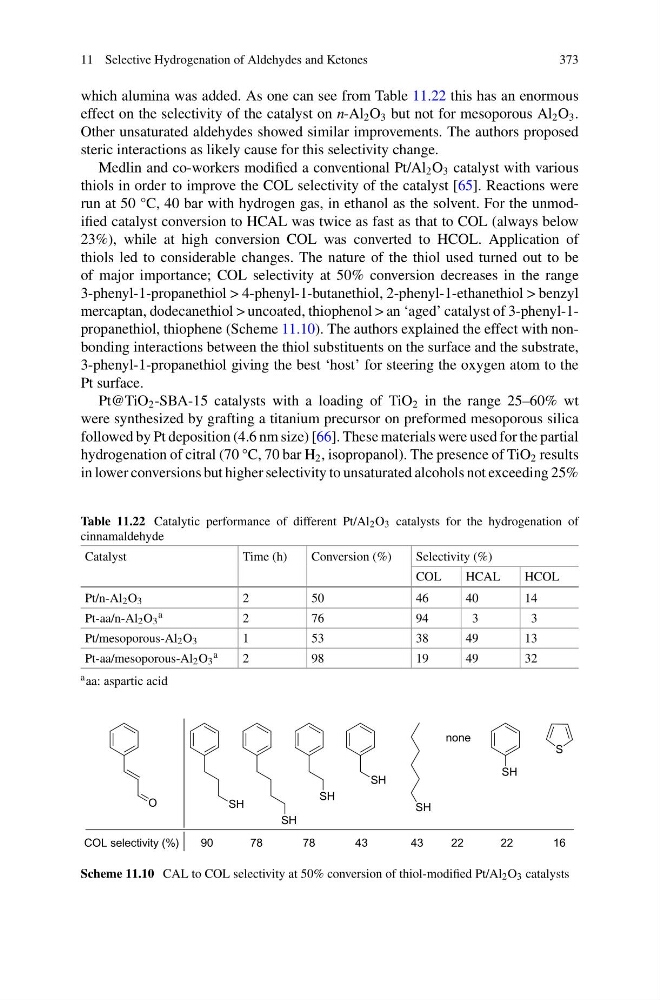
Medlin and co-workers modified a conventional Pt/Al 2 O 3 catalyst with various
thiols in order to improve the COL selectivity of the catalyst [65]. Reactions were
run at 50 °C, 40 bar with hydrogen gas, in ethanol as the solvent. For the unmodified catalyst conversion to HCAL was twice as fast as that to COL (always below
23%), while at high conversion COL was converted to HCOL. Application of
thiols led to considerable changes. The nature of the thiol used turned out to be
of major importance; COL selectivity at 50% conversion decreases in the range
3-phenyl-1-propanethiol > 4-phenyl-1-butanethiol, 2-phenyl-1-ethanethiol > benzyl
mercaptan, dodecanethiol > uncoated, thiophenol > an ‘aged’ catalyst of 3-phenyl-1propanethiol, thiophene (Scheme 11.10). The authors explained the effect with nonbonding interactions between the thiol substituents on the surface and the substrate,
3-phenyl-1-propanethiol giving the best ‘host’ for steering the oxygen atom to the
Pt surface.
Pt@TiO 2 -SBA-15 catalysts with a loading of TiO 2 in the range 25–60% wt
were synthesized by grafting a titanium precursor on preformed mesoporous silica
followed by Pt deposition (4.6 nm size) [66]. These materials were used for the partial
hydrogenation of citral (70 °C, 70 bar H 2 , isopropanol). The presence of TiO 2 results
in lower conversions but higher selectivity to unsaturated alcohols not exceeding 25%
Table 11.22 Catalytic performance of different Pt/Al 2 O 3 catalysts for the hydrogenation of
cinnamaldehyde
Catalyst
Time (h)
Conversion (%)
Selectivity (%)
COL
HCAL
HCOL
Pt/n-Al 2 O 3
2
50
46
40
14
Pt-aa/n-Al 2 O 3
a
2
76
94
3
3
Pt/mesoporous-Al 2 O 3
1
53
38
49
13
Pt-aa/mesoporous-Al 2 O 3
a
2
98
19
49
32
a aa: aspartic acid
O
SH
SH
SH
SH
SH
none
S
COL selectivity (%)
90
78
78
43
43
22
22
16
SH
Scheme 11.10 CAL to COL selectivity at 50% conversion of thiol-modified Pt/Al 2 O 3 catalysts
373
which alumina was added. As one can see from Table 11.22 this has an enormous
effect on the selectivity of the catalyst on n-Al 2 O 3 but not for mesoporous Al 2 O 3 .
Other unsaturated aldehydes showed similar improvements. The authors proposed
steric interactions as likely cause for this selectivity change.
Medlin and co-workers modified a conventional Pt/Al 2 O 3 catalyst with various
thiols in order to improve the COL selectivity of the catalyst [65]. Reactions were
run at 50 °C, 40 bar with hydrogen gas, in ethanol as the solvent. For the unmodified catalyst conversion to HCAL was twice as fast as that to COL (always below
23%), while at high conversion COL was converted to HCOL. Application of
thiols led to considerable changes. The nature of the thiol used turned out to be
of major importance; COL selectivity at 50% conversion decreases in the range
3-phenyl-1-propanethiol > 4-phenyl-1-butanethiol, 2-phenyl-1-ethanethiol > benzyl
mercaptan, dodecanethiol > uncoated, thiophenol > an ‘aged’ catalyst of 3-phenyl-1propanethiol, thiophene (Scheme 11.10). The authors explained the effect with nonbonding interactions between the thiol substituents on the surface and the substrate,
3-phenyl-1-propanethiol giving the best ‘host’ for steering the oxygen atom to the
Pt surface.
Pt@TiO 2 -SBA-15 catalysts with a loading of TiO 2 in the range 25–60% wt
were synthesized by grafting a titanium precursor on preformed mesoporous silica
followed by Pt deposition (4.6 nm size) [66]. These materials were used for the partial
hydrogenation of citral (70 °C, 70 bar H 2 , isopropanol). The presence of TiO 2 results
in lower conversions but higher selectivity to unsaturated alcohols not exceeding 25%
Table 11.22 Catalytic performance of different Pt/Al 2 O 3 catalysts for the hydrogenation of
cinnamaldehyde
Catalyst
Time (h)
Conversion (%)
Selectivity (%)
COL
HCAL
HCOL
Pt/n-Al 2 O 3
2
50
46
40
14
Pt-aa/n-Al 2 O 3
a
2
76
94
3
3
Pt/mesoporous-Al 2 O 3
1
53
38
49
13
Pt-aa/mesoporous-Al 2 O 3
a
2
98
19
49
32
a aa: aspartic acid
O
SH
SH
SH
SH
SH
none
S
COL selectivity (%)
90
78
78
43
43
22
22
16
SH
Scheme 11.10 CAL to COL selectivity at 50% conversion of thiol-modified Pt/Al 2 O 3 catalysts