

11 Selective Hydrogenation of Aldehydes and Ketones
371
top of the MIL-101. In a subsequent publication, Li and co-workers employed MIL100 with Fe as the cation and placed 3 nm Pt NPs inside followed by an outer layer
of MIL-100, Pt/MIL-100@MIL-100 [58]. The latter were used as catalysts in the
hydrogenation of CAL under 1 bar H 2 and room temperature (RT). The selectivity to
the desired COL could be enhanced up to 96%, which shows a significant increase
compared to that of the uncoated Pt/MOFs (55%).
Zhao, Yuan and co-workers also used MIL-101 (Fe, Cr) as supports to immobilize Pt NPs, which were applied for CAL to COL hydrogenation [59]. These
sandwich MIL-101@Pt@MIL-101 nanostructures were obtained by precipitating
ex-situ prepared 2.8 nm Pt/PVP NPs on top of MIL crystalline particles (300 nm,
Fe or Cr), that were subsequently covered by a thin layer of MIL-101 (2–20 nm, Fe
or Cr), thus sandwiching the Pt NPs between two MOFs. The new catalysts show
excellent selectivity towards the COL product (30 bar H 2 , 25 °C, ethanol/water,
MIL-101(Fe)@Pt@MIL-101(Fe) (9.2 nm shell) conversion 94.3%, selectivity to
COL 97%, TOF 13.3). The authors assigned the effect to Lewis acid interaction with
the substrate.
Hu and co-workers have put Pt@MIL-101 inside a hydrophobic shell of polymerized Fe-porphyrins (FeP-CMP = conjugated micro- and mesoporous polymer)
in order to increase the wettability of the catalyst with hydrophobic substrates such
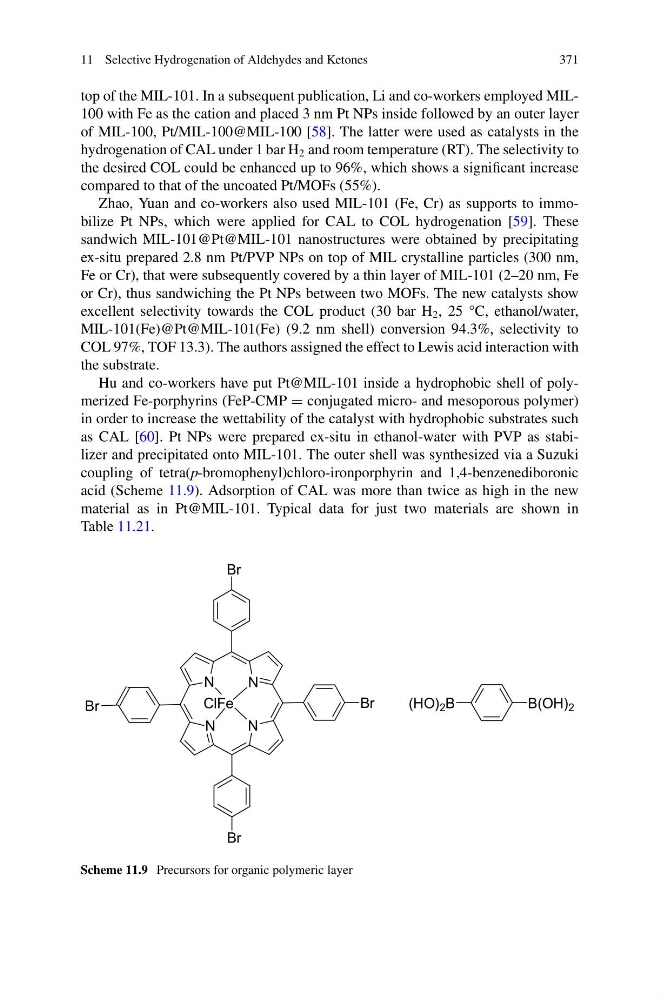
as CAL [60]. Pt NPs were prepared ex-situ in ethanol-water with PVP as stabilizer and precipitated onto MIL-101. The outer shell was synthesized via a Suzuki
coupling of tetra(p-bromophenyl)chloro-ironporphyrin and 1,4-benzenediboronic
acid (Scheme 11.9). Adsorption of CAL was more than twice as high in the new
material as in Pt@MIL-101. Typical data for just two materials are shown in
Table 11.21.
N
N
N
N
Br
Br
Br
Br
ClFe
(HO) 2 B
B(OH) 2
Scheme 11.9 Precursors for organic polymeric layer
371
top of the MIL-101. In a subsequent publication, Li and co-workers employed MIL100 with Fe as the cation and placed 3 nm Pt NPs inside followed by an outer layer
of MIL-100, Pt/MIL-100@MIL-100 [58]. The latter were used as catalysts in the
hydrogenation of CAL under 1 bar H 2 and room temperature (RT). The selectivity to
the desired COL could be enhanced up to 96%, which shows a significant increase
compared to that of the uncoated Pt/MOFs (55%).
Zhao, Yuan and co-workers also used MIL-101 (Fe, Cr) as supports to immobilize Pt NPs, which were applied for CAL to COL hydrogenation [59]. These
sandwich MIL-101@Pt@MIL-101 nanostructures were obtained by precipitating
ex-situ prepared 2.8 nm Pt/PVP NPs on top of MIL crystalline particles (300 nm,
Fe or Cr), that were subsequently covered by a thin layer of MIL-101 (2–20 nm, Fe
or Cr), thus sandwiching the Pt NPs between two MOFs. The new catalysts show
excellent selectivity towards the COL product (30 bar H 2 , 25 °C, ethanol/water,
MIL-101(Fe)@Pt@MIL-101(Fe) (9.2 nm shell) conversion 94.3%, selectivity to
COL 97%, TOF 13.3). The authors assigned the effect to Lewis acid interaction with
the substrate.
Hu and co-workers have put Pt@MIL-101 inside a hydrophobic shell of polymerized Fe-porphyrins (FeP-CMP = conjugated micro- and mesoporous polymer)
in order to increase the wettability of the catalyst with hydrophobic substrates such
as CAL [60]. Pt NPs were prepared ex-situ in ethanol-water with PVP as stabilizer and precipitated onto MIL-101. The outer shell was synthesized via a Suzuki
coupling of tetra(p-bromophenyl)chloro-ironporphyrin and 1,4-benzenediboronic
acid (Scheme 11.9). Adsorption of CAL was more than twice as high in the new
material as in Pt@MIL-101. Typical data for just two materials are shown in
Table 11.21.
N
N
N
N
Br
Br
Br
Br
ClFe
(HO) 2 B
B(OH) 2
Scheme 11.9 Precursors for organic polymeric layer