

370
I. Cano and P. W. N. M. van Leeuwen
11.4.4 Metal–Organic Frameworks as Supports
MOFs have become important supports for MNPs and nanoclusters (NCs), as they
confine the metal clusters inside their pores and also influence catalyst and substrates
through their close contact. Making uniform particles inside MOFs is not trivial,
but many researchers have succeeded in doing so. Huang et al. used UiO-66 [55]
and UiO-66-NH 2 , which are built up from [Zr 6 O 4 (OH) 4 ] clusters linked with 1,4benzenedicarboxylic acid and the amino-substituted diacid, respectively, forming a
cubic porous structure. The material presents channels and two types of cavities of 0.7
and 1.1 nm [56]. Pt was introduced as a water solution of K 2 PtCl 4 and then reduced
at high temperatures to yield 1–10% wt Pt@UiO-66-NH 2 with particle size 1.16 nm.
It was shown that the NPs were indeed inside the porous MOF. The catalysts were
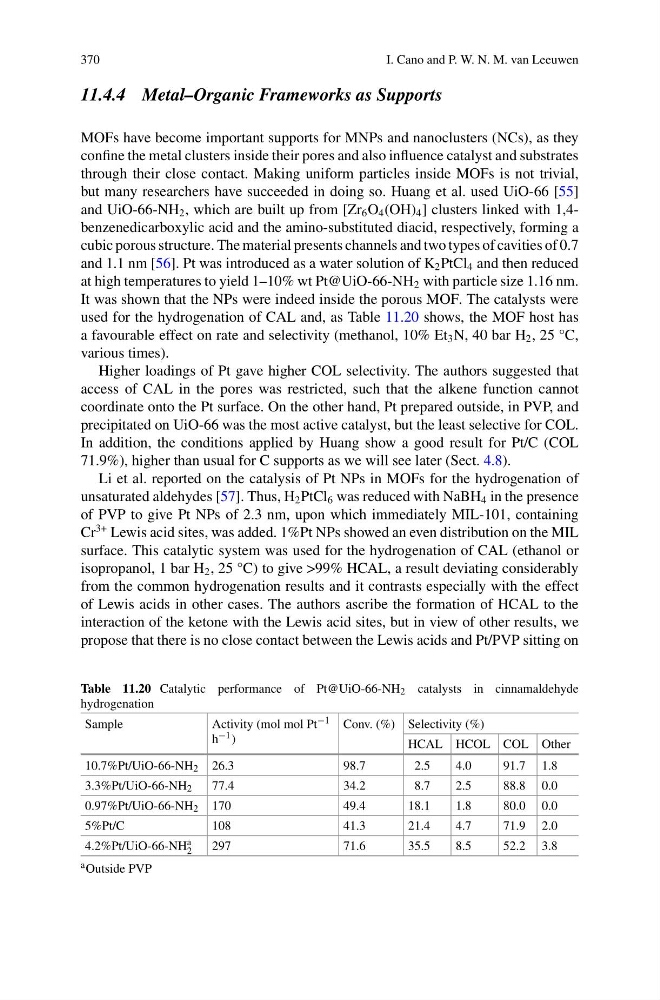
used for the hydrogenation of CAL and, as Table 11.20 shows, the MOF host has
a favourable effect on rate and selectivity (methanol, 10% Et 3 N, 40 bar H 2 , 25 °C,
various times).
Higher loadings of Pt gave higher COL selectivity. The authors suggested that
access of CAL in the pores was restricted, such that the alkene function cannot
coordinate onto the Pt surface. On the other hand, Pt prepared outside, in PVP, and
precipitated on UiO-66 was the most active catalyst, but the least selective for COL.
In addition, the conditions applied by Huang show a good result for Pt/C (COL
71.9%), higher than usual for C supports as we will see later (Sect. 4.8).
Li et al. reported on the catalysis of Pt NPs in MOFs for the hydrogenation of
unsaturated aldehydes [57]. Thus, H 2 PtCl 6 was reduced with NaBH 4 in the presence
of PVP to give Pt NPs of 2.3 nm, upon which immediately MIL-101, containing
Cr
3+ Lewis acid sites, was added. 1%Pt NPs showed an even distribution on the MIL
surface. This catalytic system was used for the hydrogenation of CAL (ethanol or
isopropanol, 1 bar H 2 , 25 °C) to give >99% HCAL, a result deviating considerably
from the common hydrogenation results and it contrasts especially with the effect
of Lewis acids in other cases. The authors ascribe the formation of HCAL to the
interaction of the ketone with the Lewis acid sites, but in view of other results, we
propose that there is no close contact between the Lewis acids and Pt/PVP sitting on
Table 11.20 Catalytic performance of Pt@UiO-66-NH 2 catalysts in cinnamaldehyde
hydrogenation
Sample
Activity (mol mol Pt −1
h −1 )
Conv. (%) Selectivity (%)
HCAL HCOL COL Other
10.7%Pt/UiO-66-NH 2 26.3
98.7
2.5
4.0
91.7 1.8
3.3%Pt/UiO-66-NH 2
77.4
34.2
8.7
2.5
88.8 0.0
0.97%Pt/UiO-66-NH 2 170
49.4
18.1
1.8
80.0 0.0
5%Pt/C
108
41.3
21.4
4.7
71.9 2.0
4.2%Pt/UiO-66-NH a
2
297
71.6
35.5
8.5
52.2 3.8
a Outside PVP
I. Cano and P. W. N. M. van Leeuwen
11.4.4 Metal–Organic Frameworks as Supports
MOFs have become important supports for MNPs and nanoclusters (NCs), as they
confine the metal clusters inside their pores and also influence catalyst and substrates
through their close contact. Making uniform particles inside MOFs is not trivial,
but many researchers have succeeded in doing so. Huang et al. used UiO-66 [55]
and UiO-66-NH 2 , which are built up from [Zr 6 O 4 (OH) 4 ] clusters linked with 1,4benzenedicarboxylic acid and the amino-substituted diacid, respectively, forming a
cubic porous structure. The material presents channels and two types of cavities of 0.7
and 1.1 nm [56]. Pt was introduced as a water solution of K 2 PtCl 4 and then reduced
at high temperatures to yield 1–10% wt Pt@UiO-66-NH 2 with particle size 1.16 nm.
It was shown that the NPs were indeed inside the porous MOF. The catalysts were
used for the hydrogenation of CAL and, as Table 11.20 shows, the MOF host has
a favourable effect on rate and selectivity (methanol, 10% Et 3 N, 40 bar H 2 , 25 °C,
various times).
Higher loadings of Pt gave higher COL selectivity. The authors suggested that
access of CAL in the pores was restricted, such that the alkene function cannot
coordinate onto the Pt surface. On the other hand, Pt prepared outside, in PVP, and
precipitated on UiO-66 was the most active catalyst, but the least selective for COL.
In addition, the conditions applied by Huang show a good result for Pt/C (COL
71.9%), higher than usual for C supports as we will see later (Sect. 4.8).
Li et al. reported on the catalysis of Pt NPs in MOFs for the hydrogenation of
unsaturated aldehydes [57]. Thus, H 2 PtCl 6 was reduced with NaBH 4 in the presence
of PVP to give Pt NPs of 2.3 nm, upon which immediately MIL-101, containing
Cr
3+ Lewis acid sites, was added. 1%Pt NPs showed an even distribution on the MIL
surface. This catalytic system was used for the hydrogenation of CAL (ethanol or
isopropanol, 1 bar H 2 , 25 °C) to give >99% HCAL, a result deviating considerably
from the common hydrogenation results and it contrasts especially with the effect
of Lewis acids in other cases. The authors ascribe the formation of HCAL to the
interaction of the ketone with the Lewis acid sites, but in view of other results, we
propose that there is no close contact between the Lewis acids and Pt/PVP sitting on
Table 11.20 Catalytic performance of Pt@UiO-66-NH 2 catalysts in cinnamaldehyde
hydrogenation
Sample
Activity (mol mol Pt −1
h −1 )
Conv. (%) Selectivity (%)
HCAL HCOL COL Other
10.7%Pt/UiO-66-NH 2 26.3
98.7
2.5
4.0
91.7 1.8
3.3%Pt/UiO-66-NH 2
77.4
34.2
8.7
2.5
88.8 0.0
0.97%Pt/UiO-66-NH 2 170
49.4
18.1
1.8
80.0 0.0
5%Pt/C
108
41.3
21.4
4.7
71.9 2.0
4.2%Pt/UiO-66-NH a
2
297
71.6
35.5
8.5
52.2 3.8
a Outside PVP