

362
I. Cano and P. W. N. M. van Leeuwen
for ‘naked’ AuNPs (NPs that are surrounded by weakly coordinating species and
thus present accessible active sites), where a homolytic H 2 activation mechanism was
demonstrated through kinetic and deuterium labelling investigations. On the other
hand, these studies revealed a heterolytic cleavage of dihydrogen for the Au/Al 2 O 3
system.
11.3 Hydrogenation of Unsaturated Aldehydes
and Ketones Catalyzed by Silver Nanoparticles
Like gold, silver displays a low capacity for hydrogen activation, but silver nanoparticles (AgNPs) have been shown to exhibit high selectivity to the allylic alcohol
product in the hydrogenation of α, β-unsaturated aldehydes and ketones. However,
in comparison with Au, there is very little precedent for hydrogenation of unsaturated
carbonyl compounds, in particular with Ag nanoparticles dispersed in solution.
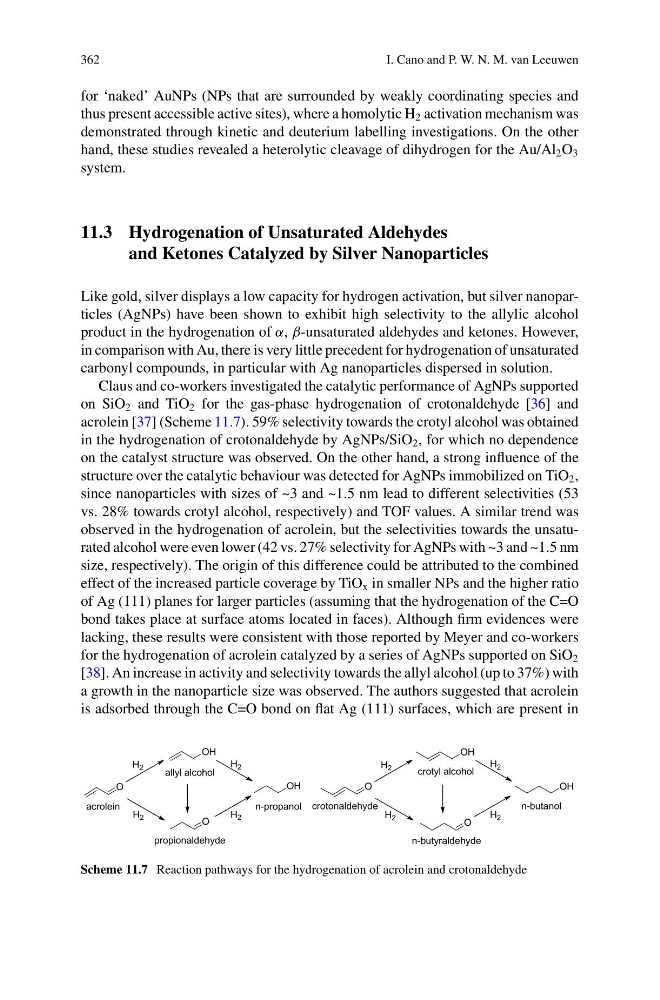
Claus and co-workers investigated the catalytic performance of AgNPs supported
on SiO 2 and TiO 2 for the gas-phase hydrogenation of crotonaldehyde [36] and
acrolein [37] (Scheme 11.7). 59% selectivity towards the crotyl alcohol was obtained
in the hydrogenation of crotonaldehyde by AgNPs/SiO 2 , for which no dependence
on the catalyst structure was observed. On the other hand, a strong influence of the
structure over the catalytic behaviour was detected for AgNPs immobilized on TiO 2 ,
since nanoparticles with sizes of ~3 and ~1.5 nm lead to different selectivities (53
vs. 28% towards crotyl alcohol, respectively) and TOF values. A similar trend was
observed in the hydrogenation of acrolein, but the selectivities towards the unsaturated alcohol were even lower (42 vs. 27% selectivity for AgNPs with ~3 and ~1.5 nm
size, respectively). The origin of this difference could be attributed to the combined
effect of the increased particle coverage by TiO x in smaller NPs and the higher ratio
of Ag (111) planes for larger particles (assuming that the hydrogenation of the C=O
bond takes place at surface atoms located in faces). Although firm evidences were
lacking, these results were consistent with those reported by Meyer and co-workers
for the hydrogenation of acrolein catalyzed by a series of AgNPs supported on SiO 2
[38]. An increase in activity and selectivity towards the allyl alcohol (up to 37%) with
a growth in the nanoparticle size was observed. The authors suggested that acrolein
is adsorbed through the C=O bond on flat Ag (111) surfaces, which are present in
O
OH
O
OH
acrolein
n-propanol
H 2
H 2
H 2
H 2
propionaldehyde
allyl alcohol
O
OH
O
OH
crotonaldehyde
n-butanol
H 2
H 2
n-butyraldehyde
crotyl alcohol
H 2
H 2
Scheme 11.7 Reaction pathways for the hydrogenation of acrolein and crotonaldehyde
I. Cano and P. W. N. M. van Leeuwen
for ‘naked’ AuNPs (NPs that are surrounded by weakly coordinating species and
thus present accessible active sites), where a homolytic H 2 activation mechanism was
demonstrated through kinetic and deuterium labelling investigations. On the other
hand, these studies revealed a heterolytic cleavage of dihydrogen for the Au/Al 2 O 3
system.
11.3 Hydrogenation of Unsaturated Aldehydes
and Ketones Catalyzed by Silver Nanoparticles
Like gold, silver displays a low capacity for hydrogen activation, but silver nanoparticles (AgNPs) have been shown to exhibit high selectivity to the allylic alcohol
product in the hydrogenation of α, β-unsaturated aldehydes and ketones. However,
in comparison with Au, there is very little precedent for hydrogenation of unsaturated
carbonyl compounds, in particular with Ag nanoparticles dispersed in solution.
Claus and co-workers investigated the catalytic performance of AgNPs supported
on SiO 2 and TiO 2 for the gas-phase hydrogenation of crotonaldehyde [36] and
acrolein [37] (Scheme 11.7). 59% selectivity towards the crotyl alcohol was obtained
in the hydrogenation of crotonaldehyde by AgNPs/SiO 2 , for which no dependence
on the catalyst structure was observed. On the other hand, a strong influence of the
structure over the catalytic behaviour was detected for AgNPs immobilized on TiO 2 ,
since nanoparticles with sizes of ~3 and ~1.5 nm lead to different selectivities (53
vs. 28% towards crotyl alcohol, respectively) and TOF values. A similar trend was
observed in the hydrogenation of acrolein, but the selectivities towards the unsaturated alcohol were even lower (42 vs. 27% selectivity for AgNPs with ~3 and ~1.5 nm
size, respectively). The origin of this difference could be attributed to the combined
effect of the increased particle coverage by TiO x in smaller NPs and the higher ratio
of Ag (111) planes for larger particles (assuming that the hydrogenation of the C=O
bond takes place at surface atoms located in faces). Although firm evidences were
lacking, these results were consistent with those reported by Meyer and co-workers
for the hydrogenation of acrolein catalyzed by a series of AgNPs supported on SiO 2
[38]. An increase in activity and selectivity towards the allyl alcohol (up to 37%) with
a growth in the nanoparticle size was observed. The authors suggested that acrolein
is adsorbed through the C=O bond on flat Ag (111) surfaces, which are present in
O
OH
O
OH
acrolein
n-propanol
H 2
H 2
H 2
H 2
propionaldehyde
allyl alcohol
O
OH
O
OH
crotonaldehyde
n-butanol
H 2
H 2
n-butyraldehyde
crotyl alcohol
H 2
H 2
Scheme 11.7 Reaction pathways for the hydrogenation of acrolein and crotonaldehyde