

11 Selective Hydrogenation of Aldehydes and Ketones
363
higher ratio in larger NPs, thus leading to the activation of the carbonyl group. In
addition, higher partial pressure of acrolein (increased acrolein coverage) produces
a rise in the selectivity. This effect could be attributed to a change in the adsorption
geometry of the substrate from parallel to the surface to expose only the C=O group.
In a subsequent work of Claus [39], an in-depth study of the different factors that
determine the activity and selectivity in the gas-phase hydrogenation of acrolein by
AgNPs supported on SiO 2 , Al 2 O 3 and ZnO was performed. Influence of the nature
of the support on the selectivity was observed, which can be ascribed to the specific
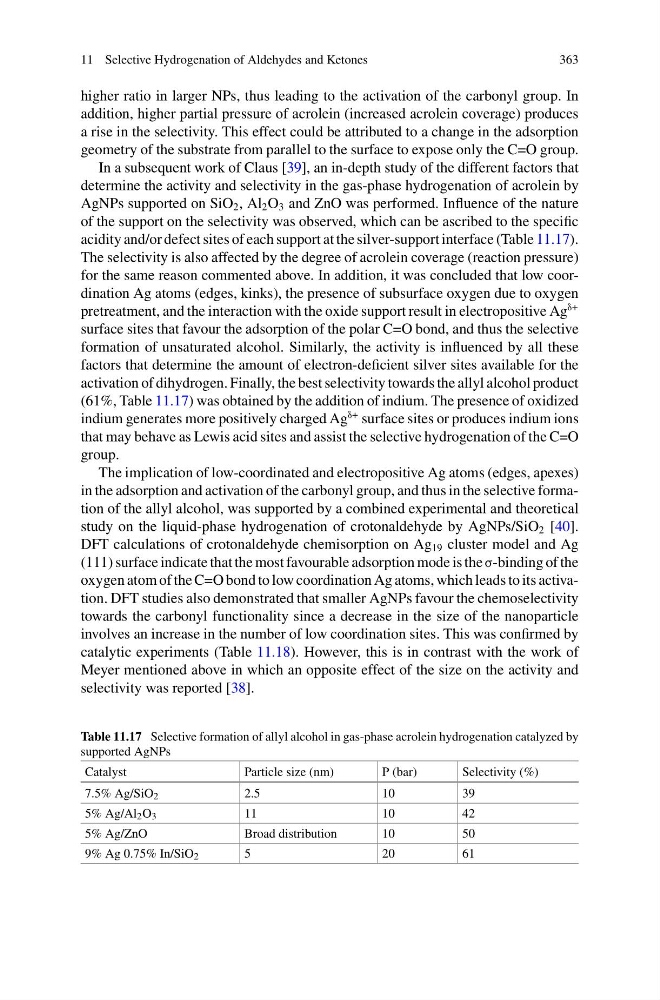
acidity and/or defect sites of each support at the silver-support interface (Table 11.17).
The selectivity is also affected by the degree of acrolein coverage (reaction pressure)
for the same reason commented above. In addition, it was concluded that low coordination Ag atoms (edges, kinks), the presence of subsurface oxygen due to oxygen
pretreatment, and the interaction with the oxide support result in electropositive Ag
δ+
surface sites that favour the adsorption of the polar C=O bond, and thus the selective
formation of unsaturated alcohol. Similarly, the activity is influenced by all these
factors that determine the amount of electron-deficient silver sites available for the
activation of dihydrogen. Finally, the best selectivity towards the allyl alcohol product
(61%, Table 11.17) was obtained by the addition of indium. The presence of oxidized
indium generates more positively charged Ag
δ+ surface sites or produces indium ions
that may behave as Lewis acid sites and assist the selective hydrogenation of the C=O
group.
The implication of low-coordinated and electropositive Ag atoms (edges, apexes)
in the adsorption and activation of the carbonyl group, and thus in the selective formation of the allyl alcohol, was supported by a combined experimental and theoretical
study on the liquid-phase hydrogenation of crotonaldehyde by AgNPs/SiO 2 [40].
DFT calculations of crotonaldehyde chemisorption on Ag 19 cluster model and Ag
(111) surface indicate that the most favourable adsorption mode is the σ-binding of the
oxygen atom of the C=O bond to low coordination Ag atoms, which leads to its activation. DFT studies also demonstrated that smaller AgNPs favour the chemoselectivity
towards the carbonyl functionality since a decrease in the size of the nanoparticle
involves an increase in the number of low coordination sites. This was confirmed by
catalytic experiments (Table 11.18). However, this is in contrast with the work of
Meyer mentioned above in which an opposite effect of the size on the activity and
selectivity was reported [38].
Table 11.17 Selective formation of allyl alcohol in gas-phase acrolein hydrogenation catalyzed by
supported AgNPs
Catalyst
Particle size (nm)
P (bar)
Selectivity (%)
7.5% Ag/SiO 2
2.5
10
39
5% Ag/Al 2 O 3
11
10
42
5% Ag/ZnO
Broad distribution
10
50
9% Ag 0.75% In/SiO 2
5
20
61
363
higher ratio in larger NPs, thus leading to the activation of the carbonyl group. In
addition, higher partial pressure of acrolein (increased acrolein coverage) produces
a rise in the selectivity. This effect could be attributed to a change in the adsorption
geometry of the substrate from parallel to the surface to expose only the C=O group.
In a subsequent work of Claus [39], an in-depth study of the different factors that
determine the activity and selectivity in the gas-phase hydrogenation of acrolein by
AgNPs supported on SiO 2 , Al 2 O 3 and ZnO was performed. Influence of the nature
of the support on the selectivity was observed, which can be ascribed to the specific
acidity and/or defect sites of each support at the silver-support interface (Table 11.17).
The selectivity is also affected by the degree of acrolein coverage (reaction pressure)
for the same reason commented above. In addition, it was concluded that low coordination Ag atoms (edges, kinks), the presence of subsurface oxygen due to oxygen
pretreatment, and the interaction with the oxide support result in electropositive Ag
δ+
surface sites that favour the adsorption of the polar C=O bond, and thus the selective
formation of unsaturated alcohol. Similarly, the activity is influenced by all these
factors that determine the amount of electron-deficient silver sites available for the
activation of dihydrogen. Finally, the best selectivity towards the allyl alcohol product
(61%, Table 11.17) was obtained by the addition of indium. The presence of oxidized
indium generates more positively charged Ag
δ+ surface sites or produces indium ions
that may behave as Lewis acid sites and assist the selective hydrogenation of the C=O
group.
The implication of low-coordinated and electropositive Ag atoms (edges, apexes)
in the adsorption and activation of the carbonyl group, and thus in the selective formation of the allyl alcohol, was supported by a combined experimental and theoretical
study on the liquid-phase hydrogenation of crotonaldehyde by AgNPs/SiO 2 [40].
DFT calculations of crotonaldehyde chemisorption on Ag 19 cluster model and Ag
(111) surface indicate that the most favourable adsorption mode is the σ-binding of the
oxygen atom of the C=O bond to low coordination Ag atoms, which leads to its activation. DFT studies also demonstrated that smaller AgNPs favour the chemoselectivity
towards the carbonyl functionality since a decrease in the size of the nanoparticle
involves an increase in the number of low coordination sites. This was confirmed by
catalytic experiments (Table 11.18). However, this is in contrast with the work of
Meyer mentioned above in which an opposite effect of the size on the activity and
selectivity was reported [38].
Table 11.17 Selective formation of allyl alcohol in gas-phase acrolein hydrogenation catalyzed by
supported AgNPs
Catalyst
Particle size (nm)
P (bar)
Selectivity (%)
7.5% Ag/SiO 2
2.5
10
39
5% Ag/Al 2 O 3
11
10
42
5% Ag/ZnO
Broad distribution
10
50
9% Ag 0.75% In/SiO 2
5
20
61