

11 Selective Hydrogenation of Aldehydes and Ketones
361
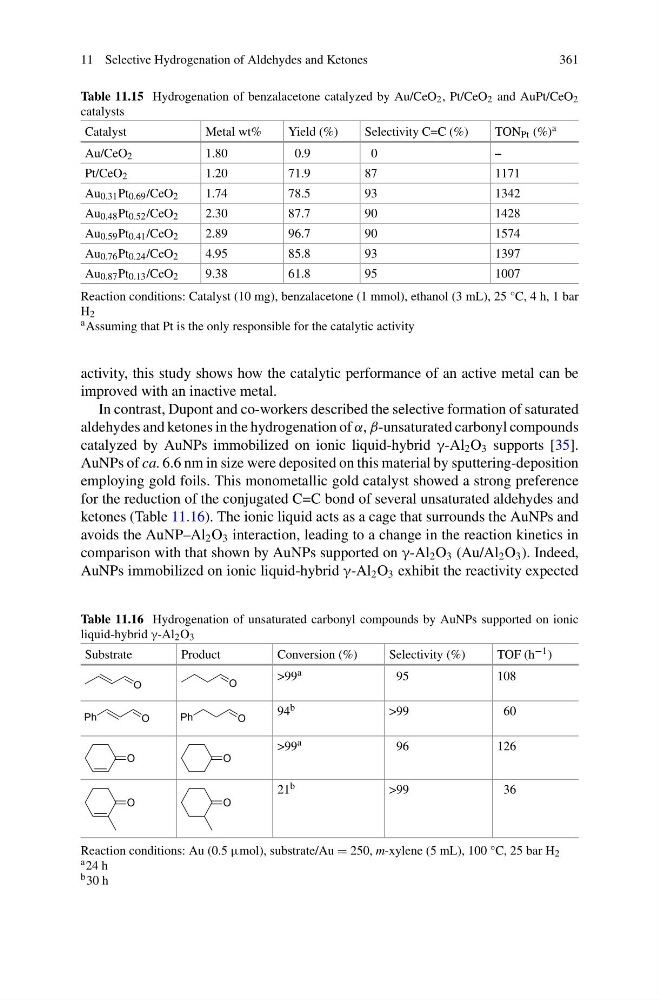
Table 11.15 Hydrogenation of benzalacetone catalyzed by Au/CeO 2 , Pt/CeO 2 and AuPt/CeO 2
catalysts
Catalyst
Metal wt%
Yield (%)
Selectivity C=C (%)
TON Pt (%) a
Au/CeO 2
1.80
0.9
0
–
Pt/CeO 2
1.20
71.9
87
1171
Au 0.31 Pt 0.69 /CeO 2
1.74
78.5
93
1342
Au 0.48 Pt 0.52 /CeO 2
2.30
87.7
90
1428
Au 0.59 Pt 0.41 /CeO 2
2.89
96.7
90
1574
Au 0.76 Pt 0.24 /CeO 2
4.95
85.8
93
1397
Au 0.87 Pt 0.13 /CeO 2
9.38
61.8
95
1007
Reaction conditions: Catalyst (10 mg), benzalacetone (1 mmol), ethanol (3 mL), 25 °C, 4 h, 1 bar
H 2
a Assuming that Pt is the only responsible for the catalytic activity
activity, this study shows how the catalytic performance of an active metal can be
improved with an inactive metal.
In contrast, Dupont and co-workers described the selective formation of saturated
aldehydes and ketones in the hydrogenation of α, β-unsaturated carbonyl compounds
catalyzed by AuNPs immobilized on ionic liquid-hybrid γ-Al 2 O 3 supports [35].
AuNPs of ca. 6.6 nm in size were deposited on this material by sputtering-deposition
employing gold foils. This monometallic gold catalyst showed a strong preference
for the reduction of the conjugated C=C bond of several unsaturated aldehydes and
ketones (Table 11.16). The ionic liquid acts as a cage that surrounds the AuNPs and
avoids the AuNP–Al 2 O 3 interaction, leading to a change in the reaction kinetics in
comparison with that shown by AuNPs supported on γ-Al 2 O 3 (Au/Al 2 O 3 ). Indeed,
AuNPs immobilized on ionic liquid-hybrid γ-Al 2 O 3 exhibit the reactivity expected
Table 11.16 Hydrogenation of unsaturated carbonyl compounds by AuNPs supported on ionic
liquid-hybrid γ-Al 2 O 3
Substrate
Product
Conversion (%)
Selectivity (%)
TOF (h −1 )
>99 a
95
108
94 b
>99
60
>99 a
96
126
21 b
>99
36
Reaction conditions: Au (0.5 μmol), substrate/Au = 250, m-xylene (5 mL), 100 °C, 25 bar H 2
a 24 h
b 30 h
361
Table 11.15 Hydrogenation of benzalacetone catalyzed by Au/CeO 2 , Pt/CeO 2 and AuPt/CeO 2
catalysts
Catalyst
Metal wt%
Yield (%)
Selectivity C=C (%)
TON Pt (%) a
Au/CeO 2
1.80
0.9
0
–
Pt/CeO 2
1.20
71.9
87
1171
Au 0.31 Pt 0.69 /CeO 2
1.74
78.5
93
1342
Au 0.48 Pt 0.52 /CeO 2
2.30
87.7
90
1428
Au 0.59 Pt 0.41 /CeO 2
2.89
96.7
90
1574
Au 0.76 Pt 0.24 /CeO 2
4.95
85.8
93
1397
Au 0.87 Pt 0.13 /CeO 2
9.38
61.8
95
1007
Reaction conditions: Catalyst (10 mg), benzalacetone (1 mmol), ethanol (3 mL), 25 °C, 4 h, 1 bar
H 2
a Assuming that Pt is the only responsible for the catalytic activity
activity, this study shows how the catalytic performance of an active metal can be
improved with an inactive metal.
In contrast, Dupont and co-workers described the selective formation of saturated
aldehydes and ketones in the hydrogenation of α, β-unsaturated carbonyl compounds
catalyzed by AuNPs immobilized on ionic liquid-hybrid γ-Al 2 O 3 supports [35].
AuNPs of ca. 6.6 nm in size were deposited on this material by sputtering-deposition
employing gold foils. This monometallic gold catalyst showed a strong preference
for the reduction of the conjugated C=C bond of several unsaturated aldehydes and
ketones (Table 11.16). The ionic liquid acts as a cage that surrounds the AuNPs and
avoids the AuNP–Al 2 O 3 interaction, leading to a change in the reaction kinetics in
comparison with that shown by AuNPs supported on γ-Al 2 O 3 (Au/Al 2 O 3 ). Indeed,
AuNPs immobilized on ionic liquid-hybrid γ-Al 2 O 3 exhibit the reactivity expected
Table 11.16 Hydrogenation of unsaturated carbonyl compounds by AuNPs supported on ionic
liquid-hybrid γ-Al 2 O 3
Substrate
Product
Conversion (%)
Selectivity (%)
TOF (h −1 )
>99 a
95
108
94 b
>99
60
>99 a
96
126
21 b
>99
36
Reaction conditions: Au (0.5 μmol), substrate/Au = 250, m-xylene (5 mL), 100 °C, 25 bar H 2
a 24 h
b 30 h