

360
I. Cano and P. W. N. M. van Leeuwen
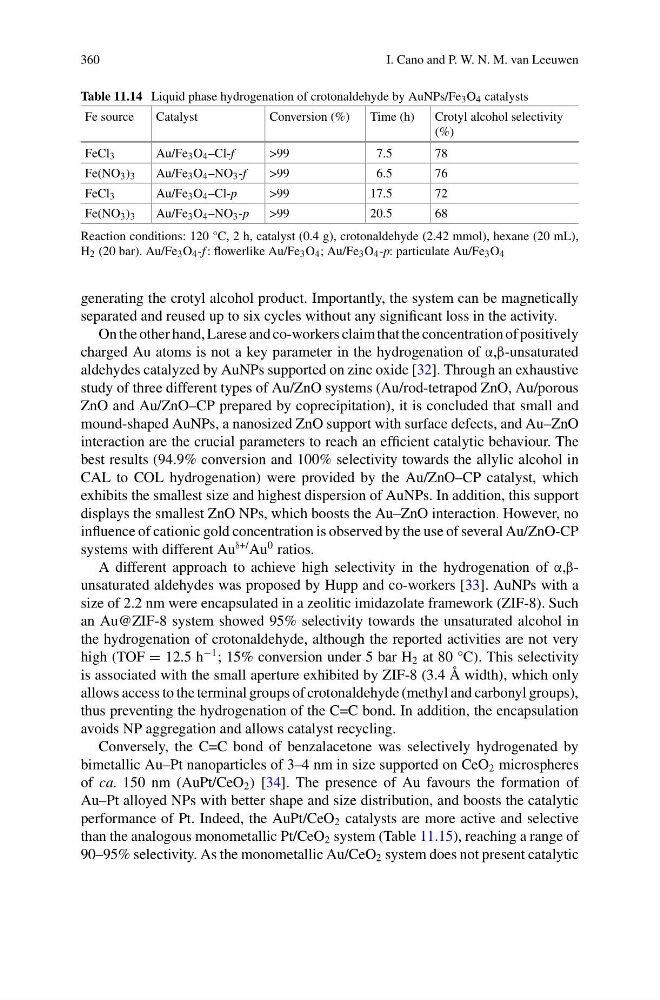
Table 11.14 Liquid phase hydrogenation of crotonaldehyde by AuNPs/Fe 3 O 4 catalysts
Fe source
Catalyst
Conversion (%)
Time (h)
Crotyl alcohol selectivity
(%)
FeCl 3
Au/Fe 3 O 4 –Cl-f
>99
7.5
78
Fe(NO 3 ) 3
Au/Fe 3 O 4 –NO 3 -f
>99
6.5
76
FeCl 3
Au/Fe 3 O 4 –Cl-p
>99
17.5
72
Fe(NO 3 ) 3
Au/Fe 3 O 4 –NO 3 -p
>99
20.5
68
Reaction conditions: 120 °C, 2 h, catalyst (0.4 g), crotonaldehyde (2.42 mmol), hexane (20 mL),
H 2 (20 bar). Au/Fe 3 O 4 -f : flowerlike Au/Fe 3 O 4 ; Au/Fe 3 O 4 -p: particulate Au/Fe 3 O 4
generating the crotyl alcohol product. Importantly, the system can be magnetically
separated and reused up to six cycles without any significant loss in the activity.
On the other hand, Larese and co-workers claim that the concentration of positively
charged Au atoms is not a key parameter in the hydrogenation of α,β-unsaturated
aldehydes catalyzed by AuNPs supported on zinc oxide [32]. Through an exhaustive
study of three different types of Au/ZnO systems (Au/rod-tetrapod ZnO, Au/porous
ZnO and Au/ZnO–CP prepared by coprecipitation), it is concluded that small and
mound-shaped AuNPs, a nanosized ZnO support with surface defects, and Au–ZnO
interaction are the crucial parameters to reach an efficient catalytic behaviour. The
best results (94.9% conversion and 100% selectivity towards the allylic alcohol in
CAL to COL hydrogenation) were provided by the Au/ZnO–CP catalyst, which
exhibits the smallest size and highest dispersion of AuNPs. In addition, this support
displays the smallest ZnO NPs, which boosts the Au–ZnO interaction. However, no
influence of cationic gold concentration is observed by the use of several Au/ZnO-CP
systems with different Au
δ+/ Au
0 ratios.
A different approach to achieve high selectivity in the hydrogenation of α,βunsaturated aldehydes was proposed by Hupp and co-workers [33]. AuNPs with a
size of 2.2 nm were encapsulated in a zeolitic imidazolate framework (ZIF-8). Such
an Au@ZIF-8 system showed 95% selectivity towards the unsaturated alcohol in
the hydrogenation of crotonaldehyde, although the reported activities are not very
high (TOF = 12.5 h
−1 ; 15% conversion under 5 bar H 2 at 80 °C). This selectivity
is associated with the small aperture exhibited by ZIF-8 (3.4 Å width), which only
allows access to the terminal groups of crotonaldehyde (methyl and carbonyl groups),
thus preventing the hydrogenation of the C=C bond. In addition, the encapsulation
avoids NP aggregation and allows catalyst recycling.
Conversely, the C=C bond of benzalacetone was selectively hydrogenated by
bimetallic Au–Pt nanoparticles of 3–4 nm in size supported on CeO 2 microspheres
of ca. 150 nm (AuPt/CeO 2 ) [34]. The presence of Au favours the formation of
Au–Pt alloyed NPs with better shape and size distribution, and boosts the catalytic
performance of Pt. Indeed, the AuPt/CeO 2 catalysts are more active and selective
than the analogous monometallic Pt/CeO 2 system (Table 11.15), reaching a range of
90–95% selectivity. As the monometallic Au/CeO 2 system does not present catalytic
I. Cano and P. W. N. M. van Leeuwen
Table 11.14 Liquid phase hydrogenation of crotonaldehyde by AuNPs/Fe 3 O 4 catalysts
Fe source
Catalyst
Conversion (%)
Time (h)
Crotyl alcohol selectivity
(%)
FeCl 3
Au/Fe 3 O 4 –Cl-f
>99
7.5
78
Fe(NO 3 ) 3
Au/Fe 3 O 4 –NO 3 -f
>99
6.5
76
FeCl 3
Au/Fe 3 O 4 –Cl-p
>99
17.5
72
Fe(NO 3 ) 3
Au/Fe 3 O 4 –NO 3 -p
>99
20.5
68
Reaction conditions: 120 °C, 2 h, catalyst (0.4 g), crotonaldehyde (2.42 mmol), hexane (20 mL),
H 2 (20 bar). Au/Fe 3 O 4 -f : flowerlike Au/Fe 3 O 4 ; Au/Fe 3 O 4 -p: particulate Au/Fe 3 O 4
generating the crotyl alcohol product. Importantly, the system can be magnetically
separated and reused up to six cycles without any significant loss in the activity.
On the other hand, Larese and co-workers claim that the concentration of positively
charged Au atoms is not a key parameter in the hydrogenation of α,β-unsaturated
aldehydes catalyzed by AuNPs supported on zinc oxide [32]. Through an exhaustive
study of three different types of Au/ZnO systems (Au/rod-tetrapod ZnO, Au/porous
ZnO and Au/ZnO–CP prepared by coprecipitation), it is concluded that small and
mound-shaped AuNPs, a nanosized ZnO support with surface defects, and Au–ZnO
interaction are the crucial parameters to reach an efficient catalytic behaviour. The
best results (94.9% conversion and 100% selectivity towards the allylic alcohol in
CAL to COL hydrogenation) were provided by the Au/ZnO–CP catalyst, which
exhibits the smallest size and highest dispersion of AuNPs. In addition, this support
displays the smallest ZnO NPs, which boosts the Au–ZnO interaction. However, no
influence of cationic gold concentration is observed by the use of several Au/ZnO-CP
systems with different Au
δ+/ Au
0 ratios.
A different approach to achieve high selectivity in the hydrogenation of α,βunsaturated aldehydes was proposed by Hupp and co-workers [33]. AuNPs with a
size of 2.2 nm were encapsulated in a zeolitic imidazolate framework (ZIF-8). Such
an Au@ZIF-8 system showed 95% selectivity towards the unsaturated alcohol in
the hydrogenation of crotonaldehyde, although the reported activities are not very
high (TOF = 12.5 h
−1 ; 15% conversion under 5 bar H 2 at 80 °C). This selectivity
is associated with the small aperture exhibited by ZIF-8 (3.4 Å width), which only
allows access to the terminal groups of crotonaldehyde (methyl and carbonyl groups),
thus preventing the hydrogenation of the C=C bond. In addition, the encapsulation
avoids NP aggregation and allows catalyst recycling.
Conversely, the C=C bond of benzalacetone was selectively hydrogenated by
bimetallic Au–Pt nanoparticles of 3–4 nm in size supported on CeO 2 microspheres
of ca. 150 nm (AuPt/CeO 2 ) [34]. The presence of Au favours the formation of
Au–Pt alloyed NPs with better shape and size distribution, and boosts the catalytic
performance of Pt. Indeed, the AuPt/CeO 2 catalysts are more active and selective
than the analogous monometallic Pt/CeO 2 system (Table 11.15), reaching a range of
90–95% selectivity. As the monometallic Au/CeO 2 system does not present catalytic