

11 Selective Hydrogenation of Aldehydes and Ketones
359
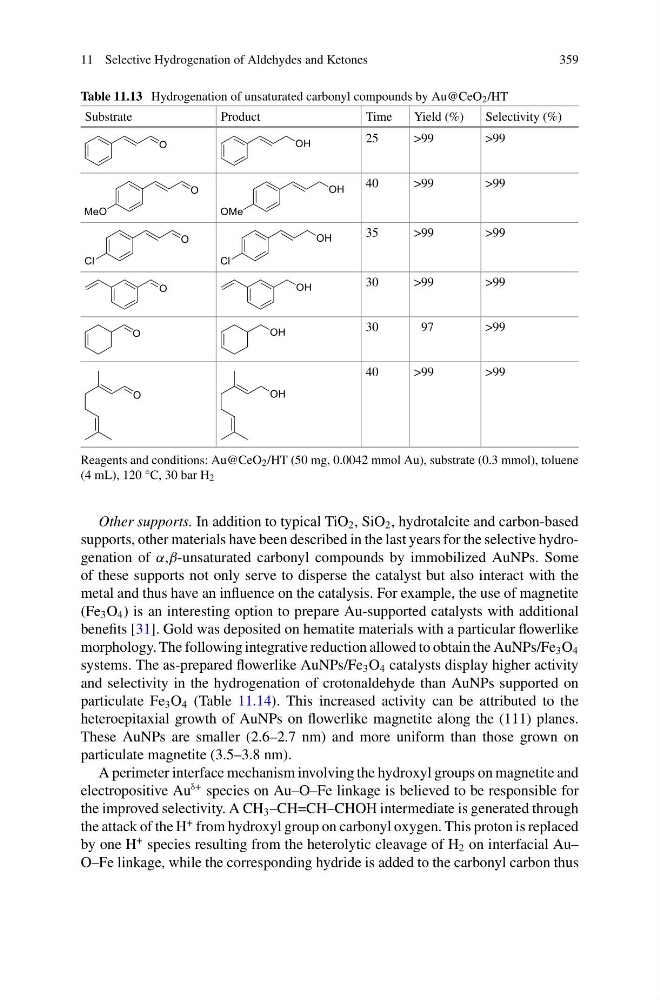
Table 11.13 Hydrogenation of unsaturated carbonyl compounds by Au@CeO 2 /HT
Substrate
Product
Time
Yield (%)
Selectivity (%)
25
>99
>99
40
>99
>99
35
>99
>99
30
>99
>99
30
97
>99
40
>99
>99
Reagents and conditions: Au@CeO 2 /HT (50 mg, 0.0042 mmol Au), substrate (0.3 mmol), toluene
(4 mL), 120 °C, 30 bar H 2
Other supports. In addition to typical TiO 2 , SiO 2 , hydrotalcite and carbon-based
supports, other materials have been described in the last years for the selective hydrogenation of α,β-unsaturated carbonyl compounds by immobilized AuNPs. Some
of these supports not only serve to disperse the catalyst but also interact with the
metal and thus have an influence on the catalysis. For example, the use of magnetite
(Fe 3 O 4 ) is an interesting option to prepare Au-supported catalysts with additional
benefits [31]. Gold was deposited on hematite materials with a particular flowerlike
morphology. The following integrative reduction allowed to obtain the AuNPs/Fe 3 O 4
systems. The as-prepared flowerlike AuNPs/Fe 3 O 4 catalysts display higher activity
and selectivity in the hydrogenation of crotonaldehyde than AuNPs supported on
particulate Fe 3 O 4 (Table 11.14). This increased activity can be attributed to the
heteroepitaxial growth of AuNPs on flowerlike magnetite along the (111) planes.
These AuNPs are smaller (2.6–2.7 nm) and more uniform than those grown on
particulate magnetite (3.5–3.8 nm).
A perimeter interface mechanism involving the hydroxyl groups on magnetite and
electropositive Au
δ+ species on Au–O–Fe linkage is believed to be responsible for
the improved selectivity. A CH 3 –CH=CH–CHOH intermediate is generated through
the attack of the H
+ from hydroxyl group on carbonyl oxygen. This proton is replaced
by one H
+ species resulting from the heterolytic cleavage of H 2 on interfacial Au–
O–Fe linkage, while the corresponding hydride is added to the carbonyl carbon thus
359
Table 11.13 Hydrogenation of unsaturated carbonyl compounds by Au@CeO 2 /HT
Substrate
Product
Time
Yield (%)
Selectivity (%)
25
>99
>99
40
>99
>99
35
>99
>99
30
>99
>99
30
97
>99
40
>99
>99
Reagents and conditions: Au@CeO 2 /HT (50 mg, 0.0042 mmol Au), substrate (0.3 mmol), toluene
(4 mL), 120 °C, 30 bar H 2
Other supports. In addition to typical TiO 2 , SiO 2 , hydrotalcite and carbon-based
supports, other materials have been described in the last years for the selective hydrogenation of α,β-unsaturated carbonyl compounds by immobilized AuNPs. Some
of these supports not only serve to disperse the catalyst but also interact with the
metal and thus have an influence on the catalysis. For example, the use of magnetite
(Fe 3 O 4 ) is an interesting option to prepare Au-supported catalysts with additional
benefits [31]. Gold was deposited on hematite materials with a particular flowerlike
morphology. The following integrative reduction allowed to obtain the AuNPs/Fe 3 O 4
systems. The as-prepared flowerlike AuNPs/Fe 3 O 4 catalysts display higher activity
and selectivity in the hydrogenation of crotonaldehyde than AuNPs supported on
particulate Fe 3 O 4 (Table 11.14). This increased activity can be attributed to the
heteroepitaxial growth of AuNPs on flowerlike magnetite along the (111) planes.
These AuNPs are smaller (2.6–2.7 nm) and more uniform than those grown on
particulate magnetite (3.5–3.8 nm).
A perimeter interface mechanism involving the hydroxyl groups on magnetite and
electropositive Au
δ+ species on Au–O–Fe linkage is believed to be responsible for
the improved selectivity. A CH 3 –CH=CH–CHOH intermediate is generated through
the attack of the H
+ from hydroxyl group on carbonyl oxygen. This proton is replaced
by one H
+ species resulting from the heterolytic cleavage of H 2 on interfacial Au–
O–Fe linkage, while the corresponding hydride is added to the carbonyl carbon thus