

358
I. Cano and P. W. N. M. van Leeuwen
charged two-dimensional hydroxide layers and interlayer regions containing charge
compensating anions. HTs are promising materials as basic supports which, when
calcined, generate mixed Mg–Al–O oxides with strong Lewis basic character.
AuNPs immobilized on hydrotalcite (2%Au/Mg 2 AlO) were employed as catalyst
in the chemoselective hydrogenation of several α,β-unsaturated aldehydes, such as
CAL [28] and crotonaldehyde [29] (Table 11.12). A decrease in activity and selectivity was observed at higher calcination temperatures of both Mg 2 AlO support and
Au/Mg 2 AlO catalyst, which can be correlated with the Au
3+ /Au
0 ratio. At lower
calcination temperatures, the Au
3+ /Au
0 ratio increases, and thus the Lewis acidity is
higher. These Lewis acid sites may favour the adsorption and subsequent activation
of the polar carbonyl group, leading to increased activity and selectivity.
Complete selectivities towards the unsaturated alcohol product were obtained
by Kaneda and co-workers in the hydrogenation of carbonyl compounds catalyzed
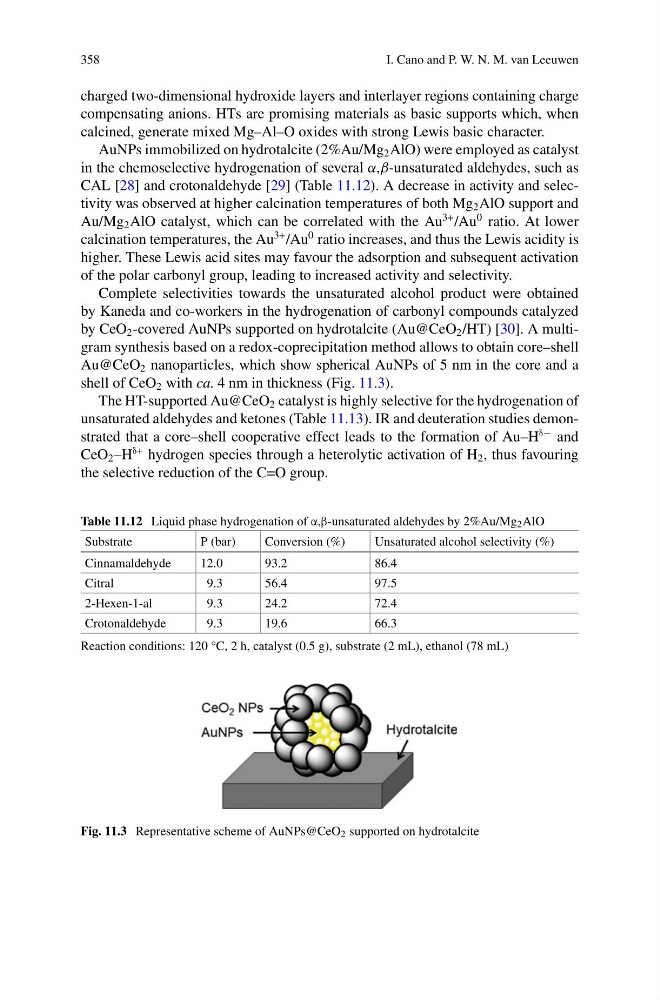
by CeO 2 -covered AuNPs supported on hydrotalcite (Au@CeO 2 /HT) [30]. A multigram synthesis based on a redox-coprecipitation method allows to obtain core–shell
Au@CeO 2 nanoparticles, which show spherical AuNPs of 5 nm in the core and a
shell of CeO 2 with ca. 4 nm in thickness (Fig. 11.3).
The HT-supported Au@CeO 2 catalyst is highly selective for the hydrogenation of
unsaturated aldehydes and ketones (Table 11.13). IR and deuteration studies demonstrated that a core–shell cooperative effect leads to the formation of Au–H
δ− and
CeO 2 –H
δ+ hydrogen species through a heterolytic activation of H 2 , thus favouring
the selective reduction of the C=O group.
Table 11.12 Liquid phase hydrogenation of α,β-unsaturated aldehydes by 2%Au/Mg 2 AlO
Substrate
P (bar)
Conversion (%)
Unsaturated alcohol selectivity (%)
Cinnamaldehyde
12.0
93.2
86.4
Citral
9.3
56.4
97.5
2-Hexen-1-al
9.3
24.2
72.4
Crotonaldehyde
9.3
19.6
66.3
Reaction conditions: 120 °C, 2 h, catalyst (0.5 g), substrate (2 mL), ethanol (78 mL)
Fig. 11.3 Representative scheme of AuNPs@CeO 2 supported on hydrotalcite
I. Cano and P. W. N. M. van Leeuwen
charged two-dimensional hydroxide layers and interlayer regions containing charge
compensating anions. HTs are promising materials as basic supports which, when
calcined, generate mixed Mg–Al–O oxides with strong Lewis basic character.
AuNPs immobilized on hydrotalcite (2%Au/Mg 2 AlO) were employed as catalyst
in the chemoselective hydrogenation of several α,β-unsaturated aldehydes, such as
CAL [28] and crotonaldehyde [29] (Table 11.12). A decrease in activity and selectivity was observed at higher calcination temperatures of both Mg 2 AlO support and
Au/Mg 2 AlO catalyst, which can be correlated with the Au
3+ /Au
0 ratio. At lower
calcination temperatures, the Au
3+ /Au
0 ratio increases, and thus the Lewis acidity is
higher. These Lewis acid sites may favour the adsorption and subsequent activation
of the polar carbonyl group, leading to increased activity and selectivity.
Complete selectivities towards the unsaturated alcohol product were obtained
by Kaneda and co-workers in the hydrogenation of carbonyl compounds catalyzed
by CeO 2 -covered AuNPs supported on hydrotalcite (Au@CeO 2 /HT) [30]. A multigram synthesis based on a redox-coprecipitation method allows to obtain core–shell
Au@CeO 2 nanoparticles, which show spherical AuNPs of 5 nm in the core and a
shell of CeO 2 with ca. 4 nm in thickness (Fig. 11.3).
The HT-supported Au@CeO 2 catalyst is highly selective for the hydrogenation of
unsaturated aldehydes and ketones (Table 11.13). IR and deuteration studies demonstrated that a core–shell cooperative effect leads to the formation of Au–H
δ− and
CeO 2 –H
δ+ hydrogen species through a heterolytic activation of H 2 , thus favouring
the selective reduction of the C=O group.
Table 11.12 Liquid phase hydrogenation of α,β-unsaturated aldehydes by 2%Au/Mg 2 AlO
Substrate
P (bar)
Conversion (%)
Unsaturated alcohol selectivity (%)
Cinnamaldehyde
12.0
93.2
86.4
Citral
9.3
56.4
97.5
2-Hexen-1-al
9.3
24.2
72.4
Crotonaldehyde
9.3
19.6
66.3
Reaction conditions: 120 °C, 2 h, catalyst (0.5 g), substrate (2 mL), ethanol (78 mL)
Fig. 11.3 Representative scheme of AuNPs@CeO 2 supported on hydrotalcite