

11 Selective Hydrogenation of Aldehydes and Ketones
357
On the contrary, the C=C bond of CAL was selectively hydrogenated by the
use of AuNPs (ca. 3.2 nm) confined in the cavity of CNTs [26]. 91% selectivity
was reached at 95% conversion in a process for which a homolytic cleavage of H 2
was proposed. A better result was obtained in the hydrogenation of CAL catalyzed
by separate Au and Pd nanoparticles immobilized on ordered mesoporous carbon
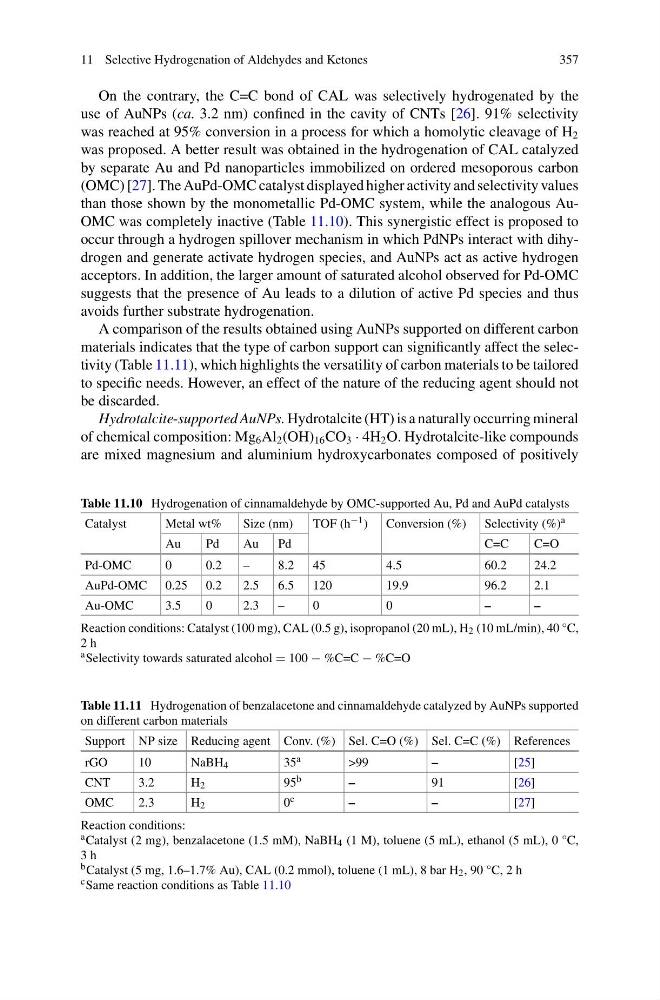
(OMC) [27]. The AuPd-OMC catalyst displayed higher activity and selectivity values
than those shown by the monometallic Pd-OMC system, while the analogous AuOMC was completely inactive (Table 11.10). This synergistic effect is proposed to
occur through a hydrogen spillover mechanism in which PdNPs interact with dihydrogen and generate activate hydrogen species, and AuNPs act as active hydrogen
acceptors. In addition, the larger amount of saturated alcohol observed for Pd-OMC
suggests that the presence of Au leads to a dilution of active Pd species and thus
avoids further substrate hydrogenation.
A comparison of the results obtained using AuNPs supported on different carbon
materials indicates that the type of carbon support can significantly affect the selectivity (Table 11.11), which highlights the versatility of carbon materials to be tailored
to specific needs. However, an effect of the nature of the reducing agent should not
be discarded.
Hydrotalcite-supported AuNPs. Hydrotalcite (HT) is a naturally occurring mineral
of chemical composition: Mg 6 Al 2 (OH) 16 CO 3 · 4H 2 O. Hydrotalcite-like compounds
are mixed magnesium and aluminium hydroxycarbonates composed of positively
Table 11.10 Hydrogenation of cinnamaldehyde by OMC-supported Au, Pd and AuPd catalysts
Catalyst
Metal wt%
Size (nm)
TOF (h −1 ) Conversion (%) Selectivity (%) a
Au
Pd
Au
Pd
C=C
C=O
Pd-OMC
0
0.2
–
8.2 45
4.5
60.2
24.2
AuPd-OMC 0.25 0.2
2.5 6.5 120
19.9
96.2
2.1
Au-OMC
3.5
0
2.3 –
0
0
–
–
Reaction conditions: Catalyst (100 mg), CAL (0.5 g), isopropanol (20 mL), H 2 (10 mL/min), 40 °C,
2 h
a Selectivity towards saturated alcohol = 100 − %C=C − %C=O
Table 11.11 Hydrogenation of benzalacetone and cinnamaldehyde catalyzed by AuNPs supported
on different carbon materials
Support NP size Reducing agent Conv. (%) Sel. C=O (%) Sel. C=C (%) References
rGO
10
NaBH 4
35 a
>99
–
[25]
CNT
3.2
H 2
95 b
–
91
[26]
OMC
2.3
H 2
0 c
–
–
[27]
Reaction conditions:
a Catalyst (2 mg), benzalacetone (1.5 mM), NaBH 4 (1 M), toluene (5 mL), ethanol (5 mL), 0 °C,
3 h
b Catalyst (5 mg, 1.6–1.7% Au), CAL (0.2 mmol), toluene (1 mL), 8 bar H 2 , 90 °C, 2 h
c Same reaction conditions as Table 11.10
357
On the contrary, the C=C bond of CAL was selectively hydrogenated by the
use of AuNPs (ca. 3.2 nm) confined in the cavity of CNTs [26]. 91% selectivity
was reached at 95% conversion in a process for which a homolytic cleavage of H 2
was proposed. A better result was obtained in the hydrogenation of CAL catalyzed
by separate Au and Pd nanoparticles immobilized on ordered mesoporous carbon
(OMC) [27]. The AuPd-OMC catalyst displayed higher activity and selectivity values
than those shown by the monometallic Pd-OMC system, while the analogous AuOMC was completely inactive (Table 11.10). This synergistic effect is proposed to
occur through a hydrogen spillover mechanism in which PdNPs interact with dihydrogen and generate activate hydrogen species, and AuNPs act as active hydrogen
acceptors. In addition, the larger amount of saturated alcohol observed for Pd-OMC
suggests that the presence of Au leads to a dilution of active Pd species and thus
avoids further substrate hydrogenation.
A comparison of the results obtained using AuNPs supported on different carbon
materials indicates that the type of carbon support can significantly affect the selectivity (Table 11.11), which highlights the versatility of carbon materials to be tailored
to specific needs. However, an effect of the nature of the reducing agent should not
be discarded.
Hydrotalcite-supported AuNPs. Hydrotalcite (HT) is a naturally occurring mineral
of chemical composition: Mg 6 Al 2 (OH) 16 CO 3 · 4H 2 O. Hydrotalcite-like compounds
are mixed magnesium and aluminium hydroxycarbonates composed of positively
Table 11.10 Hydrogenation of cinnamaldehyde by OMC-supported Au, Pd and AuPd catalysts
Catalyst
Metal wt%
Size (nm)
TOF (h −1 ) Conversion (%) Selectivity (%) a
Au
Pd
Au
Pd
C=C
C=O
Pd-OMC
0
0.2
–
8.2 45
4.5
60.2
24.2
AuPd-OMC 0.25 0.2
2.5 6.5 120
19.9
96.2
2.1
Au-OMC
3.5
0
2.3 –
0
0
–
–
Reaction conditions: Catalyst (100 mg), CAL (0.5 g), isopropanol (20 mL), H 2 (10 mL/min), 40 °C,
2 h
a Selectivity towards saturated alcohol = 100 − %C=C − %C=O
Table 11.11 Hydrogenation of benzalacetone and cinnamaldehyde catalyzed by AuNPs supported
on different carbon materials
Support NP size Reducing agent Conv. (%) Sel. C=O (%) Sel. C=C (%) References
rGO
10
NaBH 4
35 a
>99
–
[25]
CNT
3.2
H 2
95 b
–
91
[26]
OMC
2.3
H 2
0 c
–
–
[27]
Reaction conditions:
a Catalyst (2 mg), benzalacetone (1.5 mM), NaBH 4 (1 M), toluene (5 mL), ethanol (5 mL), 0 °C,
3 h
b Catalyst (5 mg, 1.6–1.7% Au), CAL (0.2 mmol), toluene (1 mL), 8 bar H 2 , 90 °C, 2 h
c Same reaction conditions as Table 11.10