

356
I. Cano and P. W. N. M. van Leeuwen
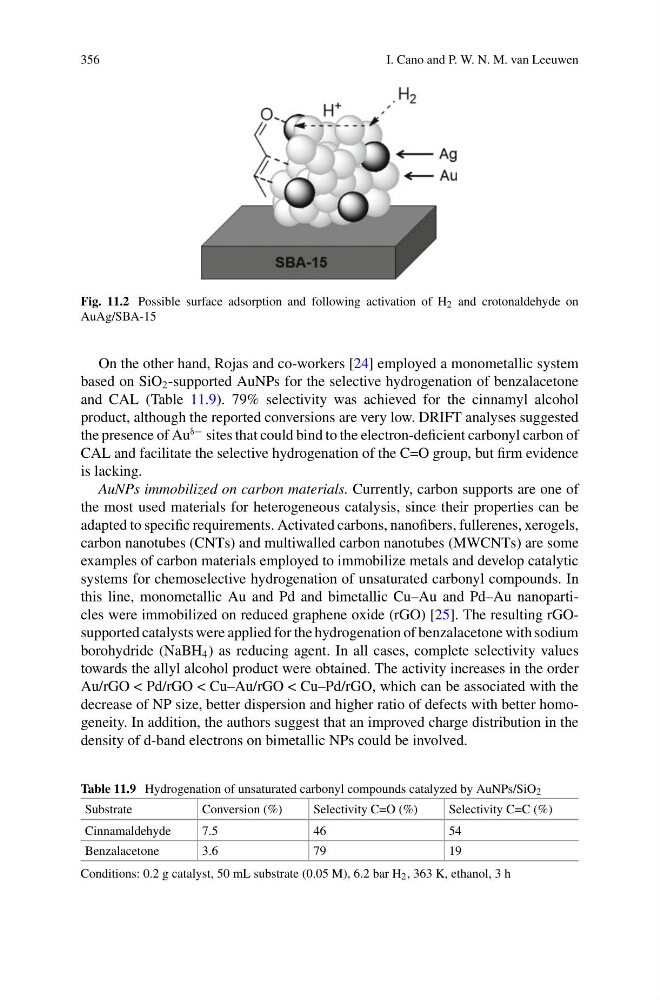
Fig. 11.2 Possible surface adsorption and following activation of H 2 and crotonaldehyde on
AuAg/SBA-15
On the other hand, Rojas and co-workers [24] employed a monometallic system
based on SiO 2 -supported AuNPs for the selective hydrogenation of benzalacetone
and CAL (Table 11.9). 79% selectivity was achieved for the cinnamyl alcohol
product, although the reported conversions are very low. DRIFT analyses suggested
the presence of Au
δ− sites that could bind to the electron-deficient carbonyl carbon of
CAL and facilitate the selective hydrogenation of the C=O group, but firm evidence
is lacking.
AuNPs immobilized on carbon materials. Currently, carbon supports are one of
the most used materials for heterogeneous catalysis, since their properties can be
adapted to specific requirements. Activated carbons, nanofibers, fullerenes, xerogels,
carbon nanotubes (CNTs) and multiwalled carbon nanotubes (MWCNTs) are some
examples of carbon materials employed to immobilize metals and develop catalytic
systems for chemoselective hydrogenation of unsaturated carbonyl compounds. In
this line, monometallic Au and Pd and bimetallic Cu–Au and Pd–Au nanoparticles were immobilized on reduced graphene oxide (rGO) [25]. The resulting rGOsupported catalysts were applied for the hydrogenation of benzalacetone with sodium
borohydride (NaBH 4 ) as reducing agent. In all cases, complete selectivity values
towards the allyl alcohol product were obtained. The activity increases in the order
Au/rGO < Pd/rGO < Cu–Au/rGO < Cu–Pd/rGO, which can be associated with the
decrease of NP size, better dispersion and higher ratio of defects with better homogeneity. In addition, the authors suggest that an improved charge distribution in the
density of d-band electrons on bimetallic NPs could be involved.
Table 11.9 Hydrogenation of unsaturated carbonyl compounds catalyzed by AuNPs/SiO 2
Substrate
Conversion (%)
Selectivity C=O (%)
Selectivity C=C (%)
Cinnamaldehyde
7.5
46
54
Benzalacetone
3.6
79
19
Conditions: 0.2 g catalyst, 50 mL substrate (0.05 M), 6.2 bar H 2 , 363 K, ethanol, 3 h
I. Cano and P. W. N. M. van Leeuwen
Fig. 11.2 Possible surface adsorption and following activation of H 2 and crotonaldehyde on
AuAg/SBA-15
On the other hand, Rojas and co-workers [24] employed a monometallic system
based on SiO 2 -supported AuNPs for the selective hydrogenation of benzalacetone
and CAL (Table 11.9). 79% selectivity was achieved for the cinnamyl alcohol
product, although the reported conversions are very low. DRIFT analyses suggested
the presence of Au
δ− sites that could bind to the electron-deficient carbonyl carbon of
CAL and facilitate the selective hydrogenation of the C=O group, but firm evidence
is lacking.
AuNPs immobilized on carbon materials. Currently, carbon supports are one of
the most used materials for heterogeneous catalysis, since their properties can be
adapted to specific requirements. Activated carbons, nanofibers, fullerenes, xerogels,
carbon nanotubes (CNTs) and multiwalled carbon nanotubes (MWCNTs) are some
examples of carbon materials employed to immobilize metals and develop catalytic
systems for chemoselective hydrogenation of unsaturated carbonyl compounds. In
this line, monometallic Au and Pd and bimetallic Cu–Au and Pd–Au nanoparticles were immobilized on reduced graphene oxide (rGO) [25]. The resulting rGOsupported catalysts were applied for the hydrogenation of benzalacetone with sodium
borohydride (NaBH 4 ) as reducing agent. In all cases, complete selectivity values
towards the allyl alcohol product were obtained. The activity increases in the order
Au/rGO < Pd/rGO < Cu–Au/rGO < Cu–Pd/rGO, which can be associated with the
decrease of NP size, better dispersion and higher ratio of defects with better homogeneity. In addition, the authors suggest that an improved charge distribution in the
density of d-band electrons on bimetallic NPs could be involved.
Table 11.9 Hydrogenation of unsaturated carbonyl compounds catalyzed by AuNPs/SiO 2
Substrate
Conversion (%)
Selectivity C=O (%)
Selectivity C=C (%)
Cinnamaldehyde
7.5
46
54
Benzalacetone
3.6
79
19
Conditions: 0.2 g catalyst, 50 mL substrate (0.05 M), 6.2 bar H 2 , 363 K, ethanol, 3 h