

11 Selective Hydrogenation of Aldehydes and Ketones
353
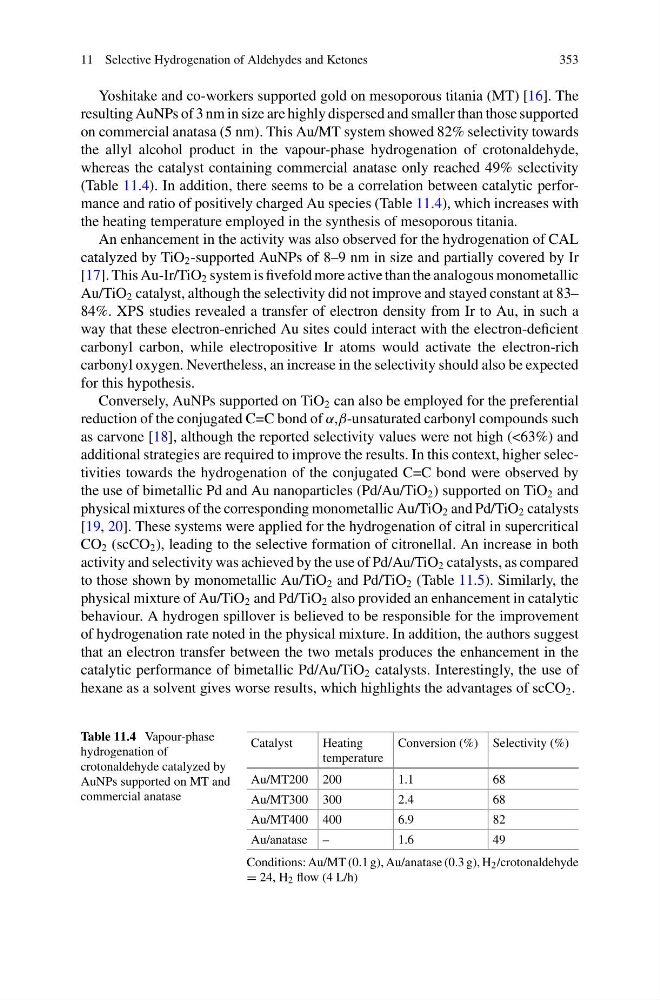
Yoshitake and co-workers supported gold on mesoporous titania (MT) [16]. The
resulting AuNPs of 3 nm in size are highly dispersed and smaller than those supported
on commercial anatasa (5 nm). This Au/MT system showed 82% selectivity towards
the allyl alcohol product in the vapour-phase hydrogenation of crotonaldehyde,
whereas the catalyst containing commercial anatase only reached 49% selectivity
(Table 11.4). In addition, there seems to be a correlation between catalytic performance and ratio of positively charged Au species (Table 11.4), which increases with
the heating temperature employed in the synthesis of mesoporous titania.
An enhancement in the activity was also observed for the hydrogenation of CAL
catalyzed by TiO 2 -supported AuNPs of 8–9 nm in size and partially covered by Ir
[17]. This Au-Ir/TiO 2 system is fivefold more active than the analogous monometallic
Au/TiO 2 catalyst, although the selectivity did not improve and stayed constant at 83–
84%. XPS studies revealed a transfer of electron density from Ir to Au, in such a
way that these electron-enriched Au sites could interact with the electron-deficient
carbonyl carbon, while electropositive Ir atoms would activate the electron-rich
carbonyl oxygen. Nevertheless, an increase in the selectivity should also be expected
for this hypothesis.
Conversely, AuNPs supported on TiO 2 can also be employed for the preferential
reduction of the conjugated C=C bond of α,β-unsaturated carbonyl compounds such
as carvone [18], although the reported selectivity values were not high (<63%) and
additional strategies are required to improve the results. In this context, higher selectivities towards the hydrogenation of the conjugated C=C bond were observed by
the use of bimetallic Pd and Au nanoparticles (Pd/Au/TiO 2 ) supported on TiO 2 and
physical mixtures of the corresponding monometallic Au/TiO 2 and Pd/TiO 2 catalysts
[19, 20]. These systems were applied for the hydrogenation of citral in supercritical
CO 2 (scCO 2 ), leading to the selective formation of citronellal. An increase in both
activity and selectivity was achieved by the use of Pd/Au/TiO 2 catalysts, as compared
to those shown by monometallic Au/TiO 2 and Pd/TiO 2 (Table 11.5). Similarly, the
physical mixture of Au/TiO 2 and Pd/TiO 2 also provided an enhancement in catalytic
behaviour. A hydrogen spillover is believed to be responsible for the improvement
of hydrogenation rate noted in the physical mixture. In addition, the authors suggest
that an electron transfer between the two metals produces the enhancement in the
catalytic performance of bimetallic Pd/Au/TiO 2 catalysts. Interestingly, the use of
hexane as a solvent gives worse results, which highlights the advantages of scCO 2 .
Table 11.4 Vapour-phase
hydrogenation of
crotonaldehyde catalyzed by
AuNPs supported on MT and
commercial anatase
Catalyst
Heating
temperature
Conversion (%) Selectivity (%)
Au/MT200 200
1.1
68
Au/MT300 300
2.4
68
Au/MT400 400
6.9
82
Au/anatase –
1.6
49
Conditions: Au/MT (0.1 g), Au/anatase (0.3 g), H 2 /crotonaldehyde
= 24, H 2 flow (4 L/h)
353
Yoshitake and co-workers supported gold on mesoporous titania (MT) [16]. The
resulting AuNPs of 3 nm in size are highly dispersed and smaller than those supported
on commercial anatasa (5 nm). This Au/MT system showed 82% selectivity towards
the allyl alcohol product in the vapour-phase hydrogenation of crotonaldehyde,
whereas the catalyst containing commercial anatase only reached 49% selectivity
(Table 11.4). In addition, there seems to be a correlation between catalytic performance and ratio of positively charged Au species (Table 11.4), which increases with
the heating temperature employed in the synthesis of mesoporous titania.
An enhancement in the activity was also observed for the hydrogenation of CAL
catalyzed by TiO 2 -supported AuNPs of 8–9 nm in size and partially covered by Ir
[17]. This Au-Ir/TiO 2 system is fivefold more active than the analogous monometallic
Au/TiO 2 catalyst, although the selectivity did not improve and stayed constant at 83–
84%. XPS studies revealed a transfer of electron density from Ir to Au, in such a
way that these electron-enriched Au sites could interact with the electron-deficient
carbonyl carbon, while electropositive Ir atoms would activate the electron-rich
carbonyl oxygen. Nevertheless, an increase in the selectivity should also be expected
for this hypothesis.
Conversely, AuNPs supported on TiO 2 can also be employed for the preferential
reduction of the conjugated C=C bond of α,β-unsaturated carbonyl compounds such
as carvone [18], although the reported selectivity values were not high (<63%) and
additional strategies are required to improve the results. In this context, higher selectivities towards the hydrogenation of the conjugated C=C bond were observed by
the use of bimetallic Pd and Au nanoparticles (Pd/Au/TiO 2 ) supported on TiO 2 and
physical mixtures of the corresponding monometallic Au/TiO 2 and Pd/TiO 2 catalysts
[19, 20]. These systems were applied for the hydrogenation of citral in supercritical
CO 2 (scCO 2 ), leading to the selective formation of citronellal. An increase in both
activity and selectivity was achieved by the use of Pd/Au/TiO 2 catalysts, as compared
to those shown by monometallic Au/TiO 2 and Pd/TiO 2 (Table 11.5). Similarly, the
physical mixture of Au/TiO 2 and Pd/TiO 2 also provided an enhancement in catalytic
behaviour. A hydrogen spillover is believed to be responsible for the improvement
of hydrogenation rate noted in the physical mixture. In addition, the authors suggest
that an electron transfer between the two metals produces the enhancement in the
catalytic performance of bimetallic Pd/Au/TiO 2 catalysts. Interestingly, the use of
hexane as a solvent gives worse results, which highlights the advantages of scCO 2 .
Table 11.4 Vapour-phase
hydrogenation of
crotonaldehyde catalyzed by
AuNPs supported on MT and
commercial anatase
Catalyst
Heating
temperature
Conversion (%) Selectivity (%)
Au/MT200 200
1.1
68
Au/MT300 300
2.4
68
Au/MT400 400
6.9
82
Au/anatase –
1.6
49
Conditions: Au/MT (0.1 g), Au/anatase (0.3 g), H 2 /crotonaldehyde
= 24, H 2 flow (4 L/h)