

354
I. Cano and P. W. N. M. van Leeuwen
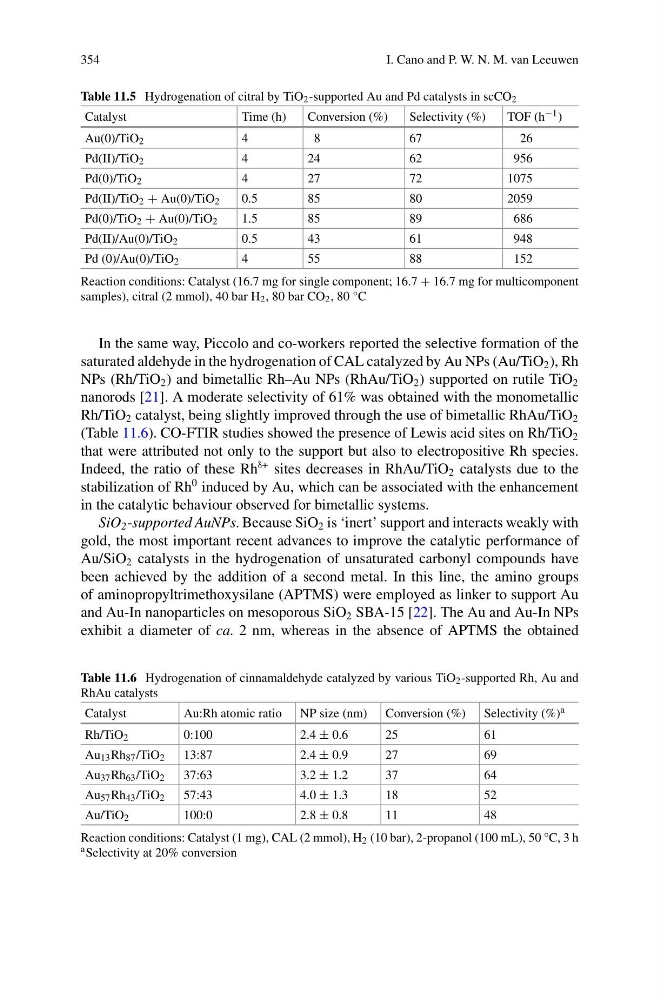
Table 11.5 Hydrogenation of citral by TiO 2 -supported Au and Pd catalysts in scCO 2
Catalyst
Time (h)
Conversion (%)
Selectivity (%)
TOF (h −1 )
Au(0)/TiO 2
4
8
67
26
Pd(II)/TiO 2
4
24
62
956
Pd(0)/TiO 2
4
27
72
1075
Pd(II)/TiO 2 + Au(0)/TiO 2
0.5
85
80
2059
Pd(0)/TiO 2 + Au(0)/TiO 2
1.5
85
89
686
Pd(II)/Au(0)/TiO 2
0.5
43
61
948
Pd (0)/Au(0)/TiO 2
4
55
88
152
Reaction conditions: Catalyst (16.7 mg for single component; 16.7 + 16.7 mg for multicomponent
samples), citral (2 mmol), 40 bar H 2 , 80 bar CO 2 , 80 °C
In the same way, Piccolo and co-workers reported the selective formation of the
saturated aldehyde in the hydrogenation of CAL catalyzed by Au NPs (Au/TiO 2 ), Rh
NPs (Rh/TiO 2 ) and bimetallic Rh–Au NPs (RhAu/TiO 2 ) supported on rutile TiO 2
nanorods [21]. A moderate selectivity of 61% was obtained with the monometallic
Rh/TiO 2 catalyst, being slightly improved through the use of bimetallic RhAu/TiO 2
(Table 11.6). CO-FTIR studies showed the presence of Lewis acid sites on Rh/TiO 2
that were attributed not only to the support but also to electropositive Rh species.
Indeed, the ratio of these Rh
δ+ sites decreases in RhAu/TiO 2 catalysts due to the
stabilization of Rh
0 induced by Au, which can be associated with the enhancement
in the catalytic behaviour observed for bimetallic systems.
SiO 2 -supported AuNPs. Because SiO 2 is ‘inert’ support and interacts weakly with
gold, the most important recent advances to improve the catalytic performance of
Au/SiO 2 catalysts in the hydrogenation of unsaturated carbonyl compounds have
been achieved by the addition of a second metal. In this line, the amino groups
of aminopropyltrimethoxysilane (APTMS) were employed as linker to support Au
and Au-In nanoparticles on mesoporous SiO 2 SBA-15 [22]. The Au and Au-In NPs
exhibit a diameter of ca. 2 nm, whereas in the absence of APTMS the obtained
Table 11.6 Hydrogenation of cinnamaldehyde catalyzed by various TiO 2 -supported Rh, Au and
RhAu catalysts
Catalyst
Au:Rh atomic ratio NP size (nm) Conversion (%) Selectivity (%) a
Rh/TiO 2
0:100
2.4 ± 0.6
25
61
Au 13 Rh 87 /TiO 2 13:87
2.4 ± 0.9
27
69
Au 37 Rh 63 /TiO 2 37:63
3.2 ± 1.2
37
64
Au 57 Rh 43 /TiO 2 57:43
4.0 ± 1.3
18
52
Au/TiO 2
100:0
2.8 ± 0.8
11
48
Reaction conditions: Catalyst (1 mg), CAL (2 mmol), H 2 (10 bar), 2-propanol (100 mL), 50 °C, 3 h
a Selectivity at 20% conversion
I. Cano and P. W. N. M. van Leeuwen
Table 11.5 Hydrogenation of citral by TiO 2 -supported Au and Pd catalysts in scCO 2
Catalyst
Time (h)
Conversion (%)
Selectivity (%)
TOF (h −1 )
Au(0)/TiO 2
4
8
67
26
Pd(II)/TiO 2
4
24
62
956
Pd(0)/TiO 2
4
27
72
1075
Pd(II)/TiO 2 + Au(0)/TiO 2
0.5
85
80
2059
Pd(0)/TiO 2 + Au(0)/TiO 2
1.5
85
89
686
Pd(II)/Au(0)/TiO 2
0.5
43
61
948
Pd (0)/Au(0)/TiO 2
4
55
88
152
Reaction conditions: Catalyst (16.7 mg for single component; 16.7 + 16.7 mg for multicomponent
samples), citral (2 mmol), 40 bar H 2 , 80 bar CO 2 , 80 °C
In the same way, Piccolo and co-workers reported the selective formation of the
saturated aldehyde in the hydrogenation of CAL catalyzed by Au NPs (Au/TiO 2 ), Rh
NPs (Rh/TiO 2 ) and bimetallic Rh–Au NPs (RhAu/TiO 2 ) supported on rutile TiO 2
nanorods [21]. A moderate selectivity of 61% was obtained with the monometallic
Rh/TiO 2 catalyst, being slightly improved through the use of bimetallic RhAu/TiO 2
(Table 11.6). CO-FTIR studies showed the presence of Lewis acid sites on Rh/TiO 2
that were attributed not only to the support but also to electropositive Rh species.
Indeed, the ratio of these Rh
δ+ sites decreases in RhAu/TiO 2 catalysts due to the
stabilization of Rh
0 induced by Au, which can be associated with the enhancement
in the catalytic behaviour observed for bimetallic systems.
SiO 2 -supported AuNPs. Because SiO 2 is ‘inert’ support and interacts weakly with
gold, the most important recent advances to improve the catalytic performance of
Au/SiO 2 catalysts in the hydrogenation of unsaturated carbonyl compounds have
been achieved by the addition of a second metal. In this line, the amino groups
of aminopropyltrimethoxysilane (APTMS) were employed as linker to support Au
and Au-In nanoparticles on mesoporous SiO 2 SBA-15 [22]. The Au and Au-In NPs
exhibit a diameter of ca. 2 nm, whereas in the absence of APTMS the obtained
Table 11.6 Hydrogenation of cinnamaldehyde catalyzed by various TiO 2 -supported Rh, Au and
RhAu catalysts
Catalyst
Au:Rh atomic ratio NP size (nm) Conversion (%) Selectivity (%) a
Rh/TiO 2
0:100
2.4 ± 0.6
25
61
Au 13 Rh 87 /TiO 2 13:87
2.4 ± 0.9
27
69
Au 37 Rh 63 /TiO 2 37:63
3.2 ± 1.2
37
64
Au 57 Rh 43 /TiO 2 57:43
4.0 ± 1.3
18
52
Au/TiO 2
100:0
2.8 ± 0.8
11
48
Reaction conditions: Catalyst (1 mg), CAL (2 mmol), H 2 (10 bar), 2-propanol (100 mL), 50 °C, 3 h
a Selectivity at 20% conversion