

352
I. Cano and P. W. N. M. van Leeuwen
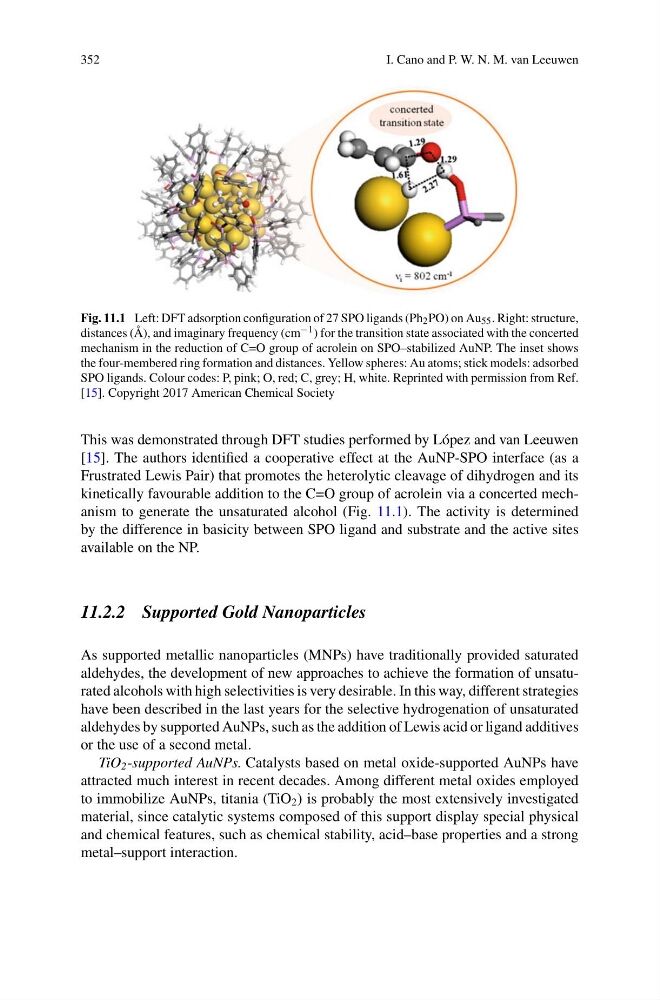
Fig. 11.1 Left: DFT adsorption configuration of 27 SPO ligands (Ph 2 PO) on Au 55 . Right: structure,
distances (Å), and imaginary frequency (cm −1 ) for the transition state associated with the concerted
mechanism in the reduction of C=O group of acrolein on SPO–stabilized AuNP. The inset shows
the four-membered ring formation and distances. Yellow spheres: Au atoms; stick models: adsorbed
SPO ligands. Colour codes: P, pink; O, red; C, grey; H, white. Reprinted with permission from Ref.
[15]. Copyright 2017 American Chemical Society
This was demonstrated through DFT studies performed by López and van Leeuwen
[15]. The authors identified a cooperative effect at the AuNP-SPO interface (as a
Frustrated Lewis Pair) that promotes the heterolytic cleavage of dihydrogen and its
kinetically favourable addition to the C=O group of acrolein via a concerted mechanism to generate the unsaturated alcohol (Fig. 11.1). The activity is determined
by the difference in basicity between SPO ligand and substrate and the active sites
available on the NP.
11.2.2 Supported Gold Nanoparticles
As supported metallic nanoparticles (MNPs) have traditionally provided saturated
aldehydes, the development of new approaches to achieve the formation of unsaturated alcohols with high selectivities is very desirable. In this way, different strategies
have been described in the last years for the selective hydrogenation of unsaturated
aldehydes by supported AuNPs, such as the addition of Lewis acid or ligand additives
or the use of a second metal.
TiO 2 -supported AuNPs. Catalysts based on metal oxide-supported AuNPs have
attracted much interest in recent decades. Among different metal oxides employed
to immobilize AuNPs, titania (TiO 2 ) is probably the most extensively investigated
material, since catalytic systems composed of this support display special physical
and chemical features, such as chemical stability, acid–base properties and a strong
metal–support interaction.
I. Cano and P. W. N. M. van Leeuwen
Fig. 11.1 Left: DFT adsorption configuration of 27 SPO ligands (Ph 2 PO) on Au 55 . Right: structure,
distances (Å), and imaginary frequency (cm −1 ) for the transition state associated with the concerted
mechanism in the reduction of C=O group of acrolein on SPO–stabilized AuNP. The inset shows
the four-membered ring formation and distances. Yellow spheres: Au atoms; stick models: adsorbed
SPO ligands. Colour codes: P, pink; O, red; C, grey; H, white. Reprinted with permission from Ref.
[15]. Copyright 2017 American Chemical Society
This was demonstrated through DFT studies performed by López and van Leeuwen
[15]. The authors identified a cooperative effect at the AuNP-SPO interface (as a
Frustrated Lewis Pair) that promotes the heterolytic cleavage of dihydrogen and its
kinetically favourable addition to the C=O group of acrolein via a concerted mechanism to generate the unsaturated alcohol (Fig. 11.1). The activity is determined
by the difference in basicity between SPO ligand and substrate and the active sites
available on the NP.
11.2.2 Supported Gold Nanoparticles
As supported metallic nanoparticles (MNPs) have traditionally provided saturated
aldehydes, the development of new approaches to achieve the formation of unsaturated alcohols with high selectivities is very desirable. In this way, different strategies
have been described in the last years for the selective hydrogenation of unsaturated
aldehydes by supported AuNPs, such as the addition of Lewis acid or ligand additives
or the use of a second metal.
TiO 2 -supported AuNPs. Catalysts based on metal oxide-supported AuNPs have
attracted much interest in recent decades. Among different metal oxides employed
to immobilize AuNPs, titania (TiO 2 ) is probably the most extensively investigated
material, since catalytic systems composed of this support display special physical
and chemical features, such as chemical stability, acid–base properties and a strong
metal–support interaction.