

11 Selective Hydrogenation of Aldehydes and Ketones
351
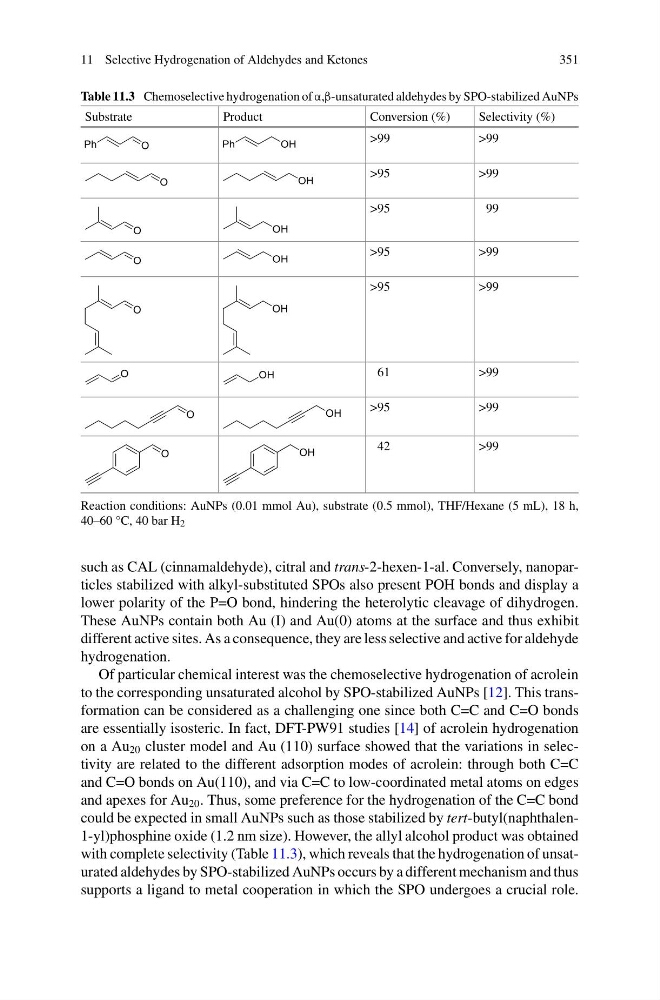
Table 11.3 Chemoselective hydrogenation of α,β-unsaturated aldehydes by SPO-stabilized AuNPs
Substrate
Product
Conversion (%)
Selectivity (%)
>99
>99
>95
>99
>95
99
>95
>99
>95
>99
61
>99
>95
>99
42
>99
Reaction conditions: AuNPs (0.01 mmol Au), substrate (0.5 mmol), THF/Hexane (5 mL), 18 h,
40–60 °C, 40 bar H 2
such as CAL (cinnamaldehyde), citral and trans-2-hexen-1-al. Conversely, nanoparticles stabilized with alkyl-substituted SPOs also present POH bonds and display a
lower polarity of the P=O bond, hindering the heterolytic cleavage of dihydrogen.
These AuNPs contain both Au (I) and Au(0) atoms at the surface and thus exhibit
different active sites. As a consequence, they are less selective and active for aldehyde
hydrogenation.
Of particular chemical interest was the chemoselective hydrogenation of acrolein
to the corresponding unsaturated alcohol by SPO-stabilized AuNPs [12]. This transformation can be considered as a challenging one since both C=C and C=O bonds
are essentially isosteric. In fact, DFT-PW91 studies [14] of acrolein hydrogenation
on a Au 20 cluster model and Au (110) surface showed that the variations in selectivity are related to the different adsorption modes of acrolein: through both C=C
and C=O bonds on Au(110), and via C=C to low-coordinated metal atoms on edges
and apexes for Au 20 . Thus, some preference for the hydrogenation of the C=C bond
could be expected in small AuNPs such as those stabilized by tert-butyl(naphthalen1-yl)phosphine oxide (1.2 nm size). However, the allyl alcohol product was obtained
with complete selectivity (Table 11.3), which reveals that the hydrogenation of unsaturated aldehydes by SPO-stabilized AuNPs occurs by a different mechanism and thus
supports a ligand to metal cooperation in which the SPO undergoes a crucial role.
351
Table 11.3 Chemoselective hydrogenation of α,β-unsaturated aldehydes by SPO-stabilized AuNPs
Substrate
Product
Conversion (%)
Selectivity (%)
>99
>99
>95
>99
>95
99
>95
>99
>95
>99
61
>99
>95
>99
42
>99
Reaction conditions: AuNPs (0.01 mmol Au), substrate (0.5 mmol), THF/Hexane (5 mL), 18 h,
40–60 °C, 40 bar H 2
such as CAL (cinnamaldehyde), citral and trans-2-hexen-1-al. Conversely, nanoparticles stabilized with alkyl-substituted SPOs also present POH bonds and display a
lower polarity of the P=O bond, hindering the heterolytic cleavage of dihydrogen.
These AuNPs contain both Au (I) and Au(0) atoms at the surface and thus exhibit
different active sites. As a consequence, they are less selective and active for aldehyde
hydrogenation.
Of particular chemical interest was the chemoselective hydrogenation of acrolein
to the corresponding unsaturated alcohol by SPO-stabilized AuNPs [12]. This transformation can be considered as a challenging one since both C=C and C=O bonds
are essentially isosteric. In fact, DFT-PW91 studies [14] of acrolein hydrogenation
on a Au 20 cluster model and Au (110) surface showed that the variations in selectivity are related to the different adsorption modes of acrolein: through both C=C
and C=O bonds on Au(110), and via C=C to low-coordinated metal atoms on edges
and apexes for Au 20 . Thus, some preference for the hydrogenation of the C=C bond
could be expected in small AuNPs such as those stabilized by tert-butyl(naphthalen1-yl)phosphine oxide (1.2 nm size). However, the allyl alcohol product was obtained
with complete selectivity (Table 11.3), which reveals that the hydrogenation of unsaturated aldehydes by SPO-stabilized AuNPs occurs by a different mechanism and thus
supports a ligand to metal cooperation in which the SPO undergoes a crucial role.