

11 Selective Hydrogenation of Aldehydes and Ketones
349
Lewis-acid metal cations to this catalytic system enhances the activity and chemoselectivity towards the allylic alcohol product (Table 11.1), since the activation of the
C=O group by Zn
2+ or Fe
3+ cations leads to an increase in the hydrogenation rate of
the carbonyl group [8].
Following this pioneering work, kinetic studies were developed for the selective hydrogenation of cinnamaldehyde (CAL) catalyzed by AuNPs stabilized with a
water-soluble imidazolium-based ionic polymer [9]. A first-order reaction regarding
substrate consumption was observed, while a moderate selectivity of 73% for the
cinnamyl alcohol (COL) product was obtained. Based on previous reports, the authors
suggest that the AuNPs are negatively charged by electron donation from the polymer
and, consequently, display a preferential interaction with the carbonyl group over the
olefinic bond.
Unsupported thiolate-stabilized gold Au 25 (SR) 18 , Au 38 (SR) 24 and Au 25 (SR) 18
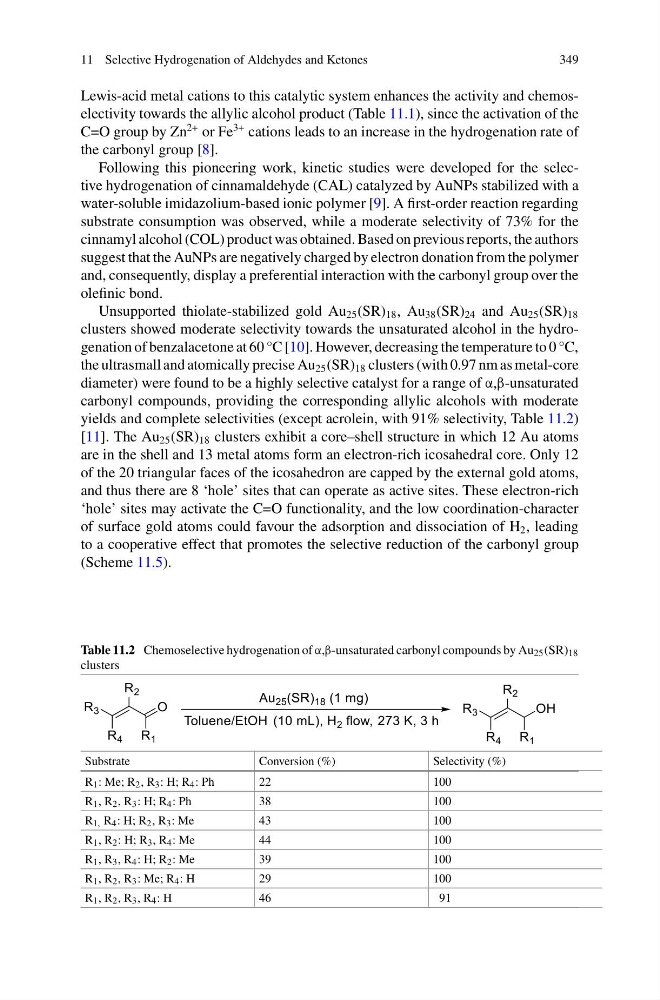
clusters showed moderate selectivity towards the unsaturated alcohol in the hydrogenation of benzalacetone at 60 °C [10]. However, decreasing the temperature to 0 °C,
the ultrasmall and atomically precise Au 25 (SR) 18 clusters (with 0.97 nm as metal-core
diameter) were found to be a highly selective catalyst for a range of α,β-unsaturated
carbonyl compounds, providing the corresponding allylic alcohols with moderate
yields and complete selectivities (except acrolein, with 91% selectivity, Table 11.2)
[11]. The Au 25 (SR) 18 clusters exhibit a core–shell structure in which 12 Au atoms
are in the shell and 13 metal atoms form an electron-rich icosahedral core. Only 12
of the 20 triangular faces of the icosahedron are capped by the external gold atoms,
and thus there are 8 ‘hole’ sites that can operate as active sites. These electron-rich
‘hole’ sites may activate the C=O functionality, and the low coordination-character
of surface gold atoms could favour the adsorption and dissociation of H 2 , leading
to a cooperative effect that promotes the selective reduction of the carbonyl group
(Scheme 11.5).
Table 11.2 Chemoselective hydrogenation of α,β-unsaturated carbonyl compounds by Au 25 (SR) 18
clusters
Substrate
Conversion (%)
Selectivity (%)
R 1 : Me; R 2 , R 3 : H; R 4 : Ph
22
100
R 1 , R 2 , R 3 : H; R 4 : Ph
38
100
R 1, R 4 : H; R 2 , R 3 : Me
43
100
R 1 , R 2 : H; R 3 , R 4 : Me
44
100
R 1 , R 3 , R 4 : H; R 2 : Me
39
100
R 1 , R 2 , R 3 : Me; R 4 : H
29
100
R 1 , R 2 , R 3 , R 4 : H
46
91
349
Lewis-acid metal cations to this catalytic system enhances the activity and chemoselectivity towards the allylic alcohol product (Table 11.1), since the activation of the
C=O group by Zn
2+ or Fe
3+ cations leads to an increase in the hydrogenation rate of
the carbonyl group [8].
Following this pioneering work, kinetic studies were developed for the selective hydrogenation of cinnamaldehyde (CAL) catalyzed by AuNPs stabilized with a
water-soluble imidazolium-based ionic polymer [9]. A first-order reaction regarding
substrate consumption was observed, while a moderate selectivity of 73% for the
cinnamyl alcohol (COL) product was obtained. Based on previous reports, the authors
suggest that the AuNPs are negatively charged by electron donation from the polymer
and, consequently, display a preferential interaction with the carbonyl group over the
olefinic bond.
Unsupported thiolate-stabilized gold Au 25 (SR) 18 , Au 38 (SR) 24 and Au 25 (SR) 18
clusters showed moderate selectivity towards the unsaturated alcohol in the hydrogenation of benzalacetone at 60 °C [10]. However, decreasing the temperature to 0 °C,
the ultrasmall and atomically precise Au 25 (SR) 18 clusters (with 0.97 nm as metal-core
diameter) were found to be a highly selective catalyst for a range of α,β-unsaturated
carbonyl compounds, providing the corresponding allylic alcohols with moderate
yields and complete selectivities (except acrolein, with 91% selectivity, Table 11.2)
[11]. The Au 25 (SR) 18 clusters exhibit a core–shell structure in which 12 Au atoms
are in the shell and 13 metal atoms form an electron-rich icosahedral core. Only 12
of the 20 triangular faces of the icosahedron are capped by the external gold atoms,
and thus there are 8 ‘hole’ sites that can operate as active sites. These electron-rich
‘hole’ sites may activate the C=O functionality, and the low coordination-character
of surface gold atoms could favour the adsorption and dissociation of H 2 , leading
to a cooperative effect that promotes the selective reduction of the carbonyl group
(Scheme 11.5).
Table 11.2 Chemoselective hydrogenation of α,β-unsaturated carbonyl compounds by Au 25 (SR) 18
clusters
Substrate
Conversion (%)
Selectivity (%)
R 1 : Me; R 2 , R 3 : H; R 4 : Ph
22
100
R 1 , R 2 , R 3 : H; R 4 : Ph
38
100
R 1, R 4 : H; R 2 , R 3 : Me
43
100
R 1 , R 2 : H; R 3 , R 4 : Me
44
100
R 1 , R 3 , R 4 : H; R 2 : Me
39
100
R 1 , R 2 , R 3 : Me; R 4 : H
29
100
R 1 , R 2 , R 3 , R 4 : H
46
91