

348
I. Cano and P. W. N. M. van Leeuwen
11.2 Hydrogenation of Unsaturated Aldehydes
and Ketones Catalyzed by Gold Nanoparticles
In comparison with traditional metals employed in hydrogenation chemistry (group
8–10 metals), gold is not a typical catalyst for hydrogenation reactions. This is not
surprising, given that Au has shown a low ability to dissociate hydrogen due to its
high resistance to oxidation. However, on the nanoscale this is no longer the case, and
Au has exhibited hydrogenation activity with a strong preference for the reduction
of C=O over C=C bonds [5]. As a consequence, in the last decade, gold has attracted
a resurgent interest by researchers working in selective hydrogenations.
11.2.1 Homogeneous Gold Nanoparticles
There are only a few reports on hydrogenation by homogeneous gold nanoparticles
(AuNPs) and most of them concern the reduction of a nitro group, most often with
NaBH 4 . In 2007, De Vos and co-workers employed polyvinylpyrrolidone stabilized
AuNPs dispersed in amide solvents for the chemoselective hydrogenation of α,βunsaturated aldehydes and ketones [6]. The hydrogenation of crotonaldehyde with
the use of AuNPs of 7 nm in size and synthesized in N,N–dimethyl formamide led
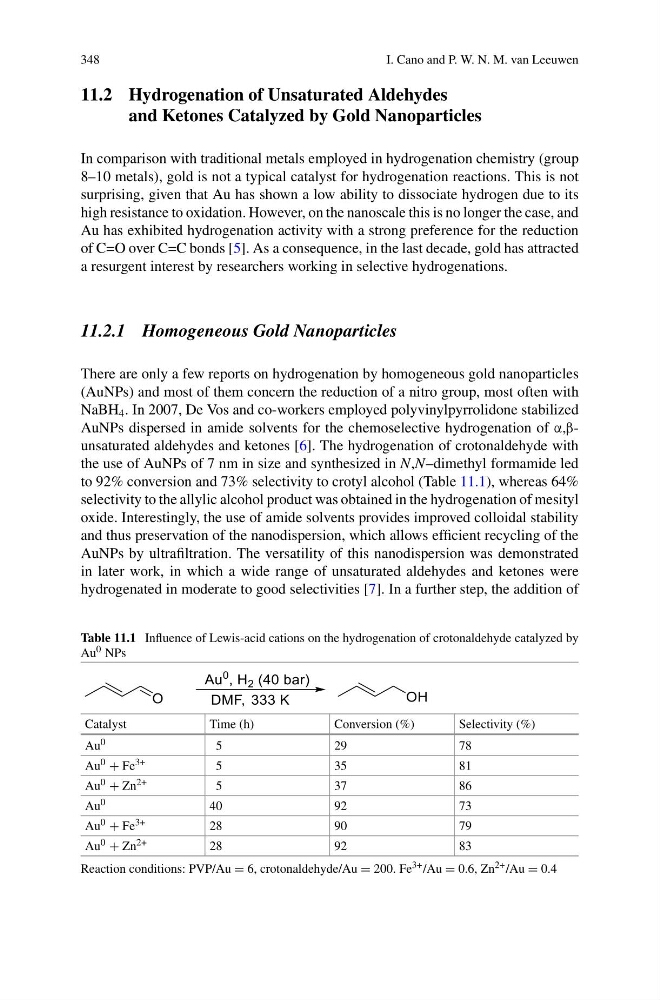
to 92% conversion and 73% selectivity to crotyl alcohol (Table 11.1), whereas 64%
selectivity to the allylic alcohol product was obtained in the hydrogenation of mesityl
oxide. Interestingly, the use of amide solvents provides improved colloidal stability
and thus preservation of the nanodispersion, which allows efficient recycling of the
AuNPs by ultrafiltration. The versatility of this nanodispersion was demonstrated
in later work, in which a wide range of unsaturated aldehydes and ketones were
hydrogenated in moderate to good selectivities [7]. In a further step, the addition of
Table 11.1 Influence of Lewis-acid cations on the hydrogenation of crotonaldehyde catalyzed by
Au 0 NPs
Catalyst
Time (h)
Conversion (%)
Selectivity (%)
Au 0
5
29
78
Au 0 + Fe 3+
5
35
81
Au 0 + Zn 2+
5
37
86
Au 0
40
92
73
Au 0 + Fe 3+
28
90
79
Au 0 + Zn 2+
28
92
83
Reaction conditions: PVP/Au = 6, crotonaldehyde/Au = 200. Fe 3+ /Au = 0.6, Zn 2+ /Au = 0.4
I. Cano and P. W. N. M. van Leeuwen
11.2 Hydrogenation of Unsaturated Aldehydes
and Ketones Catalyzed by Gold Nanoparticles
In comparison with traditional metals employed in hydrogenation chemistry (group
8–10 metals), gold is not a typical catalyst for hydrogenation reactions. This is not
surprising, given that Au has shown a low ability to dissociate hydrogen due to its
high resistance to oxidation. However, on the nanoscale this is no longer the case, and
Au has exhibited hydrogenation activity with a strong preference for the reduction
of C=O over C=C bonds [5]. As a consequence, in the last decade, gold has attracted
a resurgent interest by researchers working in selective hydrogenations.
11.2.1 Homogeneous Gold Nanoparticles
There are only a few reports on hydrogenation by homogeneous gold nanoparticles
(AuNPs) and most of them concern the reduction of a nitro group, most often with
NaBH 4 . In 2007, De Vos and co-workers employed polyvinylpyrrolidone stabilized
AuNPs dispersed in amide solvents for the chemoselective hydrogenation of α,βunsaturated aldehydes and ketones [6]. The hydrogenation of crotonaldehyde with
the use of AuNPs of 7 nm in size and synthesized in N,N–dimethyl formamide led
to 92% conversion and 73% selectivity to crotyl alcohol (Table 11.1), whereas 64%
selectivity to the allylic alcohol product was obtained in the hydrogenation of mesityl
oxide. Interestingly, the use of amide solvents provides improved colloidal stability
and thus preservation of the nanodispersion, which allows efficient recycling of the
AuNPs by ultrafiltration. The versatility of this nanodispersion was demonstrated
in later work, in which a wide range of unsaturated aldehydes and ketones were
hydrogenated in moderate to good selectivities [7]. In a further step, the addition of
Table 11.1 Influence of Lewis-acid cations on the hydrogenation of crotonaldehyde catalyzed by
Au 0 NPs
Catalyst
Time (h)
Conversion (%)
Selectivity (%)
Au 0
5
29
78
Au 0 + Fe 3+
5
35
81
Au 0 + Zn 2+
5
37
86
Au 0
40
92
73
Au 0 + Fe 3+
28
90
79
Au 0 + Zn 2+
28
92
83
Reaction conditions: PVP/Au = 6, crotonaldehyde/Au = 200. Fe 3+ /Au = 0.6, Zn 2+ /Au = 0.4