

11 Selective Hydrogenation of Aldehydes and Ketones
347
geranial to R-citronellal with a chiral homogeneous Rh catalyst, or by asymmetric
hydrogenation of geraniol with a chiral Ru complex, followed by dehydrogenation
of the alcohol. The former route is the commercial one, which requires separation
of neral and geranial as these give opposite enantiomers in the chiral hydrogenation
reaction. In the Takasago route for menthol, R-citronellal is also the key intermediate,
but this is prepared via asymmetric isomerization with Rh/BINAP from the allylic
amine and not via an asymmetric hydrogenation of the C=C bond [2].
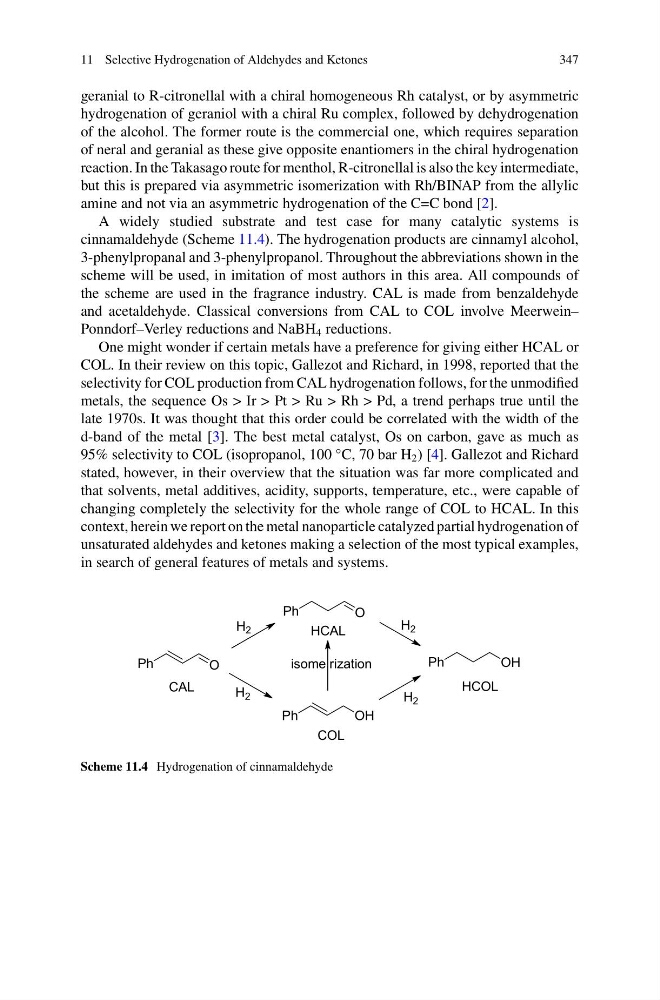
A widely studied substrate and test case for many catalytic systems is
cinnamaldehyde (Scheme 11.4). The hydrogenation products are cinnamyl alcohol,
3-phenylpropanal and 3-phenylpropanol. Throughout the abbreviations shown in the
scheme will be used, in imitation of most authors in this area. All compounds of
the scheme are used in the fragrance industry. CAL is made from benzaldehyde
and acetaldehyde. Classical conversions from CAL to COL involve Meerwein–
Ponndorf–Verley reductions and NaBH 4 reductions.
One might wonder if certain metals have a preference for giving either HCAL or
COL. In their review on this topic, Gallezot and Richard, in 1998, reported that the
selectivity for COL production from CAL hydrogenation follows, for the unmodified
metals, the sequence Os > Ir > Pt > Ru > Rh > Pd, a trend perhaps true until the
late 1970s. It was thought that this order could be correlated with the width of the
d-band of the metal [3]. The best metal catalyst, Os on carbon, gave as much as
95% selectivity to COL (isopropanol, 100 °C, 70 bar H 2 ) [4]. Gallezot and Richard
stated, however, in their overview that the situation was far more complicated and
that solvents, metal additives, acidity, supports, temperature, etc., were capable of
changing completely the selectivity for the whole range of COL to HCAL. In this
context, herein we report on the metal nanoparticle catalyzed partial hydrogenation of
unsaturated aldehydes and ketones making a selection of the most typical examples,
in search of general features of metals and systems.
Ph
O
O
OH
OH
H 2
H 2
H 2
H 2
isome rization
Ph
Ph
Ph
CAL
HCAL
COL
HCOL
Scheme 11.4 Hydrogenation of cinnamaldehyde
347
geranial to R-citronellal with a chiral homogeneous Rh catalyst, or by asymmetric
hydrogenation of geraniol with a chiral Ru complex, followed by dehydrogenation
of the alcohol. The former route is the commercial one, which requires separation
of neral and geranial as these give opposite enantiomers in the chiral hydrogenation
reaction. In the Takasago route for menthol, R-citronellal is also the key intermediate,
but this is prepared via asymmetric isomerization with Rh/BINAP from the allylic
amine and not via an asymmetric hydrogenation of the C=C bond [2].
A widely studied substrate and test case for many catalytic systems is
cinnamaldehyde (Scheme 11.4). The hydrogenation products are cinnamyl alcohol,
3-phenylpropanal and 3-phenylpropanol. Throughout the abbreviations shown in the
scheme will be used, in imitation of most authors in this area. All compounds of
the scheme are used in the fragrance industry. CAL is made from benzaldehyde
and acetaldehyde. Classical conversions from CAL to COL involve Meerwein–
Ponndorf–Verley reductions and NaBH 4 reductions.
One might wonder if certain metals have a preference for giving either HCAL or
COL. In their review on this topic, Gallezot and Richard, in 1998, reported that the
selectivity for COL production from CAL hydrogenation follows, for the unmodified
metals, the sequence Os > Ir > Pt > Ru > Rh > Pd, a trend perhaps true until the
late 1970s. It was thought that this order could be correlated with the width of the
d-band of the metal [3]. The best metal catalyst, Os on carbon, gave as much as
95% selectivity to COL (isopropanol, 100 °C, 70 bar H 2 ) [4]. Gallezot and Richard
stated, however, in their overview that the situation was far more complicated and
that solvents, metal additives, acidity, supports, temperature, etc., were capable of
changing completely the selectivity for the whole range of COL to HCAL. In this
context, herein we report on the metal nanoparticle catalyzed partial hydrogenation of
unsaturated aldehydes and ketones making a selection of the most typical examples,
in search of general features of metals and systems.
Ph
O
O
OH
OH
H 2
H 2
H 2
H 2
isome rization
Ph
Ph
Ph
CAL
HCAL
COL
HCOL
Scheme 11.4 Hydrogenation of cinnamaldehyde