

346
I. Cano and P. W. N. M. van Leeuwen
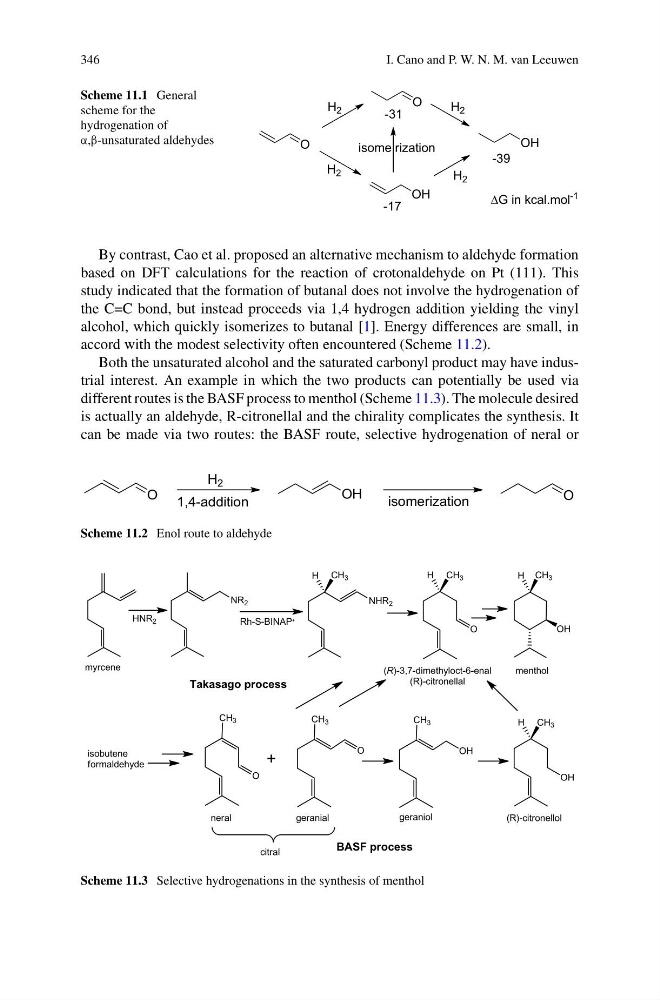
Scheme 11.1 General
scheme for the
hydrogenation of
α,β-unsaturated aldehydes
O
O
OH
OH
H 2
H 2
H 2
H 2
isome rization
-31
-17
-39
G in kcal.mol
-1
By contrast, Cao et al. proposed an alternative mechanism to aldehyde formation
based on DFT calculations for the reaction of crotonaldehyde on Pt (111). This
study indicated that the formation of butanal does not involve the hydrogenation of
the C=C bond, but instead proceeds via 1,4 hydrogen addition yielding the vinyl
alcohol, which quickly isomerizes to butanal [1]. Energy differences are small, in
accord with the modest selectivity often encountered (Scheme 11.2).
Both the unsaturated alcohol and the saturated carbonyl product may have industrial interest. An example in which the two products can potentially be used via
different routes is the BASF process to menthol (Scheme 11.3). The molecule desired
is actually an aldehyde, R-citronellal and the chirality complicates the synthesis. It
can be made via two routes: the BASF route, selective hydrogenation of neral or
O
O
H 2
isomerization
OH
1,4-addition
Scheme 11.2 Enol route to aldehyde
menthol
myrcene
H CH 3
NHR 2
NR 2
H CH 3
CH 3
OH
H
Rh-S-BINAP +
(R)-3,7-dimethyloct-6-enal
(R)-citronellal
O
Takasago process
isobutene
formaldehyde
CH 3
O
citral
CH 3
OH
geraniol
H CH 3
(R)-citronellol
OH
BASF process
CH 3
O
neral
geranial
+
HNR 2
Scheme 11.3 Selective hydrogenations in the synthesis of menthol
I. Cano and P. W. N. M. van Leeuwen
Scheme 11.1 General
scheme for the
hydrogenation of
α,β-unsaturated aldehydes
O
O
OH
OH
H 2
H 2
H 2
H 2
isome rization
-31
-17
-39
G in kcal.mol
-1
By contrast, Cao et al. proposed an alternative mechanism to aldehyde formation
based on DFT calculations for the reaction of crotonaldehyde on Pt (111). This
study indicated that the formation of butanal does not involve the hydrogenation of
the C=C bond, but instead proceeds via 1,4 hydrogen addition yielding the vinyl
alcohol, which quickly isomerizes to butanal [1]. Energy differences are small, in
accord with the modest selectivity often encountered (Scheme 11.2).
Both the unsaturated alcohol and the saturated carbonyl product may have industrial interest. An example in which the two products can potentially be used via
different routes is the BASF process to menthol (Scheme 11.3). The molecule desired
is actually an aldehyde, R-citronellal and the chirality complicates the synthesis. It
can be made via two routes: the BASF route, selective hydrogenation of neral or
O
O
H 2
isomerization
OH
1,4-addition
Scheme 11.2 Enol route to aldehyde
menthol
myrcene
H CH 3
NHR 2
NR 2
H CH 3
CH 3
OH
H
Rh-S-BINAP +
(R)-3,7-dimethyloct-6-enal
(R)-citronellal
O
Takasago process
isobutene
formaldehyde
CH 3
O
citral
CH 3
OH
geraniol
H CH 3
(R)-citronellol
OH
BASF process
CH 3
O
neral
geranial
+
HNR 2
Scheme 11.3 Selective hydrogenations in the synthesis of menthol