

10 Progress in the Selective Semi-hydrogenation of Alkynes …
321
Classical ligands employed in coordination chemistry have also been used for the
stabilization of M-NPs [116, 117].
Among the first reports addressing the application of colloidal catalysts for hydrogenation reactions, Caubere et al. described what they called “Complex Reducing
Agents (CRA)” [118]. Such reagents consisted in metal colloids prepared by reduction of metal salts using strong reducing agents such as NaBH 4 , LiAlH 4 and NaH. For
instance, a nickel catalyst named “Nic” by the authors was synthesized via the reduction of Ni(OAc) 2 using NaH in t-AmOH (under argon atmosphere) and catalysed the
hydrogenation of 1-octyne and phenylacetylene providing alkene selectivities up to
90% at full conversion [119]. Interestingly, differences in reactivity of the NPs were
observed as a function of the reaction solvent [120]. In subsequent reports, the authors
addressed the effect of the alkyne structure, the effect of quinoline as additive [120],
the reactivity of internal and terminal alkynols [121] and the evaluation of Pd-based
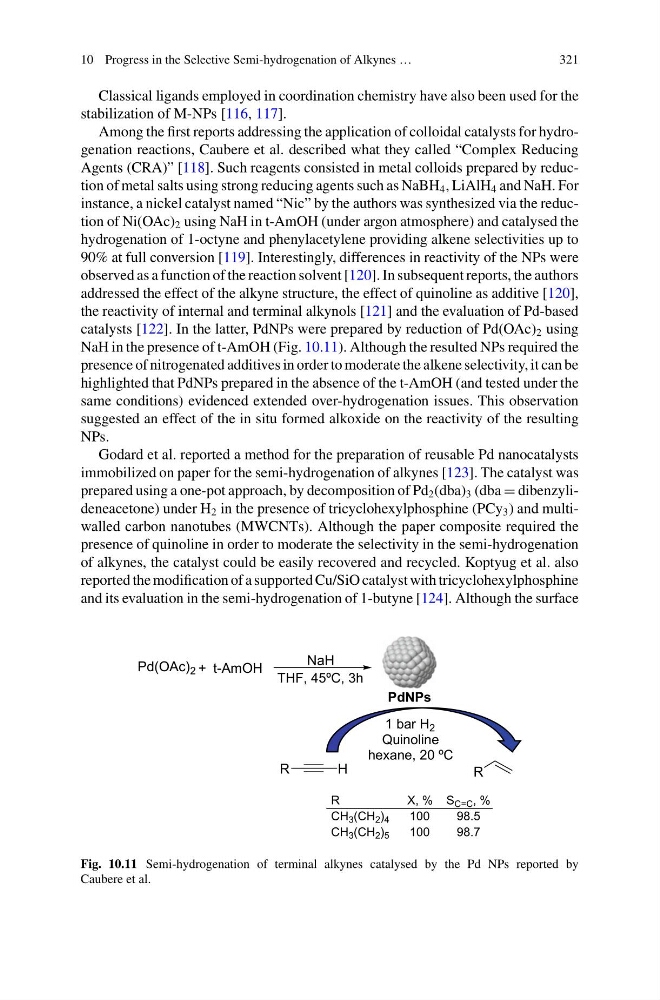
catalysts [122]. In the latter, PdNPs were prepared by reduction of Pd(OAc) 2 using
NaH in the presence of t-AmOH (Fig. 10.11). Although the resulted NPs required the
presence of nitrogenated additives in order to moderate the alkene selectivity, it can be
highlighted that PdNPs prepared in the absence of the t-AmOH (and tested under the
same conditions) evidenced extended over-hydrogenation issues. This observation
suggested an effect of the in situ formed alkoxide on the reactivity of the resulting
NPs.
Godard et al. reported a method for the preparation of reusable Pd nanocatalysts
immobilized on paper for the semi-hydrogenation of alkynes [123]. The catalyst was
prepared using a one-pot approach, by decomposition of Pd 2 (dba) 3 (dba = dibenzylideneacetone) under H 2 in the presence of tricyclohexylphosphine (PCy 3 ) and multiwalled carbon nanotubes (MWCNTs). Although the paper composite required the
presence of quinoline in order to moderate the selectivity in the semi-hydrogenation
of alkynes, the catalyst could be easily recovered and recycled. Koptyug et al. also
reported the modification of a supported Cu/SiO catalyst with tricyclohexylphosphine
and its evaluation in the semi-hydrogenation of 1-butyne [124]. Although the surface
+
THF, 45ºC, 3h
PdNPs
R
H
1 bar H 2
Quinoline
hexane, 20 ºC
Pd(OAc) 2 t-AmOH
NaH
R
R
X , % S C=C , %
CH 3 (CH 2 ) 4
100
98.5
CH 3 (CH 2 ) 5
100
98.7
Fig. 10.11 Semi-hydrogenation of terminal alkynes catalysed by the Pd NPs reported by
Caubere et al.
321
Classical ligands employed in coordination chemistry have also been used for the
stabilization of M-NPs [116, 117].
Among the first reports addressing the application of colloidal catalysts for hydrogenation reactions, Caubere et al. described what they called “Complex Reducing
Agents (CRA)” [118]. Such reagents consisted in metal colloids prepared by reduction of metal salts using strong reducing agents such as NaBH 4 , LiAlH 4 and NaH. For
instance, a nickel catalyst named “Nic” by the authors was synthesized via the reduction of Ni(OAc) 2 using NaH in t-AmOH (under argon atmosphere) and catalysed the
hydrogenation of 1-octyne and phenylacetylene providing alkene selectivities up to
90% at full conversion [119]. Interestingly, differences in reactivity of the NPs were
observed as a function of the reaction solvent [120]. In subsequent reports, the authors
addressed the effect of the alkyne structure, the effect of quinoline as additive [120],
the reactivity of internal and terminal alkynols [121] and the evaluation of Pd-based
catalysts [122]. In the latter, PdNPs were prepared by reduction of Pd(OAc) 2 using
NaH in the presence of t-AmOH (Fig. 10.11). Although the resulted NPs required the
presence of nitrogenated additives in order to moderate the alkene selectivity, it can be
highlighted that PdNPs prepared in the absence of the t-AmOH (and tested under the
same conditions) evidenced extended over-hydrogenation issues. This observation
suggested an effect of the in situ formed alkoxide on the reactivity of the resulting
NPs.
Godard et al. reported a method for the preparation of reusable Pd nanocatalysts
immobilized on paper for the semi-hydrogenation of alkynes [123]. The catalyst was
prepared using a one-pot approach, by decomposition of Pd 2 (dba) 3 (dba = dibenzylideneacetone) under H 2 in the presence of tricyclohexylphosphine (PCy 3 ) and multiwalled carbon nanotubes (MWCNTs). Although the paper composite required the
presence of quinoline in order to moderate the selectivity in the semi-hydrogenation
of alkynes, the catalyst could be easily recovered and recycled. Koptyug et al. also
reported the modification of a supported Cu/SiO catalyst with tricyclohexylphosphine
and its evaluation in the semi-hydrogenation of 1-butyne [124]. Although the surface
+
THF, 45ºC, 3h
PdNPs
R
H
1 bar H 2
Quinoline
hexane, 20 ºC
Pd(OAc) 2 t-AmOH
NaH
R
R
X , % S C=C , %
CH 3 (CH 2 ) 4
100
98.5
CH 3 (CH 2 ) 5
100
98.7
Fig. 10.11 Semi-hydrogenation of terminal alkynes catalysed by the Pd NPs reported by
Caubere et al.