

320
J. A. Delgado and C. Godard
+
BMI.BF 4 , 4 bar H 2 ,
r.t., 2-16 h
PdNPs
[Pd(acac)(COD)]BF 4
1-2 eq. Ligand
P
N
N
- NTf 2
P
N
N
- NTf 2
P
N
N
- NTf 2
- PF 6
N
N
N
N
- PF 6
N
N
N
N
2-pentyne
(Z)-2-pentene
Phosphines
X= 99%, S C=C = 82%
X= 95%, S C=C = 85%
X= 92%, S C=C = 64%
X= 97%, S C=C = 74%
X= 95%, S C=C = 87%
4 bar H 2
BMI.BF 4 ,
40 ºC, 0.5-3 h
Ligands tested:
Phen-ligands
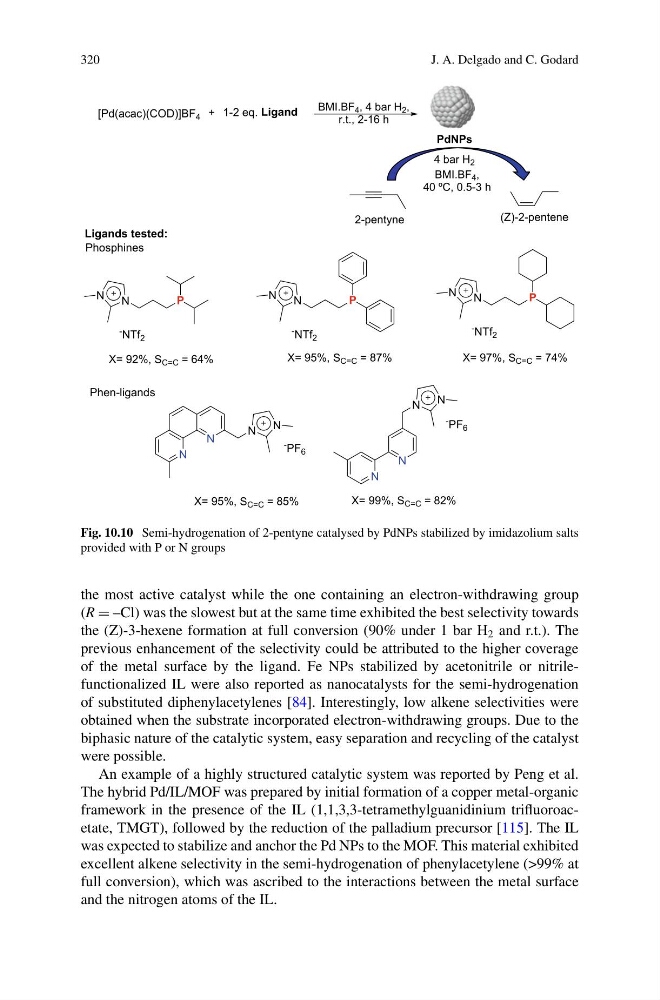
Fig. 10.10 Semi-hydrogenation of 2-pentyne catalysed by PdNPs stabilized by imidazolium salts
provided with P or N groups
the most active catalyst while the one containing an electron-withdrawing group
(R = –Cl) was the slowest but at the same time exhibited the best selectivity towards
the (Z)-3-hexene formation at full conversion (90% under 1 bar H 2 and r.t.). The
previous enhancement of the selectivity could be attributed to the higher coverage
of the metal surface by the ligand. Fe NPs stabilized by acetonitrile or nitrilefunctionalized IL were also reported as nanocatalysts for the semi-hydrogenation
of substituted diphenylacetylenes [84]. Interestingly, low alkene selectivities were
obtained when the substrate incorporated electron-withdrawing groups. Due to the
biphasic nature of the catalytic system, easy separation and recycling of the catalyst
were possible.
An example of a highly structured catalytic system was reported by Peng et al.
The hybrid Pd/IL/MOF was prepared by initial formation of a copper metal-organic
framework in the presence of the IL (1,1,3,3-tetramethylguanidinium trifluoroacetate, TMGT), followed by the reduction of the palladium precursor [115]. The IL
was expected to stabilize and anchor the Pd NPs to the MOF. This material exhibited
excellent alkene selectivity in the semi-hydrogenation of phenylacetylene (>99% at
full conversion), which was ascribed to the interactions between the metal surface
and the nitrogen atoms of the IL.
J. A. Delgado and C. Godard
+
BMI.BF 4 , 4 bar H 2 ,
r.t., 2-16 h
PdNPs
[Pd(acac)(COD)]BF 4
1-2 eq. Ligand
P
N
N
- NTf 2
P
N
N
- NTf 2
P
N
N
- NTf 2
- PF 6
N
N
N
N
- PF 6
N
N
N
N
2-pentyne
(Z)-2-pentene
Phosphines
X= 99%, S C=C = 82%
X= 95%, S C=C = 85%
X= 92%, S C=C = 64%
X= 97%, S C=C = 74%
X= 95%, S C=C = 87%
4 bar H 2
BMI.BF 4 ,
40 ºC, 0.5-3 h
Ligands tested:
Phen-ligands
Fig. 10.10 Semi-hydrogenation of 2-pentyne catalysed by PdNPs stabilized by imidazolium salts
provided with P or N groups
the most active catalyst while the one containing an electron-withdrawing group
(R = –Cl) was the slowest but at the same time exhibited the best selectivity towards
the (Z)-3-hexene formation at full conversion (90% under 1 bar H 2 and r.t.). The
previous enhancement of the selectivity could be attributed to the higher coverage
of the metal surface by the ligand. Fe NPs stabilized by acetonitrile or nitrilefunctionalized IL were also reported as nanocatalysts for the semi-hydrogenation
of substituted diphenylacetylenes [84]. Interestingly, low alkene selectivities were
obtained when the substrate incorporated electron-withdrawing groups. Due to the
biphasic nature of the catalytic system, easy separation and recycling of the catalyst
were possible.
An example of a highly structured catalytic system was reported by Peng et al.
The hybrid Pd/IL/MOF was prepared by initial formation of a copper metal-organic
framework in the presence of the IL (1,1,3,3-tetramethylguanidinium trifluoroacetate, TMGT), followed by the reduction of the palladium precursor [115]. The IL
was expected to stabilize and anchor the Pd NPs to the MOF. This material exhibited
excellent alkene selectivity in the semi-hydrogenation of phenylacetylene (>99% at
full conversion), which was ascribed to the interactions between the metal surface
and the nitrogen atoms of the IL.