

10 Progress in the Selective Semi-hydrogenation of Alkynes …
319
HO
OH
H
O
x
N
y
+
Water
K 2 PdCl 4
NaBH 4
PEO-b-P2VP-PdNPs
HO
OH
PEO-b-P2VP
cis-2-butene-1,4-diol
H 2
Water
pH=13.4
2-butyne-1,4-diol
S C=C = 100%
X= 94%
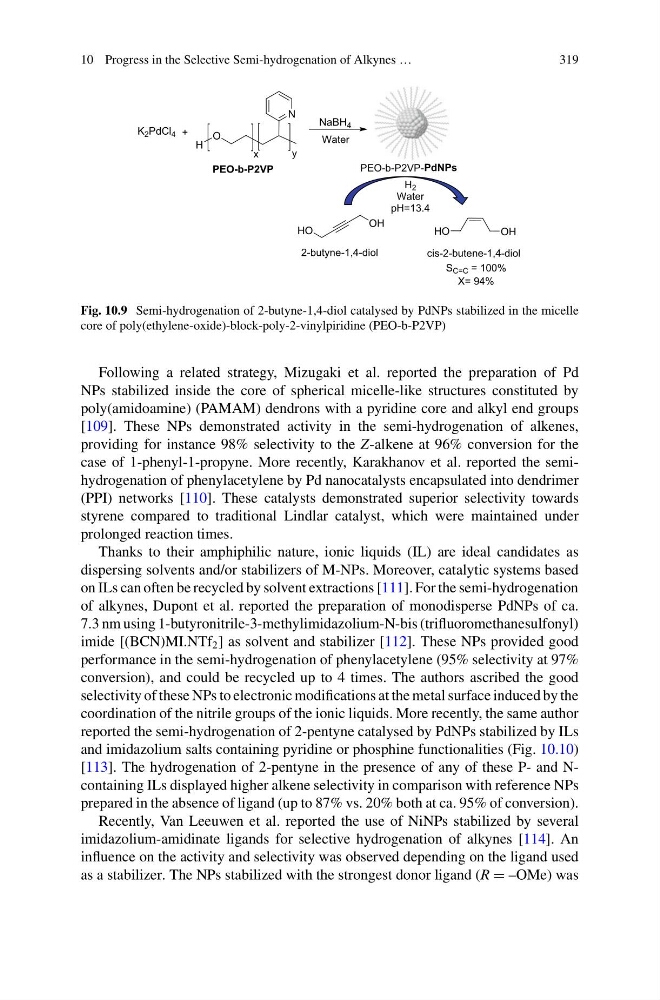
Fig. 10.9 Semi-hydrogenation of 2-butyne-1,4-diol catalysed by PdNPs stabilized in the micelle
core of poly(ethylene-oxide)-block-poly-2-vinylpiridine (PEO-b-P2VP)
Following a related strategy, Mizugaki et al. reported the preparation of Pd
NPs stabilized inside the core of spherical micelle-like structures constituted by
poly(amidoamine) (PAMAM) dendrons with a pyridine core and alkyl end groups
[109]. These NPs demonstrated activity in the semi-hydrogenation of alkenes,
providing for instance 98% selectivity to the Z-alkene at 96% conversion for the
case of 1-phenyl-1-propyne. More recently, Karakhanov et al. reported the semihydrogenation of phenylacetylene by Pd nanocatalysts encapsulated into dendrimer
(PPI) networks [110]. These catalysts demonstrated superior selectivity towards
styrene compared to traditional Lindlar catalyst, which were maintained under
prolonged reaction times.
Thanks to their amphiphilic nature, ionic liquids (IL) are ideal candidates as
dispersing solvents and/or stabilizers of M-NPs. Moreover, catalytic systems based
on ILs can often be recycled by solvent extractions [111]. For the semi-hydrogenation
of alkynes, Dupont et al. reported the preparation of monodisperse PdNPs of ca.
7.3 nm using 1-butyronitrile-3-methylimidazolium-N-bis (trifluoromethanesulfonyl)
imide [(BCN)MI.NTf 2 ] as solvent and stabilizer [112]. These NPs provided good
performance in the semi-hydrogenation of phenylacetylene (95% selectivity at 97%
conversion), and could be recycled up to 4 times. The authors ascribed the good
selectivity of these NPs to electronic modifications at the metal surface induced by the
coordination of the nitrile groups of the ionic liquids. More recently, the same author
reported the semi-hydrogenation of 2-pentyne catalysed by PdNPs stabilized by ILs
and imidazolium salts containing pyridine or phosphine functionalities (Fig. 10.10)
[113]. The hydrogenation of 2-pentyne in the presence of any of these P- and Ncontaining ILs displayed higher alkene selectivity in comparison with reference NPs
prepared in the absence of ligand (up to 87% vs. 20% both at ca. 95% of conversion).
Recently, Van Leeuwen et al. reported the use of NiNPs stabilized by several
imidazolium-amidinate ligands for selective hydrogenation of alkynes [114]. An
influence on the activity and selectivity was observed depending on the ligand used
as a stabilizer. The NPs stabilized with the strongest donor ligand (R = –OMe) was
319
HO
OH
H
O
x
N
y
+
Water
K 2 PdCl 4
NaBH 4
PEO-b-P2VP-PdNPs
HO
OH
PEO-b-P2VP
cis-2-butene-1,4-diol
H 2
Water
pH=13.4
2-butyne-1,4-diol
S C=C = 100%
X= 94%
Fig. 10.9 Semi-hydrogenation of 2-butyne-1,4-diol catalysed by PdNPs stabilized in the micelle
core of poly(ethylene-oxide)-block-poly-2-vinylpiridine (PEO-b-P2VP)
Following a related strategy, Mizugaki et al. reported the preparation of Pd
NPs stabilized inside the core of spherical micelle-like structures constituted by
poly(amidoamine) (PAMAM) dendrons with a pyridine core and alkyl end groups
[109]. These NPs demonstrated activity in the semi-hydrogenation of alkenes,
providing for instance 98% selectivity to the Z-alkene at 96% conversion for the
case of 1-phenyl-1-propyne. More recently, Karakhanov et al. reported the semihydrogenation of phenylacetylene by Pd nanocatalysts encapsulated into dendrimer
(PPI) networks [110]. These catalysts demonstrated superior selectivity towards
styrene compared to traditional Lindlar catalyst, which were maintained under
prolonged reaction times.
Thanks to their amphiphilic nature, ionic liquids (IL) are ideal candidates as
dispersing solvents and/or stabilizers of M-NPs. Moreover, catalytic systems based
on ILs can often be recycled by solvent extractions [111]. For the semi-hydrogenation
of alkynes, Dupont et al. reported the preparation of monodisperse PdNPs of ca.
7.3 nm using 1-butyronitrile-3-methylimidazolium-N-bis (trifluoromethanesulfonyl)
imide [(BCN)MI.NTf 2 ] as solvent and stabilizer [112]. These NPs provided good
performance in the semi-hydrogenation of phenylacetylene (95% selectivity at 97%
conversion), and could be recycled up to 4 times. The authors ascribed the good
selectivity of these NPs to electronic modifications at the metal surface induced by the
coordination of the nitrile groups of the ionic liquids. More recently, the same author
reported the semi-hydrogenation of 2-pentyne catalysed by PdNPs stabilized by ILs
and imidazolium salts containing pyridine or phosphine functionalities (Fig. 10.10)
[113]. The hydrogenation of 2-pentyne in the presence of any of these P- and Ncontaining ILs displayed higher alkene selectivity in comparison with reference NPs
prepared in the absence of ligand (up to 87% vs. 20% both at ca. 95% of conversion).
Recently, Van Leeuwen et al. reported the use of NiNPs stabilized by several
imidazolium-amidinate ligands for selective hydrogenation of alkynes [114]. An
influence on the activity and selectivity was observed depending on the ligand used
as a stabilizer. The NPs stabilized with the strongest donor ligand (R = –OMe) was